Communities · ICUNI Connect
AMOSA
A digital home for alumni to stay connected through school and shared interests.
The build story 8 minute read

AMOSA: Give Alumni a Home Beyond the Group Chat
At a glance
- Purpose
- A digital home for alumni to stay connected through school and shared interests.
- The build
- The React application connects Google Apps Script services with Sheets, Drive and Gmail. Membership review, Year Groups, clubs and administrative work have distinct roles and scopes.
In this story
By Menelek Makonnen · ICUNI Connect
An alumni platform built around membership, shared identity, useful participation and the care required when a community carries its history online.
AMOSA helps alumni find one another, share opportunities, organise support and keep their community history together. I developed the AMOSA Group App for the Aggrey Memorial Old Students Association, giving members a place to participate beyond whichever conversation happens to be at the top of the group chat.
A group chat can organise a reunion, locate an old photograph and generate 143 messages while you make tea. Ask it to maintain membership records, govern a fundraiser and preserve a newsletter, and the conversation starts applying for a second job.
A returning member can find their Year Group, reconnect through a House or Club, contribute photographs, discover a job or support a shared cause. The same platform gives volunteers a way to review applications and maintain the records behind that activity. Less time hunting for the latest spreadsheet means more room for the community itself.
The purpose is continuity. An alumni community needs to find people, share work, organise support and remember its members across years and locations. Those activities overlap, but they do not all belong to the same audience or require the same authority. The software needs to understand the difference.
Find your people and your place
Joining starts with a membership request. The applicant supplies school history, Year Group, House, Class, Clubs, professional context and access preferences. Directory consent is a separate choice. An authorised reviewer verifies or returns the request before activation.
The identity model is deliberately specific. A member belongs to a Year Group, an independent House and a Class, with Clubs that can span years. House competition pairings are presentation choices; they do not rewrite membership identity. That distinction prevents a temporary event arrangement from becoming a permanent error in the community record.
It also makes the administration more practical. A reviewer should see the requests they can legitimately handle. Someone helping a particular Year Group does not inherit the right to inspect every record simply because they have an impressive title in a menu.
I built the scope model into both the application and the backend. Authority follows the relationship to the community being managed. The interface can then present a useful workspace without confusing a local responsibility with universal access.

Membership: give identity its proper structure and let the relevant reviewer make the decision.
Reconnect without making every detail public
A useful directory helps alumni find one another without turning every profile into a public dossier. AMOSA separates public discovery from member visibility. A public listing requires opt-in, and profile fields carry audience choices.
Year Group and shared Club relationships can reveal a fuller identity than an unrelated viewer receives. Selected context also shapes the surrounding experience: All AMOSA, a Year Group or an eligible Club should change the content and community information together.
That becomes more than a filter on a feed. The community view includes its identity, executives, links, stories, albums and membership context. The server checks that the requested Club is one the viewer can access. Supplying a different identifier should not unlock another group's conversation.
For the member, the benefit is straightforward. Find the right people in the right context and understand where a post will go before sharing it. Privacy is easier to use when it appears as a meaningful audience rather than a page of obscure switches.
Turn shared conversation into lasting participation
The social loop includes posts, comments, replies, reactions and time-limited stories. A member can choose an audience such as their Year Group, Clubs, connections or the wider association. The selected scope carries into the composer, so the posting destination follows the context being viewed.
Other contributions need more structure. Albums can relate to groups, events or people. Newsletter submissions have an editorial review path. Job opportunities preserve a source and application route. Events support RSVP and check-in, while documents and support tools give recurring information a durable home.
These are different kinds of contribution rather than one endless feed wearing different hats. A photograph can remain part of an album. An article can wait for review. A job can tell the next person how to apply. The group chat can continue doing what it does best: enthusiastic commentary on whether anybody has seen the programme.
The member shell uses a collapsible sidebar, community context controls and responsive navigation. Mauve, yellow and white connect the application to the existing association identity. The visual system gives the community a recognisable home while the structure helps people finish the task they came for.

Participation: share with a chosen audience and give albums, editorial work and opportunities their own useful shape.
Support a cause and know where the contribution stands
Fundraising is one place where a pleasant interface cannot replace a clear rule. A proposed fundraiser carries a purpose, target, scope and review requirements. It stays pending until the defined approval quorum is met.
Contributions and dues keep payment state separate from the member's intention to pay. Received totals depend on reconciled records. A pledge can be useful without pretending the money has arrived. That distinction respects both the volunteer doing the reconciliation and the member who needs an accurate account.
The member-commerce area follows the same pattern. A business or seller application enters scoped review before listing. The server owns the price used for an order, and repeated requests have an idempotency boundary so a retry can be recognised instead of becoming another purchase.
An order or payment awaiting review remains pending. Failures should preserve something recoverable rather than showing a cheerful success screen and leaving an administrator to conduct the exorcism later.
These choices make the product more grounded. Community trust already does substantial work. Software should support it with a precise account of who requested what, who reviewed it and which outcome has actually been confirmed.
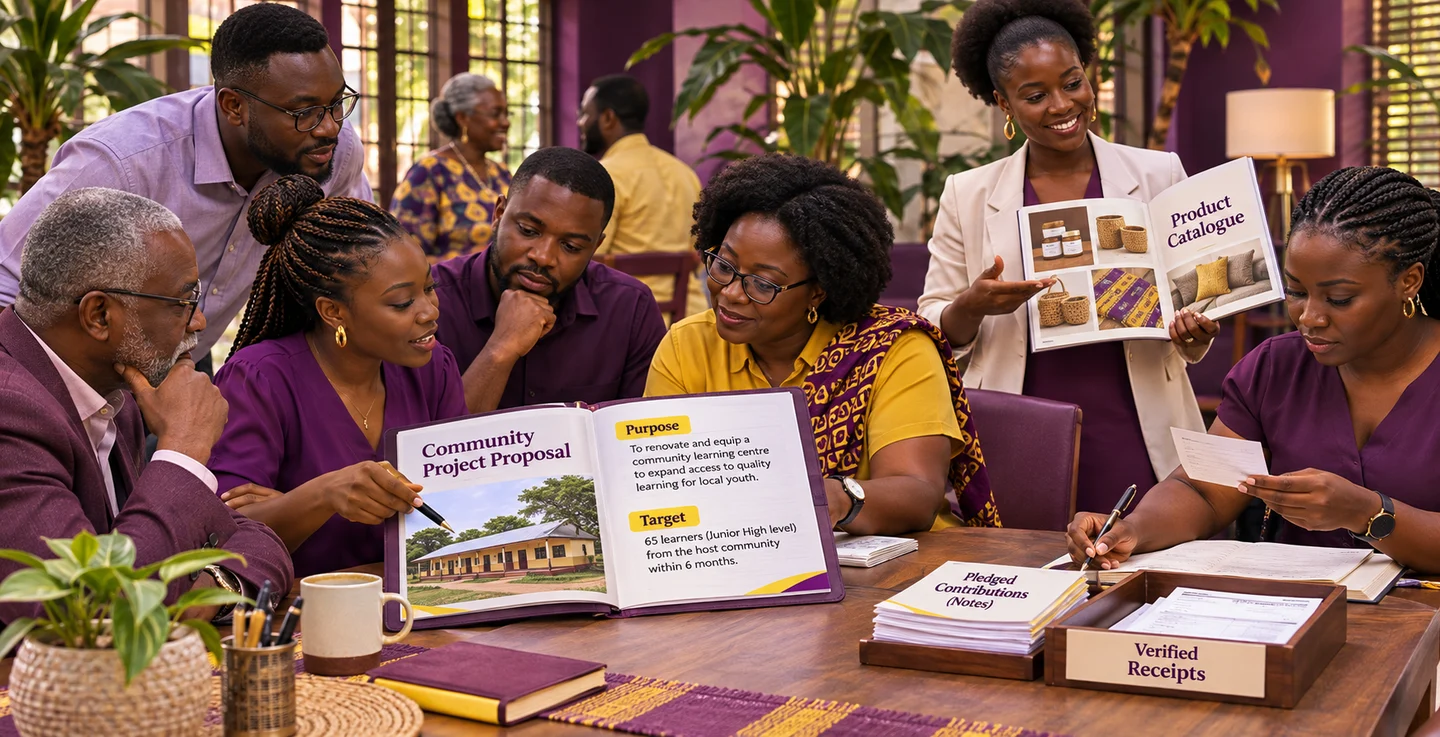
Support and commerce: review the proposal, preserve the request and distinguish a contribution from confirmed receipt.
Remembering people requires care
An alumni community also carries losses. I treated remembrance as a governed change to a person's community presence, rather than a public toggle beside a profile.
A connected member can privately record a confirmation. The system permits one confirmation per person, and the profile remains private and pending until three distinct connected members have confirmed. At the threshold, active access is revoked and a memorial room becomes available in the relevant community contexts.
The room provides a place for memories, stories, eulogies, photographs and flowers. Contributions remain attributed and dated. The person's Year Group and Club relationships preserve where the room belongs, so remembrance stays connected to the people who knew them.
That workflow does not turn software into an independent authority on a person's death. It gives a community process an explicit threshold and an audit trail. The judgement belongs to people; the application preserves the conditions and consequences of their actions.
This part of the build reinforced why domain modelling matters. Some records are more than entries in a directory. The system must handle their transitions with restraint, continuity and a clear account of what changed.

Remembrance: keep confirmation private until the defined community threshold, then preserve a place for shared memory.
Familiar tools behind the community
The frontend uses JavaScript, React and Vite. A central client sends defined actions to Google Apps Script, with Google Sheets holding operational records and Drive supporting media. Backend modules handle membership, scope, publishing, contribution records, commerce and remembrance. Existing Google mail integrations support notification paths.
A linked fictional demo lets me walk through member and administrator journeys without exposing real records. It helps me ask whether joining, finding an audience and reviewing a contribution make sense from each side of the screen.
AMOSA remains in progress. Frontend promotion and real-account journeys still need checking beyond the fictional demo, and payment-provider configuration needs to be exercised separately. A volunteer should be able to trust what “received” means before a community relies on the total. That is part of making this useful, rather than simply making it look busy.
What building it has sharpened
AMOSA reinforced a creator strength that travels across my work: keeping human relationships intact while turning them into usable software rules. Year Group, House and Club mean different things. A local administrator has a scope. A contribution has a state. A member's visibility has an audience.
The challenge is to carry those distinctions through forms, server decisions, stored records and the next person's screen. Once that continuity is in place, a platform can grow beyond a collection of modules into a coherent place to participate.
The lesson is also practical for voluntary organisations. Administrative effort is part of the product experience. A clear pending state, a scoped queue and a recoverable request can be as valuable as the feature that attracted the member in the first place.
AMOSA Group App.
A longer memory than the chat
AMOSA is built to give community activity a dependable shape: join through a clear process, find people with care, contribute to the right audience, organise support with evidence and preserve shared memory.
The group chat still has a place. It can keep the reunion jokes and the urgent debate about where to park. The lasting records deserve a home that remembers why they mattered after the conversation has moved on.
the existing association crest belongs to its institutional identity.
Back to the story’s beginning ↑Project details
A membership platform connecting alumni through groups, community updates, events and member services.
Design and technical decisions
The React application connects Google Apps Script services with Sheets, Drive and Gmail. Membership review, Year Groups, clubs and administrative work have distinct roles and scopes.
Inside the workflow
A membership platform connecting alumni through groups, community updates, events and member services.
Have something in mind?
Bring the problem, the audience and what you want to make possible.
Discuss your project