
Websites · ICUNI Consult
AwoYoga
A welcoming space for discovering yoga practice, classes and wellbeing guidance.
The build story 6 minute read

AwoYoga: Find a Session, Understand the Choices and Leave Staff Ready to Help
At a glance
- Purpose
- A welcoming space for discovering yoga practice, classes and wellbeing guidance.
- The build
- The website and operations application connect a class-calendar booking flow with payment callbacks, client records and scheduled communication source. Public content, bookings and staff tasks remain different parts of the journey.
In this story
By Menelek Makonnen
AwoYoga helps visitors find a studio session and work through the practical booking choices, while giving staff a connected place to manage sessions, clients and follow-up. The standalone studio project combines a public website, weekly calendar, booking screens and administration application. It is distinct from the community and seasonal-programme experience of Home by AwoYoga.
A visitor wants to know what is on, whether the session suits their plans, what to bring and what happens next. Staff need the same booking to connect to a class, a client record, venue details and communication. An hour-long class can acquire an afternoon of coordination before anybody reaches a mat.
I built AwoYoga around that surrounding work. The aim is a clear route from interest to a manageable booking record, with less repetitive explaining on either side. I can build the software; I cannot responsibly claim that debugging payment callbacks has improved my flexibility.
Find a class without restarting the search
The public interface uses earthy green, cream and brown, with a thin lowercase awoyoga wordmark and an editorial mix of Inter, Playfair Display and Cormorant Garamond. A sticky glass header, theme toggle and mobile navigation keep the experience accessible across the public pages.
The booking destination has a more practical job. It combines a week selector, category filters, calendar grid, class details and search. Week and category values can be included in links, so somebody can arrive at a relevant view rather than beginning the hunt again.
For a visitor arriving from a shared link, preserving the week and category means the invitation still makes sense when they reach the calendar. They can begin with the relevant sessions rather than repeat the search. That is the kind of detail I want service software to absorb quietly.
The interface subscribes to shared state and reloads the relevant week as selections change. It is a working calendar model, not a static timetable pasted beneath a Book Now button.
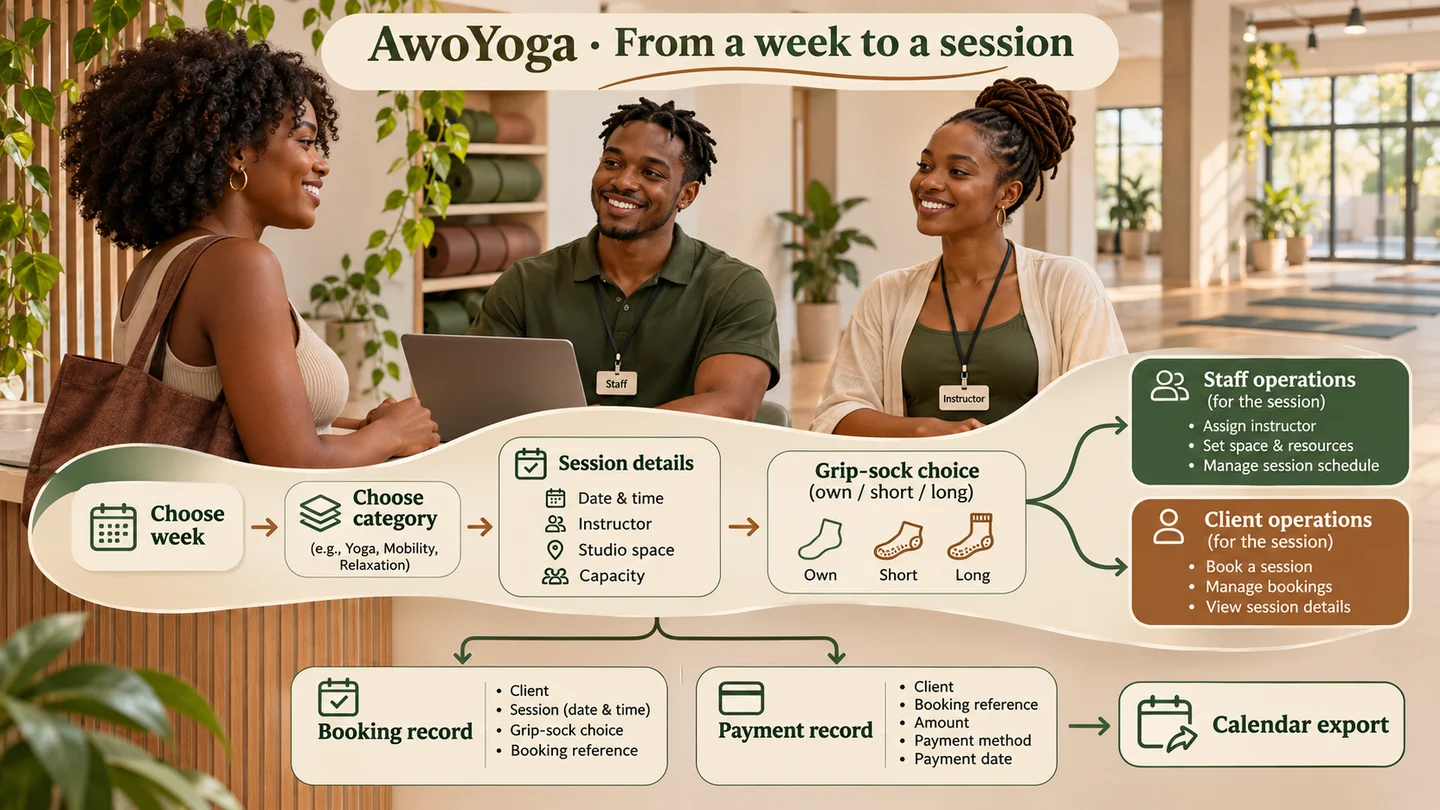
Payment and booking remain separate records.
Know the choices before moving to payment
The booking modal collects contact details and whether it is a first visit. Optional health or injury notes have a place in the form, and the visitor can choose to bring their own grip socks or select short or long options. The price summary responds to those choices.
Those are ordinary details, which is precisely why they matter. A system should absorb the repetitive practical questions so staff can spend more attention on people.
The interface then moves through details, payment and completion stages using a Paystack popup integration. It includes an important recovery path: if the payment callback succeeds but saving the booking fails, the reference is preserved and the visitor gets a support route. Asking someone to pay again would be a very expensive interpretation of “try again”.
Calendar outputs provide another useful handover. The receipt interface can offer a Google Calendar link and an ICS file. Those exports help the session move into the visitor’s own planning tools; they do not themselves prove a live calendar insertion.
Let staff pick up the work behind the booking
The administration application spans bookings, sessions and events, clients, instructors, venues, offerings, pricing, marketing, communications, community and settings. A role-filtered rail and mobile drawer help staff reach the relevant work, with focus restoration and accessibility handling around the drawer.
The website uses vanilla JavaScript and Vite, with a shared state store and a lazily loaded administration shell. Google Apps Script services provide the backend operations.
I like the directness of that arrangement. It makes the relationship between a public selection and the staff work behind it relatively easy to follow. A booking is not merely a success screen; it leads into a client record, a session’s occupied places and attempted follow-up communications.
Some administrative navigation is restricted more narrowly than ordinary staff modules. That presentation helps people orient themselves, while actual mutation permission remains a backend responsibility. A hidden menu item is not an access-control system, however confidently it disappears.
Keep a saved booking visible when a message fails
After writing a booking, the backend attempts confirmation email, preparation follow-up and welcome scheduling separately. A communication failure does not roll back the booking record.
That separation is useful because a reservation and its notification are different facts.
Cancellation has its own state update and communication path. Manual payment has a separate privileged operation. Together these pieces describe the work of running sessions after the public form has done its part.
The frontend API also distinguishes ordinary application errors from transient transport problems. An invalid request inside an HTTP-success envelope should not receive the same retries as a temporary server failure. Cached reads and in-flight deduplication reduce repeated work, while bounded retries handle the conditions where retrying can help.
What needs to be strengthened before relying on the booking promise
The booking handler checks capacity and duplicate session/email combinations, yet the overall read-check-write path is not protected by a single lock. Simultaneous last-seat requests therefore need a stronger concurrency contract.
The payment helper can also permit manual or skipped verification paths, including missing configuration and network failure. The booking handler does not compare a successful processor amount and currency against a server-calculated expected total. Pending payment can be stored internally while the returned message still says the booking is confirmed.
These are concrete priorities: fail closed where verification is required, own the expected price on the server, align the returned wording with the stored status and protect seat allocation under concurrent requests. A calming interface cannot stretch those contracts into shape.
The storage layer has its own operational lesson. It can create new Sheets shards at a configured threshold and preserve each row’s origin for updates. Failed shard reads are skipped, so a returned merged list can be partial. Completeness needs an explicit signal before staff can rely on it as the whole picture.
What the visitor’s journey taught me
The calendar and optional choices help the visitor make a practical plan. The client, session and communication records help staff look after that plan. Building both sides made the engineering priorities unusually concrete: the software must allocate the right place, verify the right amount and describe the saved status accurately before anyone can rely on the promise.
That is the work I find interesting in service software. The interface makes the next action obvious. The backend must make the resulting promise defensible.
Give people more room for the session
AwoYoga is for the visitor trying to find and arrange a class and the studio team managing everything around it. It brings those two sides into a connected workflow instead of leaving staff to translate a public form into the rest of the working day.
The payment, capacity and storage hardening has that same practical destination: a booking people can trust. The surrounding coordination deserves good software precisely because the session itself should be where people spend their attention. My contribution is to work on the surrounding tangle; the mat can remain blissfully unaware of JavaScript.
Back to the story’s beginning ↑Project details
A yoga service experience for presenting classes, supporting bookings and sharing practice resources.
Design and technical decisions
The website and operations application connect a class-calendar booking flow with payment callbacks, client records and scheduled communication source. Public content, bookings and staff tasks remain different parts of the journey.
Inside the workflow
A yoga service experience for presenting classes, supporting bookings and sharing practice resources.
Have something in mind?
Bring the problem, the audience and what you want to make possible.
Discuss your project