
Business Systems · ICUNI Consult
Bobbin
Connecting the craft of tailoring with quotations, fabric coordination and the work of training.
The build story 6 minute read

Bobbin: Keep the Wearer, the Garment and the Workshop on the Same Thread
At a glance
- Purpose
- Connecting the craft of tailoring with quotations, fabric coordination and the work of training.
- The build
- A tailoring and training workspace for multi-customer quotations, production tracking, fabric coordination and customer portals. The demonstration is non-persistent.
In this story
By Menelek Makonnen · ICUNI Consult
Bobbin gives a tailoring business a workspace shaped around the people wearing the clothes and the team making them. Its frontend brings wearer-specific garments, measurements, materials and estimates together, with workshop, customer-portal and training surfaces for the next steps. Backend integration remains a separate delivery task.
A group order is rarely one garment repeated without variation. Different people need different measurements, styles, finishing and fabric arrangements. Meanwhile the workshop needs to know what to buy and who should do what next. A reference image can explain the look, but it has a regrettable inability to disclose somebody's shoulder measurement.
I built Bobbin's domain and interaction model to keep those details together through quotation and workshop coordination. This is the sort of specificity I enjoy building: the software should understand why customer-supplied fabric changes an estimate and why a training session is a different kind of work from a pickup. Otherwise I have simply put a generic task board in a very expensive outfit.
Build a group quote without losing the individual wearer
The quote builder groups work by customer, then by garment. Each garment has type, complexity, staff tier, finishing choices and material lines. Yardage, shop or customer supply, and heavy handling all affect the local estimate.
A measurement grid organises upper and lower body, arms, shoulders and other dimensions. Collapsible groups and Enter-to-next-field entry support the repetitive work of capturing measurements. Reference images are handled separately, keeping the visual intention close without pretending an image supplies every dimension.
The local calculation builds a rate map, applies complexity with a base fallback, adds the relevant higher-tier surcharge, charges yardage for shop-supplied materials, and includes handling and finishing. Garment totals roll into customer and overall totals. A fixed band around the firm estimate provides the displayed range.
For an estimator handling a mixed order, this means being able to discuss each person's choices while still seeing the group total. Change who supplies the fabric or which finishing applies and the local estimate responds. The breakdown makes that conversation possible without requiring the customer to trust a number that looks personally offended by questions.
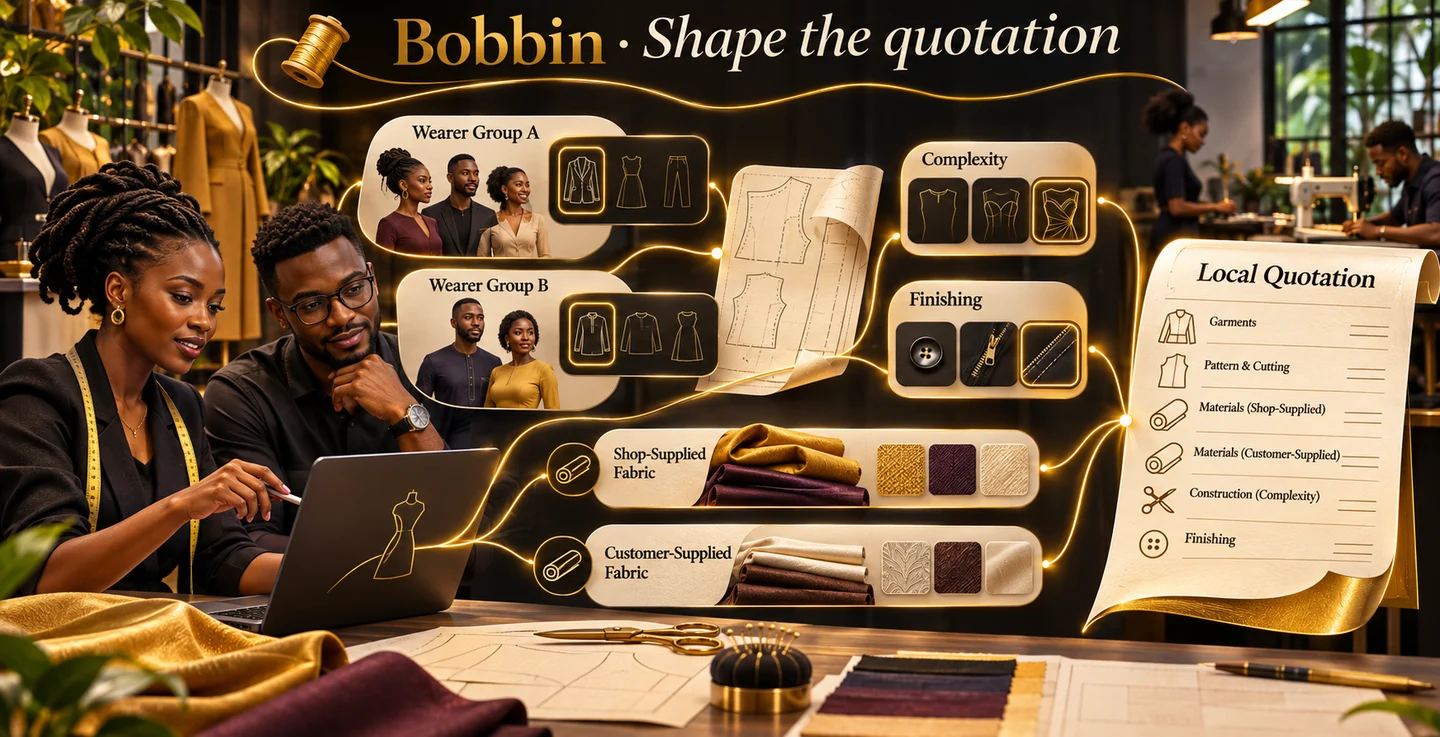
Quotation workflow: organise customers and garments, capture measurements and inspect the local estimate.
See what the workshop and fabric run need next
The production board presents six stages spanning material gathering, staff allocation, review, payment record, pickup/delivery and satisfaction. A hold-and-swipe interaction maps a deliberate gesture to domain actions before reloading the job list.
I like that interaction because it makes movement feel intentional. A workshop card represents work moving between responsibilities. Its vocabulary should be closer to that work than a generic “next status” menu.
Fabric Run gives buying its own workspace: a material filter, remaining items, estimated spend from yardage and last price, manual additions, shopping day and purchase inputs. Actual spend and unit price can be entered when an item is marked bought.

Workshop and buying: organise material needs and the next garment action in related workspaces.
Let customers describe the order without entering the staff workspace
Customers use New Order, Track Orders and My Account rather than the staff shell. The request captures contact details, garment/material lines and reference images. Progress display derives from available production and payment fields.
That separation matters to the product. A customer wants to describe a garment and follow the order; a workshop needs the operational detail behind it. Sharing the same underlying subject does not require sharing every menu.

Customer workflow: collect an order request and present its progress through a dedicated portal.
Plan lessons and attendance alongside the tailoring business
Bobbin also models the training side of a tailoring business. Students, sessions, records, curriculum and a training calendar sit beside staff operations. Session screens include current, upcoming, creation and history paths, with attendance requests carrying student, date and class context.
That is a useful extension of the domain: the business makes garments and develops people who make garments. A lesson has a different lifecycle from a customer order, so its interface needs a different rhythm.
For a business that teaches as well as makes clothes, these screens give planning, curriculum and attendance a home of their own. The current synthetic lesson content is demonstration material, not a record of actual learners or delivered teaching. Completing and accepting the backend connection is necessary before these interactions can be relied on as a running school service.

Training workflow: organise curriculum, sessions and attendance in a dedicated teaching surface.
I used JavaScript, React, Vite and Zustand for the frontend, with a central action adapter targeting Apps Script. The sidebar genuinely resizes and remembers its dimensions; mobile uses role-filtered bottom navigation. Four token themes support light/dark presentation, with warm gold and the actual bobbin-spool SVG carrying the main craft identity.
This version focuses on the frontend and API contracts; the backend integration remains a separate delivery task. Demo mutations explicitly return success without persistence. Role-filtered navigation is presentation, and the current proof-photo action contains a placeholder rather than an uploaded garment photograph. Those are concrete integration tasks before end-to-end operational acceptance.
The lesson is that domain specificity earns its detail. Measurements, fabric ownership, group orders and training sessions create different needs. The interface becomes useful when those needs remain visible.
A better fit for the business behind the clothes
Bobbin is a frontend foundation for a tailoring business whose work spans customers, garments, buying, workshop coordination and teaching. Its value is the care taken to keep different wearers and responsibilities visible inside the same overall order.
Back to the story’s beginning ↑Project details
A tailoring and training workspace for multi-customer quotations, production tracking, fabric coordination and customer portals. The demonstration is non-persistent.
Inside the workflow
A tailoring and training workspace for multi-customer quotations, production tracking, fabric coordination and customer portals. The demonstration is non-persistent.
Have something in mind?
Bring the problem, the audience and what you want to make possible.
Discuss your project