
Business Systems · ICUNI Consult
DSM
Bringing the moving parts of a department store into connected branch workspaces.
The build story 5 minute read

DSM: Bring Branch Sales, Stock and Requests into One Operating Picture
At a glance
- Purpose
- Bringing the moving parts of a department store into connected branch workspaces.
- The build
- A department-store management system covering sales accounting, supply workflows and payroll calculations, with an in-memory demonstration layer.
In this story
By Menelek Makonnen · ICUNI Consult
DSM, Department Store Manager, brings branch sales, stock, work requests and purchasing into a shared retail workspace. Its purpose is to help a branch team carry out its work and give company staff a way to understand the activity across locations. The current implementation includes service models and demonstration paths, with substantial live-operation hardening still needed.
In a multi-branch shop, a sale changes more than the till total. It affects stock and cost records. A shortage can become a request, then a purchase order, then a receipt somewhere else in the business. When those details travel by spreadsheet and memory, asking where an item is can become a group research project with no funding.
Find the work for a branch and the view across branches
The branch-first model organises stock, sales, staff and requests around the place doing the work. Company users can work across branches. The same overall application provides those scopes rather than maintaining a separate product for every location.
The interface gives that structure a clear visual language: warm charcoal, stone surfaces and gold, with an actual A*Z diamond/lettermark from the source. A draggable navigation rail remembers its width, can collapse, and becomes an overlay on smaller screens. Pinned header/footer areas leave navigation itself free to scroll.
Those are practical details in a broad operating workspace. Navigation needs to accommodate the person moving among sales, procurement and records without taking control of the screen. The sidebar should support the store manager's day; it should not become another department that needs managing.
Follow a sale into its stock and accounting records
The implemented sale service receives a branch and item lines, resolves each SKU against the server catalogue and derives its price there. Quantities become positive integers and discounts are bounded. The service calculates revenue and cost, writes the sale, posts accounting lines and updates stock.
For a branch manager, the useful picture includes what was sold, its catalogue price, its cost and the associated stock change. For company oversight, the same branch context lets those records contribute to reporting without pretending every location has identical work to do. I modelled the connection because the till total alone cannot explain the stockroom.
The accounting helper creates cash/income lines for revenue and cost-of-goods/inventory lines for cost. Branch and date filters support the balance and reporting views. A manager can therefore inspect the model of how a sale contributes to a branch's operating picture.
The current implementation also exposes concrete hardening work. Stock is clamped at zero rather than rejecting an insufficient-stock sale, and the series of writes does not have an encompassing transaction or idempotency guard. Those details matter before using it as an accepted point-of-sale control.
A product can have a convincing till screen while its stock model still needs attention. The screen's confidence is not a replenishment strategy.
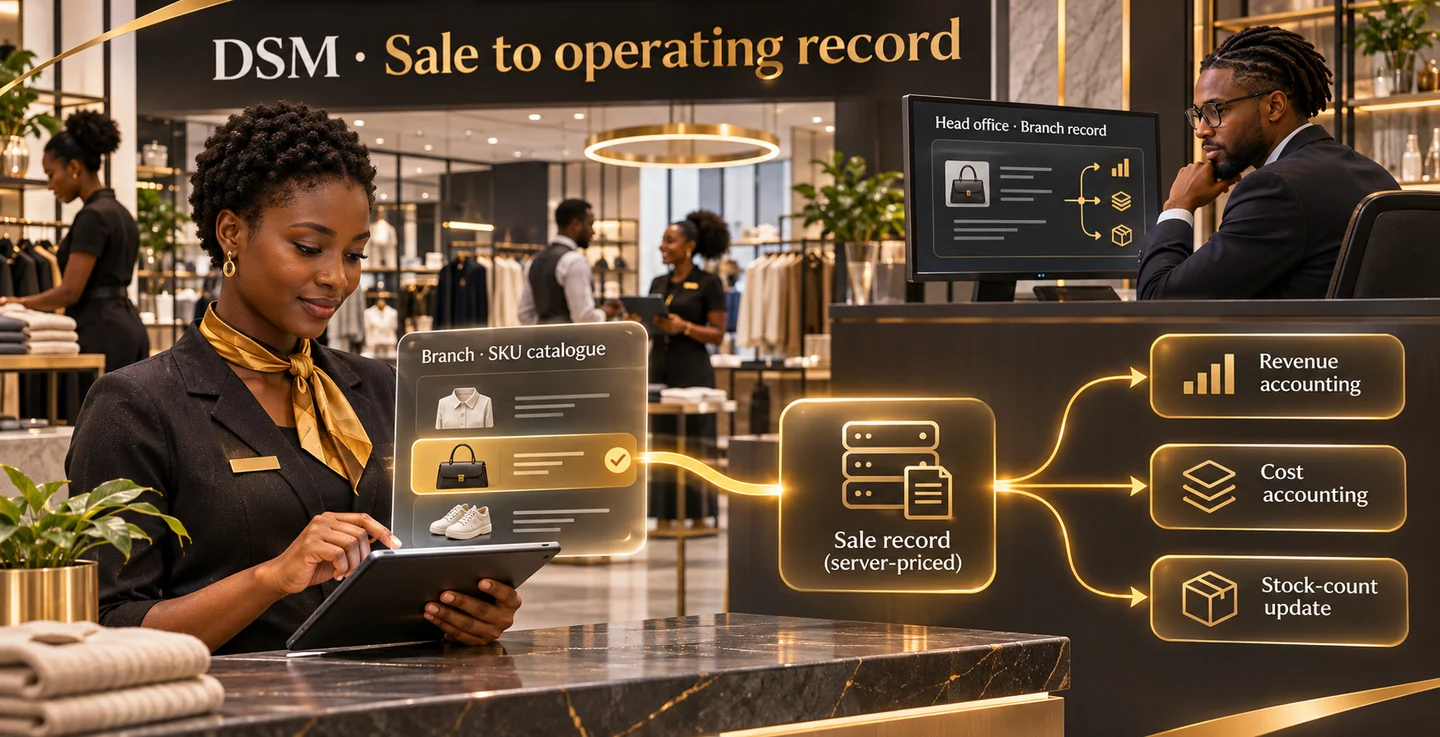
Sale workflow: resolve catalogue prices, record the sale and connect its accounting and stock effects.
Carry a request through purchasing and receipt
Work requests record sender, recipient, branch, type, priority, due date, stage and a human-readable log. Branch and company views help organise who needs to act next. File references in this path retain metadata.
Procurement has its own lifecycle. A purchase order resolves a supplier and requested items, records its draft or submitted state, and carries confirmation and receipt fields. A received action adds the recorded quantity to warehouse stock. Rejection can return the request to draft with a reason.
I see those as the consequential parts of operational modelling. A state needs to describe what happened, and repeating the command needs a defined meaning. Otherwise “received” can become a highly creative inventory multiplier.
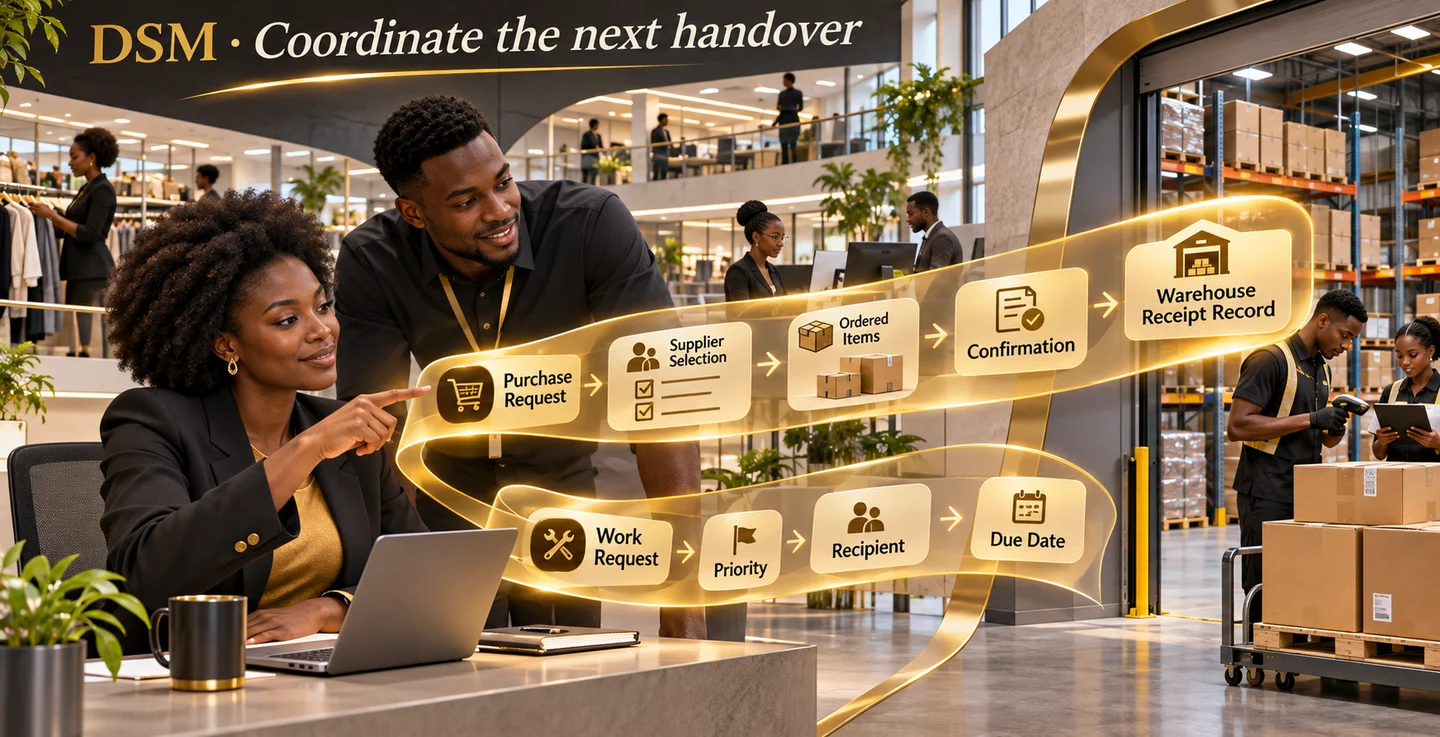
The wider workspace and the work before live reliance
The application also contains attendance, payroll, staff, customer, growth and system surfaces. Attendance records status and lateness; payroll models salary-based calculations. Those are separate modules with separate validation needs, including current-rule review for payroll.
I implemented the browser in TypeScript, React and Vite, with React Router and charting components. Google Apps Script services route actions into Google Sheets records. The application includes explicit in-memory demonstration paths and seeded examples.
This matters to the person deciding whether to use DSM operationally. The model is useful for explaining the intended branch workflow, but a successful-looking demonstration cannot establish that live stock or money records were updated. Separating live write receipts from demo responses is a prerequisite to making the shared operating picture dependable.
Help the branch and head office talk about the same work
DSM is an implementation of the connected workspace a multi-branch retailer needs: branch activity with enough context for the wider business to follow it. Sales, requests and procurement have related records rather than disappearing into unrelated lists.
Its next engineering work is clear: make live results unmistakable, enforce stock and transition safeguards, and validate branch access and recovery. I want that work to serve the manager's day, not merely decorate it. A department store already has enough departments. Chasing the truth through spreadsheets does not need to become another one.
Back to the story’s beginning ↑Project details
A department-store management system covering sales accounting, supply workflows and payroll calculations, with an in-memory demonstration layer.
Inside the workflow
A department-store management system covering sales accounting, supply workflows and payroll calculations, with an in-memory demonstration layer.
Have something in mind?
Bring the problem, the audience and what you want to make possible.
Discuss your project