
Creative Tools · ICUNI Labs
Forgiven
Exploring recovery: finding lost media and reconnecting files to meaningful structure.
The build story 8 minute read
Forgiven: Investigate Missing Footage and Rebuild a Usable File Collection
At a glance
- Purpose
- Exploring recovery: finding lost media and reconnecting files to meaningful structure.
- The build
- A Windows recovery-tool family combining media carving, size-based name/structure matching and Premiere-project signature extraction. Recovery results depend on the source media.
In this story
By Menelek Makonnen · ICUNI Labs
Forgiven helps investigate missing media by extracting candidate video files, comparing them with an earlier file inventory and searching for compressed Premiere project streams. It brings those recovery questions into one Windows interface, so promising material can be organised and inspected instead of remaining an anonymous pile of bytes.
For a filmmaker facing an empty folder, that is a practical next step. The absence already provides a complete horror experience. I do not need the software to add theatrical certainty about what it can restore.
I built Forgiven as a recovery experiment with three distinct jobs: Recover looks for media signatures, Organize proposes names from manifest sizes, and Projects looks for possible Premiere project data. Each can provide a useful clue without proving the original is intact.
That honesty is central to its value. A candidate gives me something concrete to inspect. A size match gives me a naming hypothesis. A project stream might retain editing decisions even when its referenced footage is still missing. The tool advances the investigation; it does not rewrite the ending by naming itself hopefully.
Three questions behind one interface
The unified application uses Python and CustomTkinter, with a text-led dark blue identity, a sidebar and three working tabs: Recover, Organize and Projects. Each lane asks a different question about the material.
Recover asks where candidate media begins in the input bytes. Organize asks whether an extracted file plausibly matches an entry in an existing manifest. Projects asks whether a compressed stream resembles a Premiere project.
That structure reflects the practical postproduction problem. A pile of numbered files may be a better position than an empty folder, but it still needs identity, structure and content checks. A useful recovery workflow has several stages between “found” and “ready for the edit.”
I brought the recovery engines together in the unified interface while retaining their different jobs. A packaged file labelled FINAL still needs the same checks as any other version. Naming something final remains one of software’s more optimistic literary genres.
Read the source as bytes
The first job is to inspect available bytes without attempting to repair the source filesystem. Forgiven opens input in binary read mode, handling aligned physical-drive reads in the reader and ordinary seek/read for its separate image-file path. That gives the carving engine material to investigate while keeping recovery output a distinct destination.
That makes it an input adapter, rather than a disk repair writer. The carving engine receives bytes and an output destination; it does not rebuild a damaged filesystem in place.
The scan moves through bounded chunks and searches for MP4/MOV ftyp signatures with a brand check. Deep mode broadens candidate recognition and adds repeated MTS transport-sync patterns. Recorded byte ranges help avoid scanning the same extracted area repeatedly.
Those recognisers are deliberately specific enough to explain. They are not a general promise to understand every camera format or reconstruct fragmented filesystem extents. A header is a starting point for extraction, rather than a complete map of where every byte of the original file went.
Target-size filtering can narrow the work when an expected size is known. Typed targets or selected manifest rows provide that extra constraint. It is useful evidence to bring to a scan; it cannot replace the media structure that has been lost.
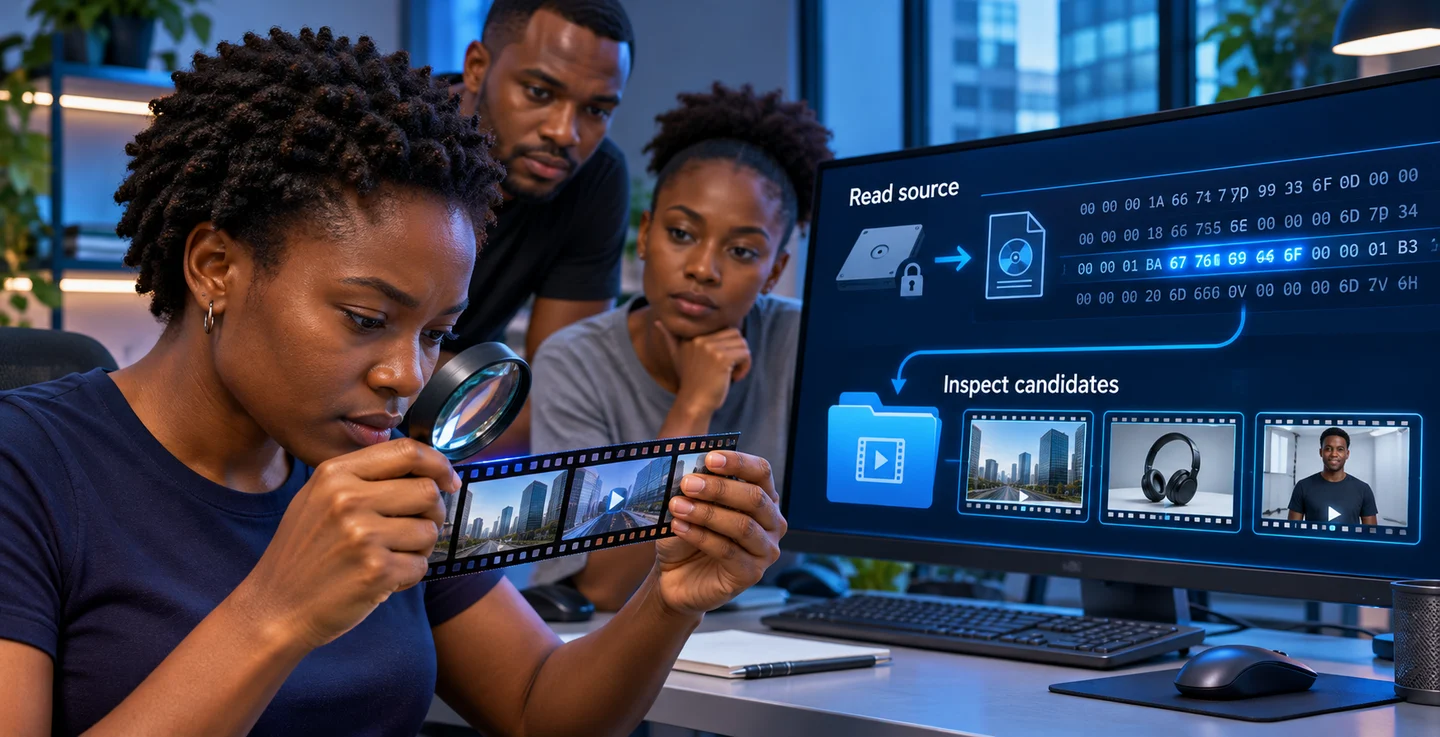
Recover lane: read input and inspect extracted candidates.
Extract a candidate before calling it a recovery
The carver writes numbered candidate media files, stopping according to later signature boundaries and configured size limits. An optional absolute-byte tolerance can reject candidates outside a target range.
This is heuristic extraction. The next useful question is what the file actually contains and whether a suitable reader can open it.
The interface runs scanning on a background thread and passes progress back to the UI. Errors are logged, and the Start control is restored after the attempt. That keeps a long-running task legible without pretending that progress percentage measures recovered quality.
There are implementation limits I keep explicit. The current GUI call does not wire the scanner’s stop event, and it does not enforce a separate physical device for output. The underlying reader’s image mode is also not an interchangeable GUI feature merely because the engine supports it.
For demonstrating the design, a fabricated disk image and manifest give a controlled way to show a known signature and resulting candidate. That is a different exercise from making claims about an irreplaceable live drive.
Reconstruct a useful name as a hypothesis
The Organize lane takes recovered candidates and a CSV manifest containing original names, lengths and directories. It accepts usable positive lengths, compares candidates with those records and chooses a nearest size match within a percentage tolerance, with a compatible video extension.
That percentage comparison is different from the carver’s absolute-byte filter. Both use size, but they answer different questions at different stages. Keeping the units clear avoids a surprisingly efficient route to confident nonsense.
A proposed relative directory comes from the manifest’s common root or a fallback. Analysis fills the match list before Restore becomes available, creating a review step between collecting candidates and applying a naming layout.
For a production folder with an earlier inventory, that can help turn numbered files into a more navigable set of suggestions. The manifest carries information that the raw media scan cannot rediscover by staring harder at a byte stream.
Two recordings can still have similar or identical sizes. The matcher does not hash content or prove original identity. I treat its output as a naming hypothesis to inspect, especially when several candidates could plausibly fit the same record.
Applying the proposal creates directories and moves files, skipping an already existing destination. It is a real organisational change, not a preview or a copy-only operation. The implementation has no persisted undo journal, so the review step needs to remain visible in the product story.
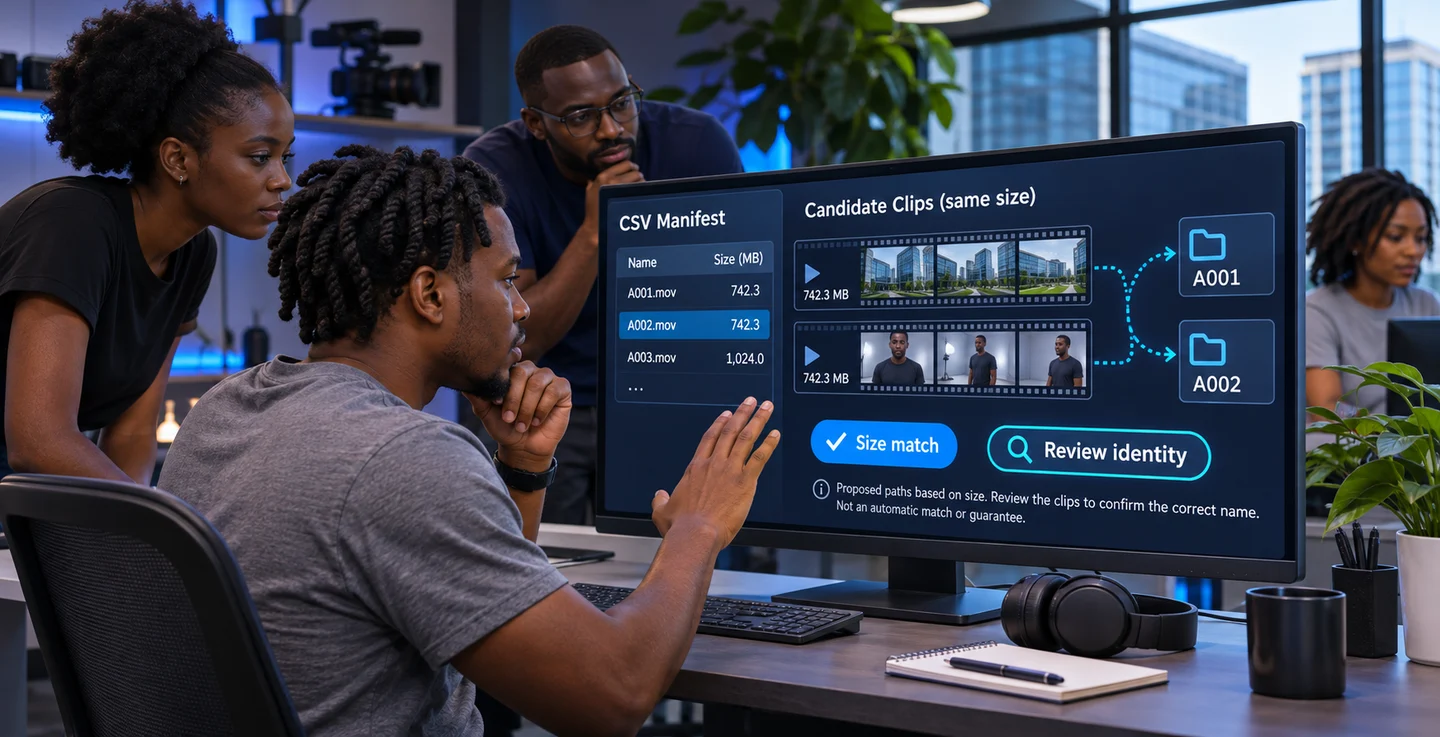
Organize lane: compare sizes and inspect proposed identities before applying moves.
Search for the project as well as the footage
Premiere projects present a different extraction problem. The Projects lane searches for gzip signatures, attempts decompression and checks for XML or Project markers in the candidate content.
When a candidate passes that initial recognition, the engine writes a numbered .prproj stream until the compressed data ends, an error occurs or the configured cap is reached. It uses the compressed source representation rather than mistaking the XML probe for the complete saved project.
This matters because a project can retain editing decisions that the media files alone do not describe. Even a promising project candidate remains separate from the footage it references. Recovering its container would not automatically reconnect missing source media.
The current found count can include an extraction that stopped on an error or cap. I therefore keep “candidate located” separate from “project opened successfully.” That is a product definition, not modesty: the two states require different evidence.
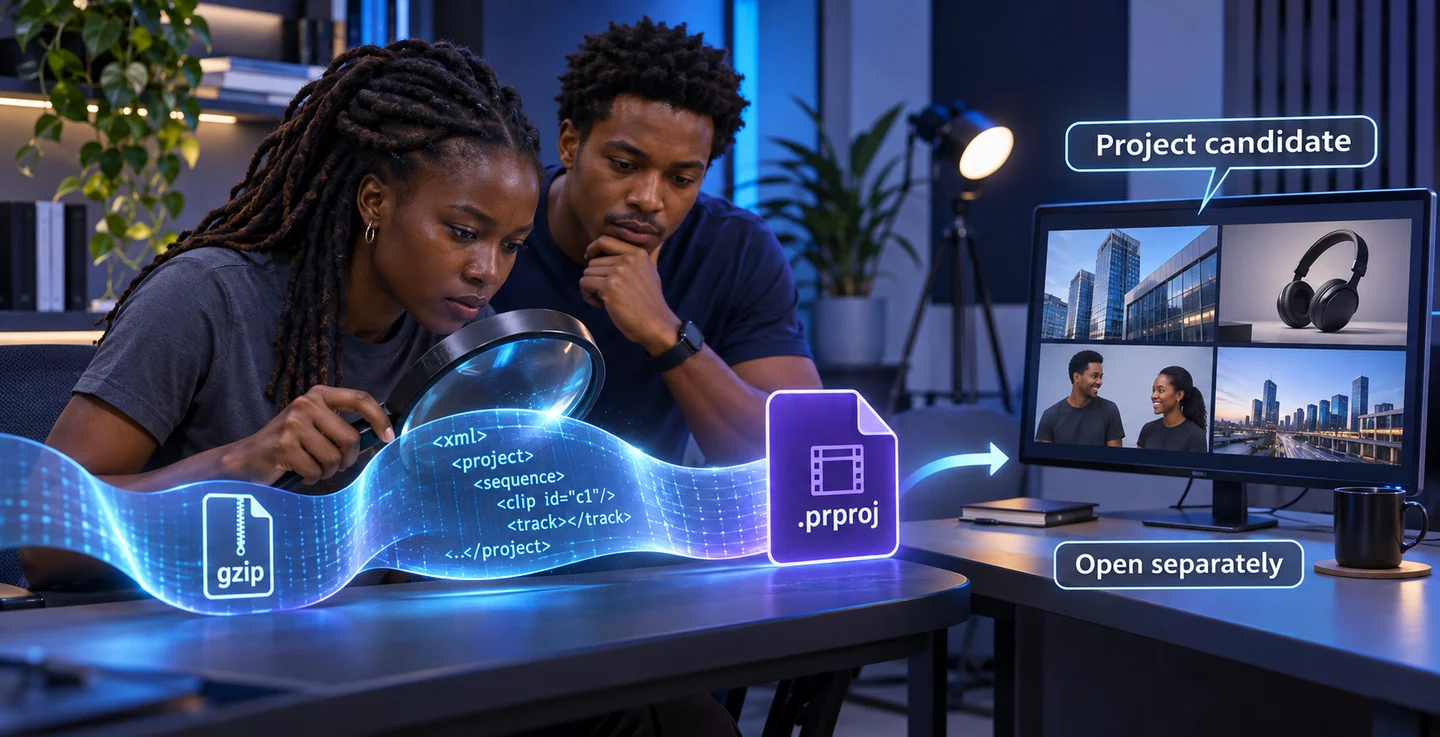
Projects lane: identify and extract a possible project stream, then check it separately.
What the experiment taught me
Forgiven brought together byte-level reading, format recognition, threaded progress and a reviewable organisation step. Each layer needs a contract that the next layer can understand.
For the person facing missing work, a reassuring counter is not enough. I learned to preserve useful intermediate answers: here is a candidate, here is a plausible name, here is a project stream to test. Each can reduce the search without pretending the whole shoot has returned. That is more helpful than a large number labelled success with an extremely imaginative definition.
Separating the engines also gives each question a clearer implementation home. The drive reader handles aligned access. The carver recognises media boundaries. The matchmaker deals with names and lengths. The project engine deals with compressed streams. The desktop layer collects the user’s choices and reports progress across them. That division makes a failed hypothesis easier to locate than one enormous recovery button whose internal explanation is simply enthusiasm.
The same thinking applies outside recovery. When I build media tools, I want intermediate results that another stage can inspect. A numbered candidate, a proposed match and a project stream are imperfect but concrete outputs. They let the next decision start from something more useful than a reassuring percentage.
It also reinforced a strength I value in my own tooling: taking an emotionally messy creative problem and giving its different technical questions separate working spaces. The aim is to make the next decision clearer, even when the available evidence is incomplete.
Forgiven is a recovery experiment, with specific recognisers and current limitations. Its value is the pipeline from raw input to inspectable candidates and naming proposals, rather than a universal restoration claim. A tool can be useful without borrowing certainty from its own hopeful name.
A better next question
Forgiven gives a missing-media investigation a working sequence: find candidate bytes, inspect the extraction, compare available inventory and test possible project data. Its Python and CustomTkinter interface separates those questions so the next decision can begin with something concrete.
The empty folder may still have a talent for horror. I built a way to investigate the scene without making the evidence audition for a happy ending.
Back to the story’s beginning ↑
Project details
A Windows recovery-tool family combining media carving, size-based name/structure matching and Premiere-project signature extraction. Recovery results depend on the source media.
Inside the workflow
A Windows recovery-tool family combining media carving, size-based name/structure matching and Premiere-project signature extraction. Recovery results depend on the source media.
Have something in mind?
Bring the problem, the audience and what you want to make possible.
Discuss your project