
Communities · ICUNI Consult
Home by AwoYoga
A community experience designed around belonging, small circles and shared activities.
The build story 6 minute read

Home by AwoYoga: Arrive Privately, Find Your Circle and Join Something Meaningful
At a glance
- Purpose
- A community experience designed around belonging, small circles and shared activities.
- The build
- Scoped circles, private arrivals and capacity-aware gatherings form the community model. Reusable virtual activities keep demonstration state distinct from configured provider-backed behaviour.
In this story
By Menelek Makonnen · ICUNI Consult
Home by AwoYoga is a community application that gives people different ways to take part: arrive privately, join a circle, reserve a gathering, offer help or work through a seasonal activity. It sits alongside the wider AwoYoga brand and is distinct from the studio's class calendar.
Sometimes you want to acknowledge how you feel without publishing it. Sometimes you want a smaller conversation, a place at an event or a way to offer a useful skill. Those needs do not all fit comfortably into an endless feed. I have already given enough of my life to scrolling past things I did not come to find.
I built Home around purposeful rooms and voluntary participation. Today, Circles, Gather, Exchange and People give different intentions a place. The builder's challenge is to make those choices understandable and preserve their scope after the welcoming copy has done its work. This remains a controlled implementation with explicit launch gates.
Check in without making it a public performance
Today begins with an arrival: one of six emotional or energy states, with an optional bounded note for the member's local date. The service updates or creates that day's arrival and returns a private projection. Writing the note does not publish it as a reflection.
That distinction shaped the experience. A person can acknowledge how they are arriving without first deciding how to perform it for an audience. The system can suggest a next step from ordinary arrival, circle and gathering state; these are product rules.
The visual language supports that gentleness: warm paper, green ink, sky blue and clay accents. The actual house-and-door identity includes an illuminated room and a breath stroke. Desktop room navigation, mobile bottom navigation and a focused contextual drawer make the metaphor useful beyond the logo.
A metaphor earns its keep when it helps someone choose. If every room leads to the same endless feed, the house is mostly an estate agent's description.
Find a circle, offer a skill or ask for help
Circles create smaller contexts inside the wider community. An open circle can activate membership immediately; another joining policy records a request for host approval. An already-active member receives the existing membership rather than another duplicate.
The backend resolves active membership and scope roles. Posts are projected according to moderation state, visibility and audience. The person choosing to participate needs to understand where their contribution is going; the service needs to preserve that boundary.
Exchange gives offers and asks their own structure: title, description, availability, scope and visibility. The People lane uses accepted connections before its bounded contact relay. That relay creates an internal notification without exposing contact details through that particular response.
For the member, this means being able to choose the kind of participation they want. An offer can state availability; an ask can describe the help needed; a circle contribution can stay within its audience. Making each form explicit gives the person a better starting point than translating everything into a generic post and hoping the right people happen to scroll by.
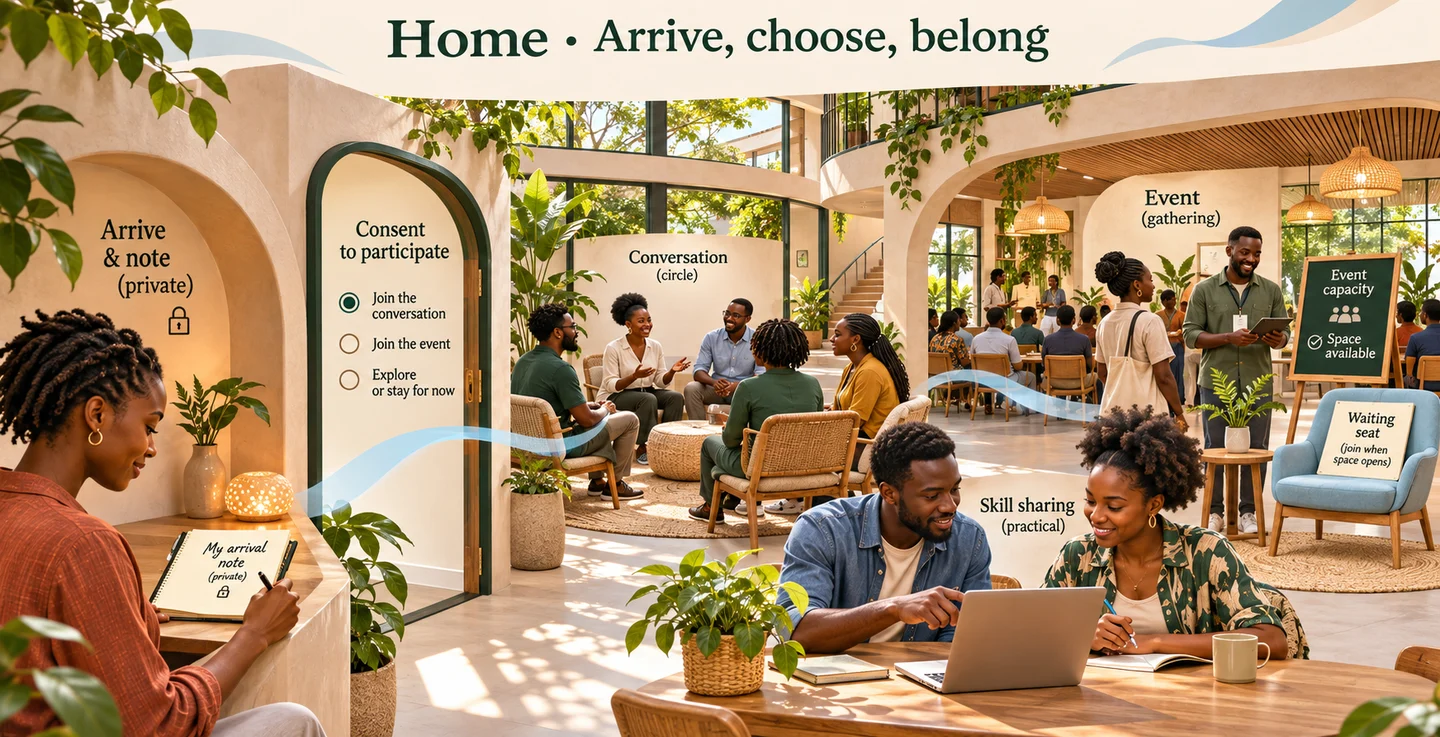
Community workflow: arrive privately, choose an appropriate room and participate within its audience and membership rules.
Know where your gathering reservation stands
Gather models capacity, guests and RSVP changes. When a reservation changes, the capacity check excludes that member's existing place before assessing the new request. A request that cannot fit becomes waitlisted when enabled, or receives a capacity conflict.
Cancellation can promote a waiting member. Hosts cannot set an end before the start or reduce capacity below confirmed attendance. Those rules turn a gathering into a working reservation model rather than a pleasant-looking date card.
I also built explicit retry behaviour. A keyed mutation binds the actor, action and request details. A completed matching request can return its recorded result, while changed data under the same key conflicts. The client reports a timeout without quietly resending the change.
For someone arranging their day around a gathering, the important answer is whether they have a place, are waiting or need to make a different choice. Capacity rules and explicit retry behaviour support that answer. A network timeout should not casually volunteer the same person for several versions of the evening.
Take part in a seasonal experience without another app
Seasonal rooms use reusable typed activity blocks rather than a separate application for every event. A host defines the room, scope, visibility, lifecycle and activities. Members join subject to capacity and save participation or progress against that room's valid blocks.
A checklist can require all choices before completion. Colouring stores its own activity state. A timed pause is a local timer, while externally hosted media or meeting links retain their own role. The experience can bring those materials together without pretending to contain a video-conferencing service.
The player waits for the API result before updating the parent event state and exposes errors. I wanted progress to mean a saved response in the workflow, with room for the member to understand a failed attempt.
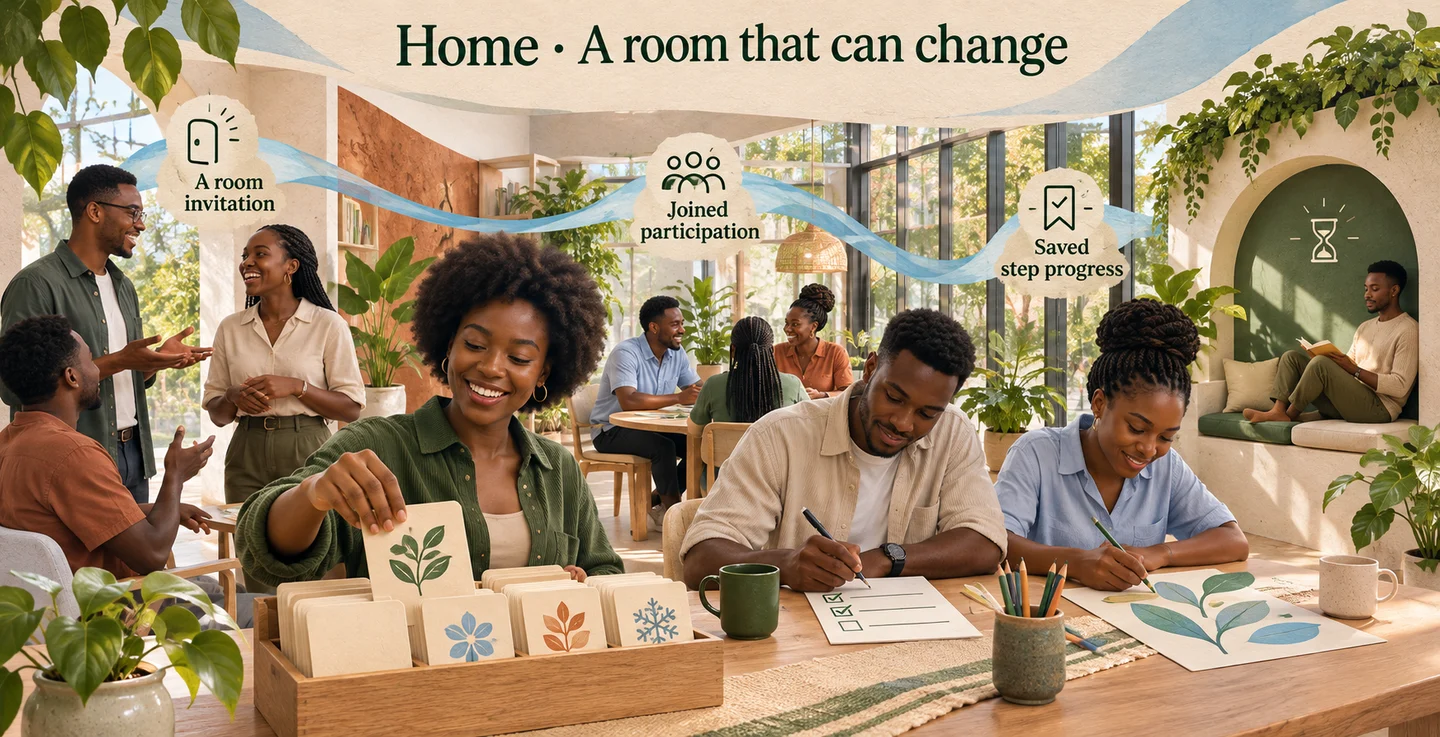
Seasonal workflow: join a reusable activity room, work through its blocks and save participation.
How I built the rooms and what still gates launch
I implemented Home with TypeScript, React and Vite, supported by modular Google Apps Script services and Google Sheets records. The fictional demo has a separate adapter and never creates a real member account. Production without a configured backend reports that state instead of substituting a convincing demonstration.
The current controlled version still has explicit launch gates around email delivery, member provisioning, abuse controls, private media and payments. Giving and shop models retain pending payment states; an unconfigured provider remains a closed action boundary. No active membership, successful donation or community outcome is implied by the demo.
The design lesson is that calm and precision belong together. Privacy, capacity, audience and saved-state rules are part of a welcoming experience. They are how the interface respects the person after the welcoming copy has finished speaking.
Give the visit a purpose beyond the scroll
Home by AwoYoga is for a community that wants several ways to connect without forcing every visit into the same public feed. A private arrival, a chosen circle, a gathering and an offer of help have their own place and their own rules.
What I learned building it is that a welcoming experience depends on precision: audience, capacity and saved progress are part of caring for the person using it. The remaining launch gates matter for that reason. The aim is to help somebody arrive, choose a room and take part, rather than leave with excellent scrolling statistics and no idea why they opened the app.
Back to the story’s beginning ↑Project details
A membership community with scoped circles, private arrivals, capacity-aware gatherings and reusable virtual activities.
Design and technical decisions
Scoped circles, private arrivals and capacity-aware gatherings form the community model. Reusable virtual activities keep demonstration state distinct from configured provider-backed behaviour.
Inside the workflow
A membership community with scoped circles, private arrivals, capacity-aware gatherings and reusable virtual activities.
Have something in mind?
Bring the problem, the audience and what you want to make possible.
Discuss your project