
Creative Tools · ICUNI Consult
I’m Hungry
A household food companion connecting what to cook with what is already in the pantry.
The build story 8 minute read

I’m Hungry: Plan Dinner, Use the Leftovers and Remember What Actually Happened
At a glance
- Purpose
- A household food companion connecting what to cook with what is already in the pantry.
- The build
- Meal ranking, planning and cooking logs connect with pantry records, separate spending pools and recoverable offline updates.
In this story
By Menelek Makonnen
I’m Hungry helps a household decide what to eat, plan a cooking session and connect the leftovers, actual meals and spending afterwards. It brings meal planning, pantry records and food-budget information into the same workspace, with reasons behind its suggestions rather than a mysterious command from an algorithm.
“What are we eating?” sounds like one question. It usually smuggles in several others: what is already in the kitchen, how much effort is available, what did we eat recently and can tonight's cooking also cover tomorrow's lunch? A container in the fridge may have its own agenda by this point. I would prefer not to give it voting rights.
I built I’m Hungry around that ordinary household tangle. The product helps the person making dinner see the plan and update the record of what actually happened. The newer local implementation also handles pending edits and remote acknowledgements explicitly. That hardening is not yet deployed, and the existing public deployment remains security-blocked; this is a build story, not an invitation into the held service.
Choose a meal with the reasons in front of you
The application begins with household preferences: size, budget pools, cooking defaults, effort and leftover tolerance.
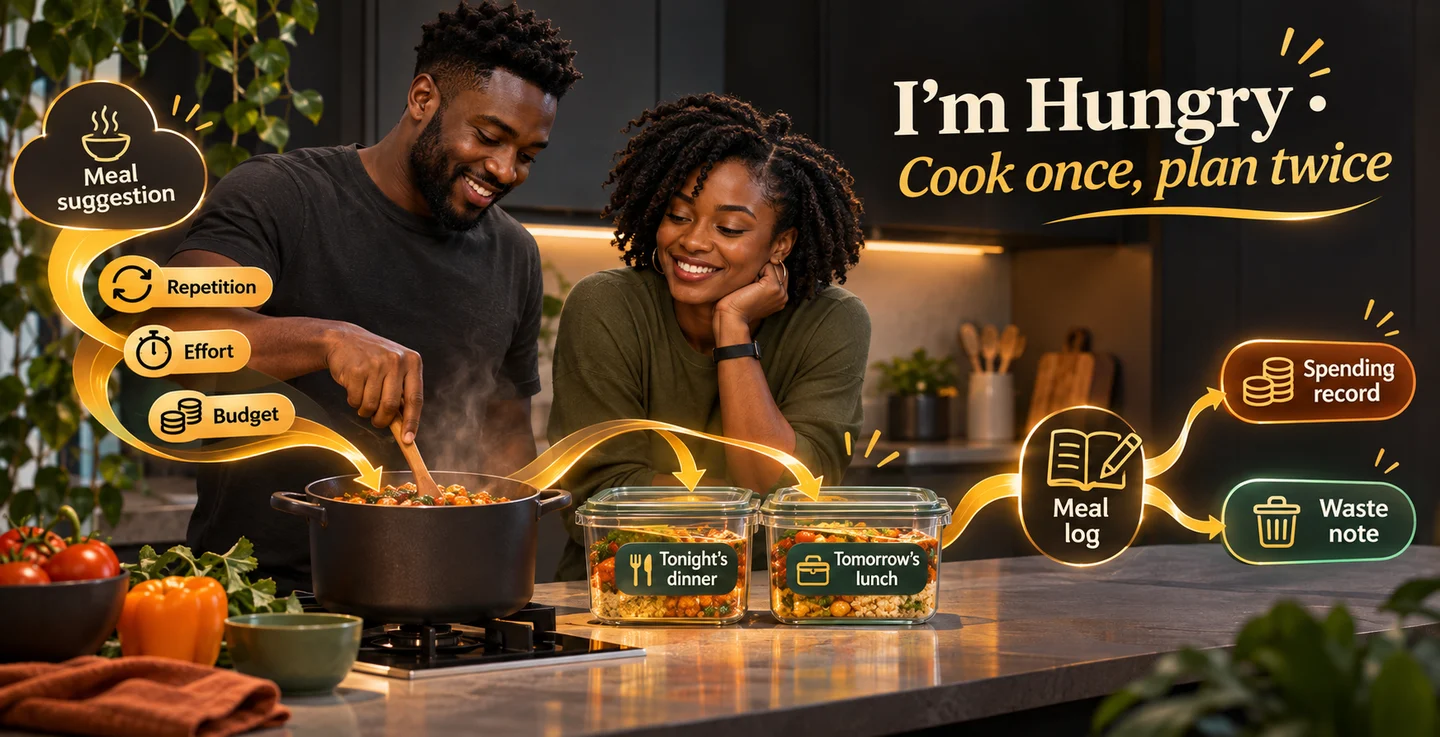
A local rules engine ranks eligible meals. It considers repetition, recorded waste, budget fit and effort, alongside stored preference scores. The selected meal comes back with component scores and a reason assembled from them.
That gives the person a useful point of disagreement. If a suggestion fits the remaining budget but feels too repetitive, they can see the trade-off. “The algorithm has spoken” is not a particularly appetising reason to eat something.
The logic is deterministic JavaScript. It filters by meal suitability and excludes discretionary, craving and social items from regular suggestions before scoring the candidates. The budget component compares an estimated meal cost with the remaining daily planning allowance.
Some stored scores relate to weight goals. Those are household inputs in a ranking rule, not validated nutritional guidance or proof of a health outcome. Likewise, several so-called hard rules are warnings or checks rather than universal exclusions. I want the interface to explain the actual decision, not inflate the label on the function.
Plan tonight’s dinner and tomorrow’s leftover lunch together
The cook-session workflow captures a selected cooked meal, portions and cost. It creates a parent record, then creates or replaces tonight’s dinner and tomorrow’s leftover lunch in the weekly plan.
That models a familiar practical decision: cook once and use the result twice. The session retains the spawned plan references, and the meal library updates its count and last date.
There are deliberate household assumptions here. The dinner cost calculation uses two portions, tomorrow’s lunch has no additional expected cooking cost, and some actor and serving values remain fixed defaults. These are implementation choices to generalise before presenting the system as a product for every household.
For someone planning the next shopping trip, that boundary matters: a cook session can organise the meals without proving what is left in the cupboard. Reliable pantry deduction would need explicit ingredients and quantities. I would rather make that missing link clear than let a reassuring screen send someone to cook with an ingredient that has entered the realm of memory.
Keep the plan separate from what the household really ate
Meal Log captures the meal, its source and type, people, cost and a waste estimate or reason. A positive cost can create a linked spending entry in the relevant budget category. A matching planned meal can be marked logged, including a deviation where the actual meal differs from the specific plan.
That separation is central. A cook session describes preparation. A planned leftover describes intention. A consumed meal describes an event. Combining them into one record would make the dashboard simpler and the household’s history much harder to interpret.
Budget records also distinguish general, fufu and discretionary pools, with a discretionary buffer affecting the effective planning budget. Those categories reflect a particular routine. They are bookkeeping rules, not advice about how anyone else should allocate their money.
The pantry groups items into fridge, freezer and dry-shelf storage. Dates help derive freshness, use and disposal reminders, alongside shopping-list and update flows. Those reminders cannot independently assess food safety. A calendar is useful; it does not have a nose.
Know whether the meal record is on this device or saved remotely
The strongest engineering part of I’m Hungry sits underneath those everyday screens.
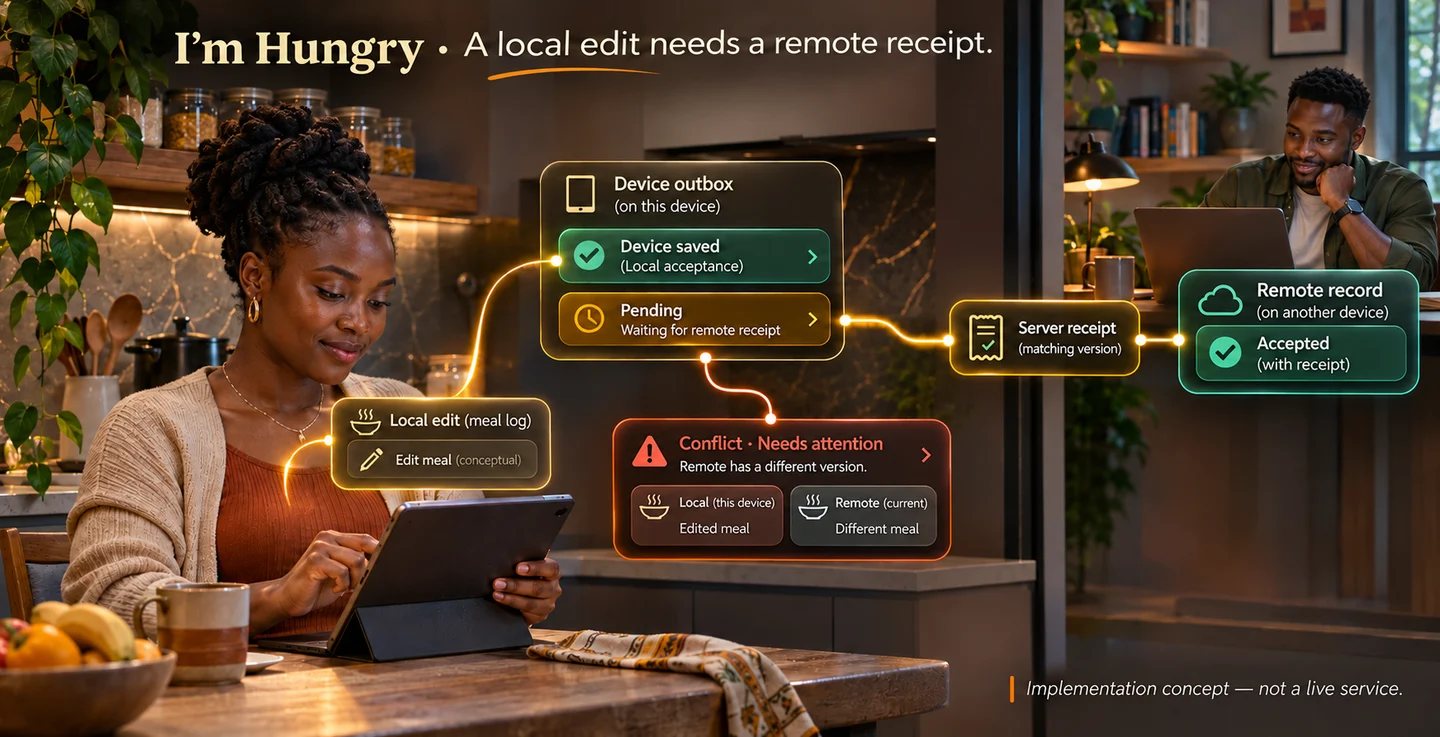
A local create, update or removal receives an operation identity, collection, record identity, actor and relevant base version. It enters a per-device outbox. The browser can show the edit while the operation remains pending for remote acceptance.
When a fresh server snapshot arrives, pending operations replay over it rather than being silently discarded. The outbox flush is serialised, respects the original actor and stops when a foreign-actor or failed operation needs attention.
A successful response must contain a receipt before the operation leaves the queue. A network problem retains pending work. A rejection stays visible. Retry and discard are explicit actions, rather than accidental side effects of refreshing a page.
This makes the save status meaningful: device-only, offline, sign-in required, syncing, saved and needs attention describe different conditions. A cloud icon should not be allowed to settle all of them by looking vaguely optimistic.
Protect the household history when edits are retried
The Apps Script backend allowlists household collections and actions, checks identity fields and computes a payload fingerprint. Under a lock, it checks a previous operation receipt before writing.
A matching operation can return its existing receipt. Reusing an identity with conflicting content is rejected. Base-version checks can preserve a newer server record instead of allowing an old local edit to overwrite it.
The code can also recover a create or update whose requested data already exists and append the missing receipt afterwards. That is practical recovery for a sequence involving both a record and an acknowledgement.
The architecture uses plain browser JavaScript, local storage and Google Apps Script. It does not require an LLM to remember that lunch happened, and it should not require someone to interpret silence as a successful save.
The actor boundary is especially useful in a shared household. If one person creates an operation and another signs in on the same device, the queue should not quietly relabel the first person’s work. The operation waits for the appropriate identity instead. That preserves a more honest account of who changed what, even when the screen is shared.
A stale-version conflict is similarly useful friction. It gives the household a chance to notice that the remote record changed after an edit began. Automatically choosing the latest arriving request would be convenient for the network and potentially confusing for the people trying to understand their food and spending history.
The newer local source also hardens authentication and rendering: server-validated sessions, hashed login-code and token storage, request limits and a controlled HTML-rendering path with a Content Security Policy.
The remaining release evidence includes live email sign-in, rejection of unauthenticated access, an accepted mutation receipt and a cross-device conflict exercise. Source changes and a deployed service are different milestones.
The household model also needs further generalisation around fixed users, serving assumptions and linked corrections. Those are concrete product responsibilities, not reasons to discard the useful planning and sync design.
What building for dinner taught me about continuity
I’m Hungry started with the friction around an ordinary meal. It ended up making me think much harder about identity, correction and acknowledgement.
A useful household tool needs enough flexibility to reflect what people actually did. It also needs enough discipline to avoid quietly rewriting that history when the network returns or a second person edits the same record.
The person returning tomorrow can see more than yesterday's intention. A suggested meal has reasons, a cook session can create the leftover plan, and the actual log can say what changed and what was spent. That is the continuity I want this tool to provide: context for the next food decision without asking the household to remember every previous one.
Let dinner be dinner again
I’m Hungry is for the household trying to turn a recurring question into a workable plan. It connects the meal choice, the cooking, tomorrow's lunch and the history of what was eaten, while keeping the person in charge of the decision.
The next deployment and acceptance work needs to make that record dependable across devices and interrupted saves. The purpose remains pleasingly ordinary. I want software to absorb some of the administration around dinner, so the fridge does not need to chair another emergency committee.
Back to the story’s beginning ↑Project details
Meal ranking, planning and cooking logs connect with pantry records, separate spending pools and recoverable offline updates.
Inside the workflow
Meal ranking, planning and cooking logs connect with pantry records, separate spending pools and recoverable offline updates.
Have something in mind?
Bring the problem, the audience and what you want to make possible.
Discuss your project