
Business Systems · ICUNI Consult
imPress
Shaping detailed book quotations into a clearer print-production workflow.
The build story 6 minute read

imPress: Price a Book Job Clearly, Then Carry the Quote into Production
At a glance
- Purpose
- Shaping detailed book quotations into a clearer print-production workflow.
- The build
- Granular book-job quoting connects to production stages, file handoff and accounting entries. The design treats the quotation as part of an operational job record, rather than an isolated document.
In this story
By Menelek Makonnen · ICUNI Consult
imPress helps a print shop turn a customer's book specification into an itemised quote and then into a production job the team can follow. It brings paper, binding, finishing and labour assumptions together, keeps the artwork close to the job and connects the work to accounting entries.
A customer wants a run of books. Front desk needs a defensible price. Production needs the exact specification. Accounts needs to know what the accepted job represents. If those three conversations happen in isolation, the cost of “we'll sort that out later” eventually arrives with the subtlety of a stapler through a window.
I built imPress around that journey. The estimator can work through the ingredients of the price, and the next colleague can inherit more than a total. I care about that continuity because a quote should keep being useful after the customer says yes. Selling a beautifully formatted mystery is still selling a mystery.
Build a quote from the book the customer actually wants
A book quote begins with customer and job details, page count, run quantity and format. Text stock, cover stock, binding, finishing and labour come from configurable libraries. A capable manager can add a missing option while quoting; another role receives a clear instruction to ask an administrator.
The calculator turns those selections into cost lines. It rounds required sheets from pages and paper yield, then applies the selected pricing bases: paper by sheet, binding by book or job, finishing by page, book or job, and labour by hours, books or jobs. Overhead is calculated from direct cost.
The field labelled margin applies a percentage to total cost. That means markup on cost in this implementation. I call that out because margin and markup are perfectly capable of ruining a commercial conversation while sounding like close personal friends.
Multiple jobs can sit in one quote. Labelled additions apply to the combined prices before a quote-level discount. For the estimator, that means being able to explain where the quote came from and revisit an assumption when the customer changes the run. For the next colleague, the breakdown gives the number a memory. Confidence is more useful when it has ingredients.
The browser recalculates while the operator edits. On save, the backend loads its own pricing configuration and recomputes the breakdown. I wanted a responsive interface and an authoritative save path: the convenient number on screen should not become the backend's unquestioned instruction.

Quote workflow: turn book specifications and configured rates into an inspectable, server-recomputed estimate.
Hand production the specification alongside the price
An authorised operator can convert a saved quote into a queued production job. The service rejects missing or already-converted quotes, assigns a job number, posts a receivable/sales journal entry, marks the quote converted and records an audit event.
That is the meaningful transition. The estimate becomes work with an identity, while its original costing remains available. Artwork attached to the quote or job appears in the job view. The team does not have to abandon the estimate to explain what was sold.
The visible production track moves through queued, prepress, printing, finishing, ready and delivered. Operators can move backwards or forwards and select a declared stage directly. I implemented the stage vocabulary without pretending it automatically proves every physical production step occurred.
An accounting-capable operator can add a positive supplementary invoice with a memo. Its record connects back to the customer and posts the corresponding entry. Files, costing and production status give the job view different kinds of context, each useful to the person taking over next.
For a production operator, the job view brings together the stage, artwork and original costing so a handover can begin with the work itself. Accounts can follow the connected entry, while the estimator can return to the accepted assumptions. The purpose is fewer gaps between those jobs, rather than a dashboard competing with the press for attention.

Quote to production: preserve costing and artwork through a staged job, with linked accounting entries.
Let front desk, production and accounts work in their own context
Front desk, production, accounting and owner roles have different responsibilities. Capabilities are combined for people holding multiple roles. The interface reflects those permissions; the backend action registry makes the actual decision about whether an operation is allowed.
That keeps a production stage update distinct from editing pricing libraries or posting accounting entries. A role view helps focus the interface, while service checks remain the authority behind the action.
The quote editor has a draggable split between form and result, so an estimator can give more space to the assumptions or the breakdown. Tables borrow a useful spreadsheet habit: drag a column boundary when a field needs room. The sidebar collapses, and smaller screens use a drawer.
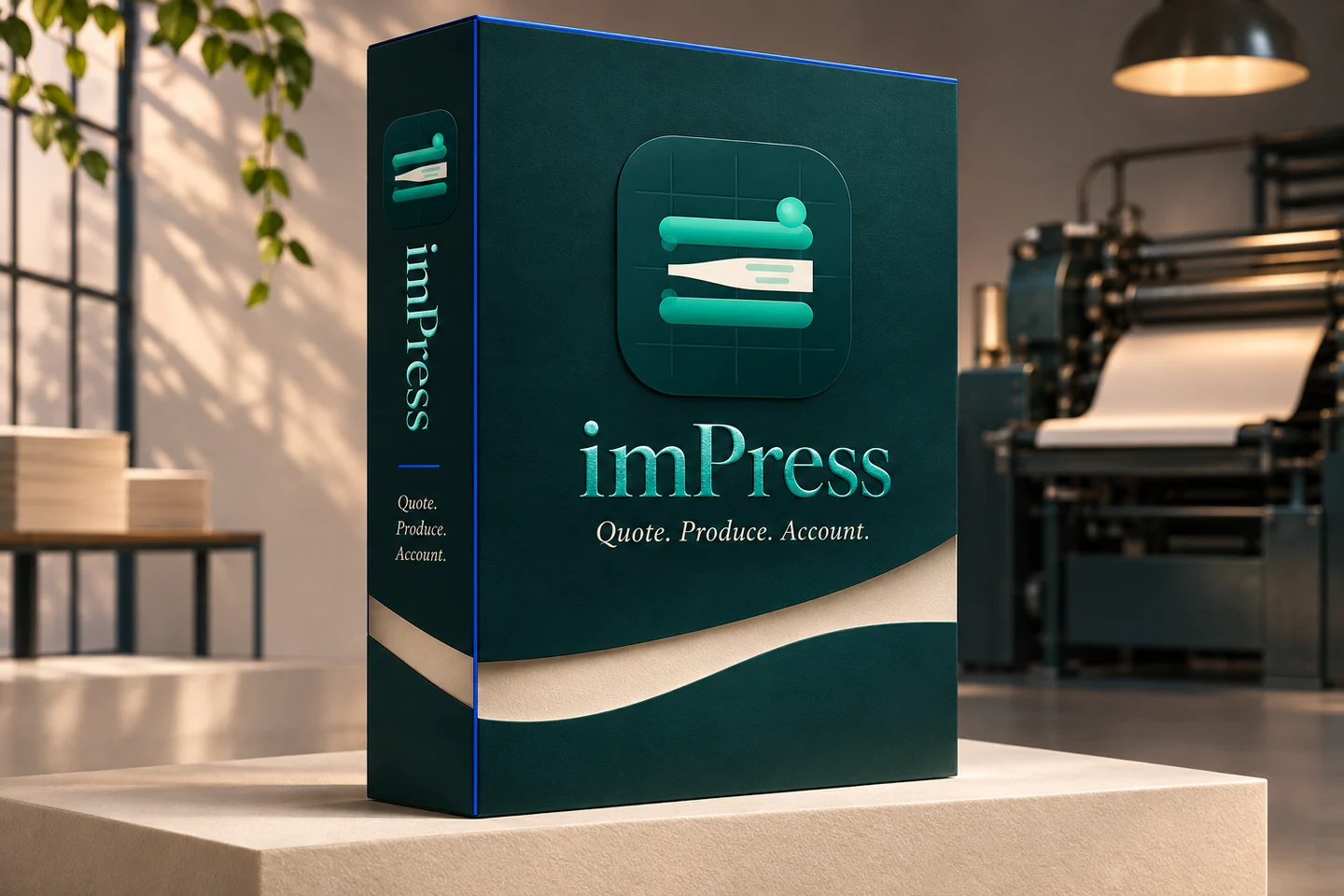
The interface pairs deep teal navigation with cool surfaces and bright blue actions, with light, dark and a cream-toned Tally skin. Its actual printing-press mark has a paper sheet between platens and a small ink dot. Even the identity has a job to do.
What I built beneath the handover
imPress uses JavaScript, React and Vite in the browser, with Google Apps Script services over Google Sheets and Drive file handling. Its README records governance foundations adapted from PrintShop; I developed the print-specific costing and job flow around that operational lineage.
Script locks serialise selected writes. They do not turn a sequence of journal, job, quote and notification writes into a database transaction with automatic rollback. The common journal writer checks account codes and balanced debit/credit totals, but live accounting reconciliation remains a separate acceptance task.
The explicit demo works in memory. A failed configured live request surfaces an error instead of quietly saving into demo storage. That is a useful product rule: a failed save should not become a successful performance.
A shop adopting the implementation would still need to validate its pricing configuration, Drive access and accounting reconciliation in the deployed setup. The wider payroll modules need their own current-rule review.
My main lesson was that transparency must survive conversion. A helpful estimate explains its ingredients. A helpful job retains that explanation when the work changes hands.
Let the yes become a job people can deliver
imPress is for the print shop that needs the commercial promise and the production detail to stay together. It supports the estimator explaining the price, the team producing the books and the account record following the accepted work.
The lesson I take from building it is that a useful quote has a life beyond the PDF. It should carry its assumptions into the job, where paper, labour and binding become very physical expenses. “Later” can remain a time of day. It does not need to remain a pricing strategy.
Back to the story’s beginning ↑Project details
A print-shop workspace connecting granular book-job quotations with production stages, file handoff and accounting entries.
Design and technical decisions
Granular book-job quoting connects to production stages, file handoff and accounting entries. The design treats the quotation as part of an operational job record, rather than an isolated document.
Inside the workflow
A print-shop workspace connecting granular book-job quotations with production stages, file handoff and accounting entries.
Have something in mind?
Bring the problem, the audience and what you want to make possible.
Discuss your project