
Business Systems · ICUNI Consult
KeyStore
A practical study in keeping material requests connected to approvals and delivery.
The build story 6 minute read

KeyStore: Know What the Site Has, What It Needs and What Actually Arrived
At a glance
- Purpose
- A practical study in keeping material requests connected to approvals and delivery.
- The build
- A React single-page workspace uses Google Apps Script services and Sheets records. Role-specific steps connect material requests, project-manager approval, sourcing, dispatch and physical receipt; stock movements remain attached to a ledger.
In this story
By Menelek Makonnen · ICUNI Consult
KeyStore helps construction teams keep track of materials from the store to the site and through the next delivery. Storekeepers can record what leaves stock, project managers can review requests, supply teams can arrange dispatch, and receivers can record what actually arrived. Everyone works from a connected history rather than a collection of competing recollections.
Picture a site running low on cement. Asking for more is only the first step. Someone has to approve the quantity, supply has to commit to it, a delivery has to leave, and the site has to count what it accepts. A dashboard that skips those handovers is essentially interior decoration for a shortage.
I built KeyStore around the people doing that work, particularly nontechnical storekeepers. I wanted an ordinary stock action to be easy to record and useful to the next person. My contribution is the connection between the practical task, the decision and the surviving record. A bag of cement has enough weight already; it should not also have to carry the organisation's entire memory.
Start with the storekeeper's working day
The original product brief put nontechnical storekeepers at the centre. That mattered to my design: a system intended for site work should understand that recording an issue is a task someone needs to finish, rather than an invitation to tour an enterprise menu.
A storekeeper searches the catalogue, chooses an item, enters a quantity and adds a note when context matters. The service checks the site, role, item and available balance before writing an ISSUE movement. A request for more stock follows a separate path. Using something and asking for something are different events; blurring them produces wonderfully confident nonsense.
Loss recording sits alongside issue recording, because damaged or missing materials should have an explicit explanation. The ledger gives movement a vocabulary. Head office can inspect records that distinguish routine usage from a loss instead of treating every shrinking balance as the same mystery.
I gave the interface role-specific dashboards and grouped navigation. The desktop rail resizes; mobile uses a drawer and bottom navigation. Light and dark themes, compact density and the indigo key-shaped identity support the work without requiring everyone to adopt the same screen arrangement.

Issue workflow: select an item, check the site balance and record the movement.
Get a materials request all the way to an accepted delivery
The most substantial workflow begins with a multiline materials request. The storekeeper enters quantities, line urgency, notes and an overall priority. A local draft preserves work before submission. That is a small feature with a clear purpose: assembling a request should not depend on finishing every line in one uninterrupted sitting.
The project manager then reviews the lines. Approve, reject and return are distinct decisions. Returned lines can become a new draft, keeping revision part of the process rather than a conversation detached from it.
Supply staff work from the approved request. They can confirm quantities, defer items, add delivery-note information and dispatch. At the site, the receiver records accepted, rejected and returned quantities, with discrepancy notes. Accepted material becomes an inward stock movement.
I wanted that chain to retain its meaning from desk to delivery bay. A dispatch record says something left; a receipt says what the site accepted. Those statements deserve separate records. A lorry reaching the gate is useful evidence of a lorry reaching the gate. It is an ambitious accounting policy to let it prove everything else.
For the project manager, that connected history answers whether a request needs attention or has moved to supply. For the storekeeper, it explains which shortages have a delivery behind them. For the receiver, it preserves discrepancies instead of asking them to agree that dispatch and receipt were identical. These are different jobs joined by one materials journey.

Request to receipt: carry line decisions through approval, sourcing, dispatch and accepted stock.
Make the physical count useful to tomorrow’s team
Daily reconciliation is its own consequential workflow. An administrator selects a site and date and works with opening, inward, outward and closing quantities. The draft draws on the previous closing and recorded movements. Saving a closing that differs from the live ledger creates an adjustment movement.
That distinction shaped the implementation. This is not simply a form that prints a report. It changes the recorded position, so the discrepancy needs an explicit place in the movement history.
I see reconciliation as an explanation mechanism. A physical count and the recorded balance can disagree; the useful system preserves the difference and its adjustment. Painting over the number would make the dashboard tidier and the next investigation considerably more theatrical.
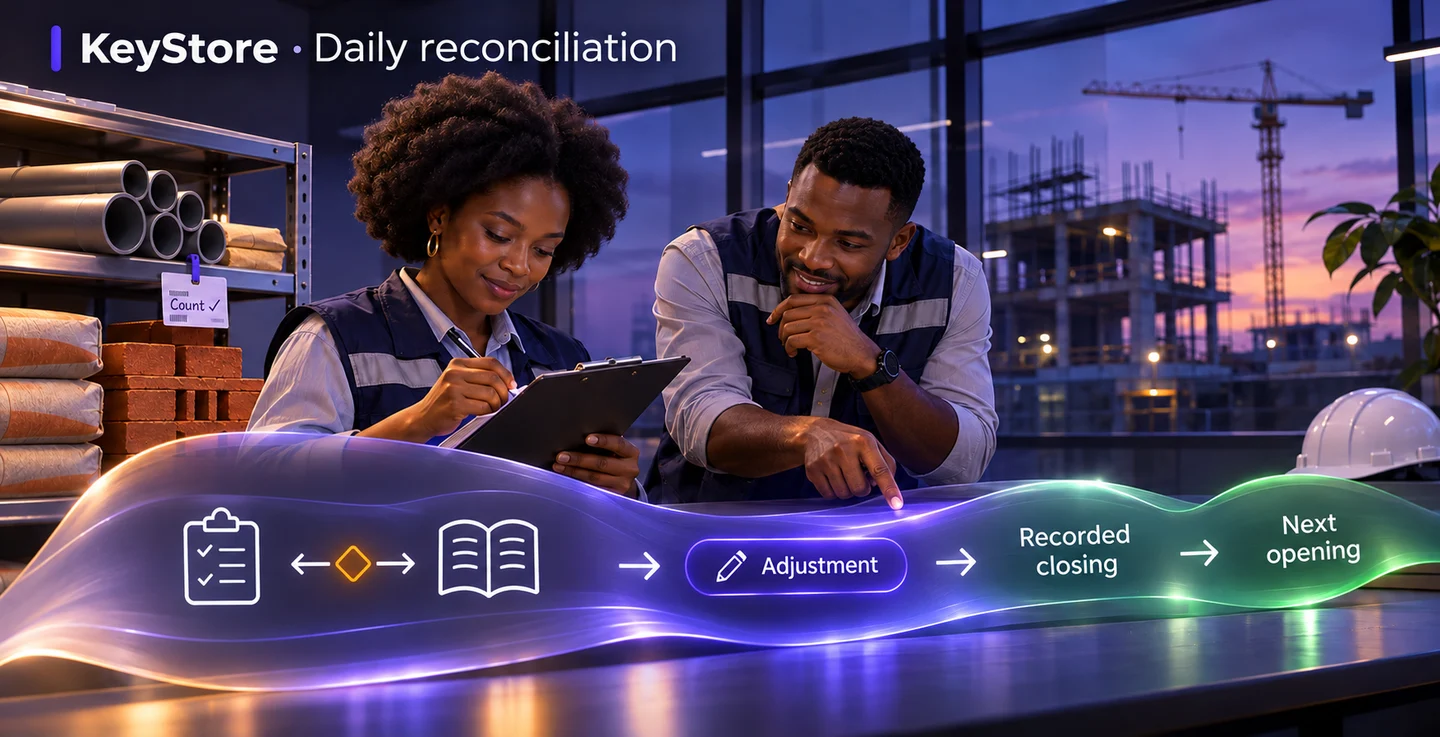
Daily stock: compare recorded movement with the entered closing count and retain the adjustment.
Keep delivery and concrete-test details close to site work
Construction stores also sit near material-quality work. KeyStore includes separate premix and concrete-test logs. Premix entries capture a site, date, concrete type and positive volume. Test records capture the pour date and strength, with optional seven-day and twenty-eight-day milestones, results and remarks.
These records add useful operational context without pretending that a materials ledger is a laboratory. They give teams places to record deliveries and testing milestones; they do not imply automatic laboratory ingestion or a calculation of concrete consumption.

Materials records: log premix deliveries and concrete-test milestones in separate records.
How I built a workspace people can hand over
I implemented the browser workspace in JavaScript and React, using Vite, React Router, Tailwind CSS and Framer Motion. Google Apps Script routes named actions into separate authentication, request, issue, stock and specialist services. Google Sheets stores the records.
That separation keeps the operational rules in services rather than making a disabled button the final authority. The client centralises API parsing, session handling and read caching; successful writes invalidate relevant cached reads. Selected server operations use script locks to reduce overlapping writes. Sheets remain a deliberate storage boundary, with different guarantees from a transactional database.
A fixture-backed demo makes the workflow available for repeatable walkthroughs with sample roles and records. Before broader operational use, I still need to strengthen server-side quantity checks in receipt and approval, then validate the complete deployed journey with real operating conditions. The implementation gives that work a structure.
The lesson I carry from KeyStore is that operational software lives in handovers. Interface clarity, state transitions and a comprehensible ledger have to agree. A beautiful request form is only the beginning of the request's life.
Let the next person find the answer
KeyStore is for construction teams who need to know what they have, what has been used and where the next delivery stands. It gives everyday site work a shared record without asking a storekeeper to become a software specialist first.
The deeper lesson for me is that a handover is part of the product. An issue form, an approval and a receipt become useful together because the next person can pick up the story. The cement still needs carrying. I built KeyStore so the explanation does not have to be carried entirely in somebody's head.
Back to the story’s beginning ↑Project details
A materials workflow linking requests, approvals, dispatch and accepted receipts to a movement record.
Design and technical decisions
A React single-page workspace uses Google Apps Script services and Sheets records. Role-specific steps connect material requests, project-manager approval, sourcing, dispatch and physical receipt; stock movements remain attached to a ledger.
Inside the workflow
A materials workflow linking requests, approvals, dispatch and accepted receipts to a movement record.
Have something in mind?
Bring the problem, the audience and what you want to make possible.
Discuss your project