
Experiments · ICUNI Labs
LeRoom/The Room
A small brainstorming room made from the AI conversations already open in a browser.
The build story 5 minute read
The Room: Explore an Idea with Two Assistants Without Becoming the Clipboard
At a glance
- Purpose
- A small brainstorming room made from the AI conversations already open in a browser.
- The build
- A browser side-panel prototype assigns roles to ChatGPT/Claude tabs and relays a bounded brainstorming exchange.
In this story
By Menelek Makonnen · ICUNI Labs
The Room is my browser side-panel workspace for directing a two-assistant discussion and following the exchange in one attributed transcript. Assign a Starter and Responder from existing ChatGPT and Claude tabs, set the topic and round limit, and give the discussion a visible structure.
The intended benefit is less copying between conversations when exploring a creative brief or product question. One participant proposes; another responds. I can follow how the idea develops rather than spend the whole session providing unpaid logistics for the clipboard.
I built it to explore that coordination interface, not to turn agreement between assistants into truth. The person directing the exchange still judges the answer, and the current relay is a two-speaker loop rather than an arbitrary panel of independent experts.
It remains a workspace with packaging and lifecycle work to finish before operational use. The value in this project is a clear interaction design and an equally clear account of what it still needs to become dependable.
Put a topic at the centre
Setup lists eligible conversational tabs and lets me select participants. The roles distinguish a Starter, a Responder and an optional Decision Bot. A topic and maximum round count give the exchange an intended subject and a stopping boundary.
That creates a practical design exercise for brainstorming. One participant can open a proposal and another can challenge or extend it. The transcript can preserve attribution so the person reviewing the exchange sees the order in which ideas developed.
The current relay is a two-speaker ping-pong. Selecting more tabs does not turn it into an arbitrary deliberation graph. I keep that scope explicit because a room full of names and a working turn-taking mechanism are different things.
For a creative brief, the intended value is a more legible exchange of options. For a product question, it is a way to follow an initial proposal and a response without manually carrying every message between windows. Agreement between assistants would still need human judgement; repetition is not independent evidence merely because it has changed tabs.
Keep the exchange visible
I wanted the person directing the discussion to stay oriented without juggling the source tabs. Setup chooses the participants; Monitor brings the round badge, attributed contributions and controls into view. Navy surfaces with cyan and blue accents distinguish the panel while the browser supplies its side-panel space. The interface gives the conversation a place to be followed.
The worker groups selected tabs into a browser group named The Room, creates session state and injects the appropriate site connector. Replies are attached to an author and round before being passed to the next speaker with attribution.
An optional decision role has a summary path when the session is stopped through the implemented stopping branch. The summary is a requested assistant response, rather than a guarantee that the topic has reached a sound decision. Giving something the Decision Bot role does not confer a small judicial wig.
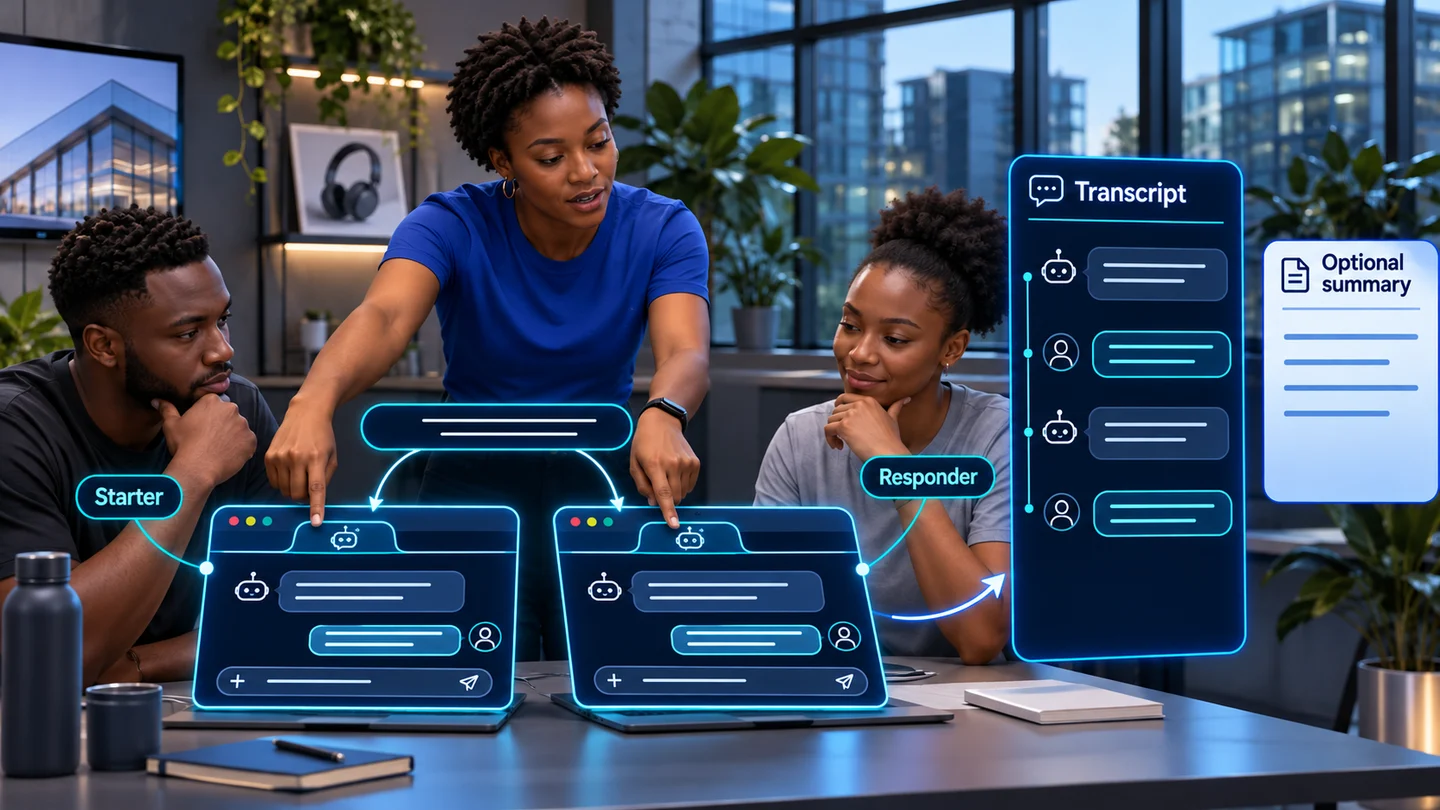
workflow: choose participants, alternate contributions and follow the transcript.
Separate the design from the lifecycle work
I implemented the workspace with JavaScript, Manifest V3 extension surfaces, a service worker, browser tab grouping and site-specific content connectors. It uses the existing websites’ editors and response elements; it does not contain a separate inference engine or direct provider API.
That choice makes the integration dependent on each website’s DOM. A connector must find the input, send the message and recognise a finished response. A changed selector or a missed mutation can interrupt that contract.
Response waiting also needs a deadline and an already-finished check. Force Stop changes session activity; it does not cancel an assistant response that is already being awaited. The session transcript lives in worker memory, with no established durable replay or export workflow.
What the small room taught me
Building the workspace showed me what a person needs from a conversation coordinator: who is speaking, whether the response is still coming, what stopping will actually stop and where the transcript will survive. Those questions turn into lifecycle states in code. They are also the difference between a useful discussion tool and another tab demanding supervision.
That lesson carries into larger tools I build. Visible roles and an attractive monitor are useful, but they need lifecycle semantics beneath them. The interface should help the person understand who is speaking and what the system is currently doing.
It also sharpened how I think about multi-assistant work: the important product decisions include turn-taking, attribution and control, alongside the quality of any individual answer. The human directing the discussion needs room to judge the result.
Give the discussion a shape
The Room explores a useful everyday idea: let two existing assistant conversations exchange proposals and responses around a defined topic, while a person follows the authors and turn order in one place.
The clipboard has attended enough meetings. I would like to give it something more interesting to do.
Back to the story’s beginning ↑
Project details
A browser side-panel prototype assigns roles to ChatGPT/Claude tabs and relays a bounded brainstorming exchange.
Inside the workflow
A browser side-panel prototype assigns roles to ChatGPT/Claude tabs and relays a bounded brainstorming exchange.
Have something in mind?
Bring the problem, the audience and what you want to make possible.
Discuss your project