
Games & Worlds · ICUNI Games
LoreSim
An Accra simulation study exploring how people respond to a changing situation at a market junction.
The build story 9 minute read

LoreSim: Investigate a Fictional Accra Incident from More Than One Mind
At a glance
- Purpose
- An Accra simulation study exploring how people respond to a changing situation at a market junction.
- The build
- A deterministic, non-canon Accra market-junction simulation with responders, civilians, validated actions and reviewable event records.
In this story
By Menelek Makonnen · ICUNI Games
A Heroes of Accra incident slice where partial perception, bounded intentions and deterministic consequences make agent behaviour inspectable.
LoreSim lets you follow a fictional incident in Accra through several characters’ incomplete views, intervene and inspect how the situation changes. It is a local simulation for exploring believable agent behaviour: responders act on what they perceive, civilians react, and your choice can change the information or help available to them.
Give every character perfect information and the mystery becomes a meeting with excellent minutes. Give every character permission to rewrite reality and the meeting becomes much harder to insure.
I built LoreSim to make that uncertainty playable and understandable. A player can investigate why a character acted; as a world-builder, I can test whether authored abilities and constraints produce a coherent incident. Characters can perceive, remember, believe and propose. The world decides what actually happens.
The current playable vertical slice, White Wind at Market Junction, puts that principle inside the LoreMaker universe. A transformer disturbance, an unexplained pressure wave and conflicting witness reports create a situation no single responder understands completely.
Seven durable responder agents and twenty-four lightweight civilian agents react to the same incident from different positions. The slice is local and deterministic, with no model or network calls. “Agent” describes a simulated decision-maker with its own state; it does not mean a remote language model is narrating the world into existence.
Step into a junction where nobody has the whole story
Market Junction gives the simulation a bounded problem. The initial event contains an electrical failure and an unusual residual phenomenon. Public reports disagree about what witnesses saw.
Nearby locations include a clinic, transit stop and rooftop relay. Those relationships give movement and information a practical context. A clear route to care is different from a report about a route, and surveillance is different from being physically present.
I chose a slice because it forces the systems to meet. Perception, capabilities, civilian risk, rumours, intervention and resolution all have to refer to the same situation.
A vast map could conceal missing relationships behind distance. One crowded junction is less forgiving. If a character acts on evidence they never received, the contradiction is close enough to notice.
The incident is explicitly non-canon. It exercises authored character capabilities and constraints without rewriting LoreMaker history. That gives me room to test consequences while preserving the difference between an experiment and a creator ruling.
Let the player choose how to intervene
The operator can leave the agents to work, open a civilian route to the clinic, share a bounded evidence packet or amplify a livestream.
Each option changes a different part of the situation. A clear corridor reduces evacuation uncertainty. Shared evidence changes what particular teams can use. Amplification increases reach while also increasing exposure, panic and rumour risk.
The incident continues without the player. That matters because the agents should not exist only as furniture waiting for a button press.
The interface can advance the world by a minute or run it to resolution. A chosen seed and intervention make a run something the operator can return to and compare, rather than an anecdote they can only describe afterwards.
These are meaningful choices within a small scenario. The junction is the proving ground for the rules.
Separate what happened from what someone thinks happened
LoreSim keeps authoritative facts, observations, beliefs and proposals in different records.
An observation belongs to a perceiver. A belief can carry uncertainty and a relationship to evidence. A proposal expresses an intended action. None of those records automatically becomes a world fact.
That distinction is the centre of the design. If one responder senses a supernatural signature while another sees damaged electrical infrastructure, they can form different interpretations without the simulation secretly changing the underlying incident to agree with both.
A rumour is allowed to travel as a rumour. Its spread can change behaviour and pressure without granting it the status of verified truth.
This gives the characters a more useful kind of fallibility. They can be confident, incomplete, mistaken or influenced by what others say. The system still has an account of which evidence reached them and which events actually occurred.
For a player, that creates an investigation worth following. For me as the builder, it creates behaviour I can explain without attributing every surprise to mysterious intelligence.
Let a character try, without giving them control of reality
A responder might want to use a power, move someone or investigate a target. LoreSim gives that proposed action a defined form: a typed intent with an identity, kind, target, structured parameters and bounded confidence. That lets the world consider what the character wants instead of treating a confident explanation as an automatic success.
The validator checks the intent contract, whether the agent exists, whether the action kind is registered, whether the agent has the required capability and whether the incident is still active. More specific rules then apply to the particular action.
That is how an intention becomes something the engine can consider. A persuasive rationale cannot supply a missing ability, and a confident sentence cannot make an unregistered target real.
The proposal also has to remain a proposal until resolution. The agent does not get to declare that it succeeded and ask the world to update its paperwork later.
This is a practical architecture choice with narrative consequences. Characters can retain ambition and personality while the rules retain authority over what those ambitions achieve.
Make a rejected action part of the story
An area-lightning proposal near civilians is rejected by the slice's collateral and target rules. The incident has not established a discrete hostile target that would justify that action.
The rejection is not the end of the character's usefulness. Kweku can move towards structural bracing instead of treating a blocked power as a broken turn.
Object possession requires an authorised host. Human possession has its own explicit consent and duration conditions. Other capabilities require an appropriate corridor, known imprint or sufficient energy.
Those constraints give powers a shape. A capability is more interesting when it has conditions, costs and an intelligible reason it might fail.
The engine issues an approval or rejection receipt with the relevant checks. Approved actions can produce causal events and change the world; rejected actions remain visible as attempted intentions with reasons.
That makes the failed proposal valuable information. It helps explain the next action rather than disappearing behind a generic error message.

Perception, bounded intervention and world-rule consequences.
Follow the evidence behind a surprising decision
Approved actions append events that the rest of the simulation can perceive and react to. The event history, observations, intentions and receipts belong to one run.
The Incident, Agents, Intent receipts, and Canon & replay views give the player different ways to investigate. Follow what is happening, open an agent’s beliefs, inspect why a power was rejected or compare the run with its replay. A surprising decision becomes a question you can pursue, rather than a line of dialogue you have to accept.
That separation helps the interface tell a complicated story without collapsing it into one omniscient feed. An agent's private observation should not quietly become public knowledge just because the operator can inspect it.
The agent-view export reflects that boundary. It includes public event summaries and the selected agent's own beliefs and memories, rather than exporting every other mind's private perception detail.
These are fictional minds and simulated secrets, but the architectural discipline is useful. Visibility is part of the world model, not simply a decision about which panel happens to be open.
Replay the history, not just the ending
A resolution exports the seed, scenario, intervention, final fingerprint, event identities and receipt identities.
Replay reconstructs the world from the seed and intervention, runs the incident again and compares the resulting fingerprint and histories. A matching final headline alone is not enough.
That is an important distinction for an agent simulation. Two runs could both end with civilians safe while taking different actions, rejecting different intentions or sharing different evidence.
The fingerprint includes more of the actual state: incident, events, observations, intentions, receipts, rumours, agent beliefs and memories, and civilian population. It gives the comparison a defined object rather than relying on the operator's impression that the story felt similar.
This is deterministic verification of this bounded implementation.
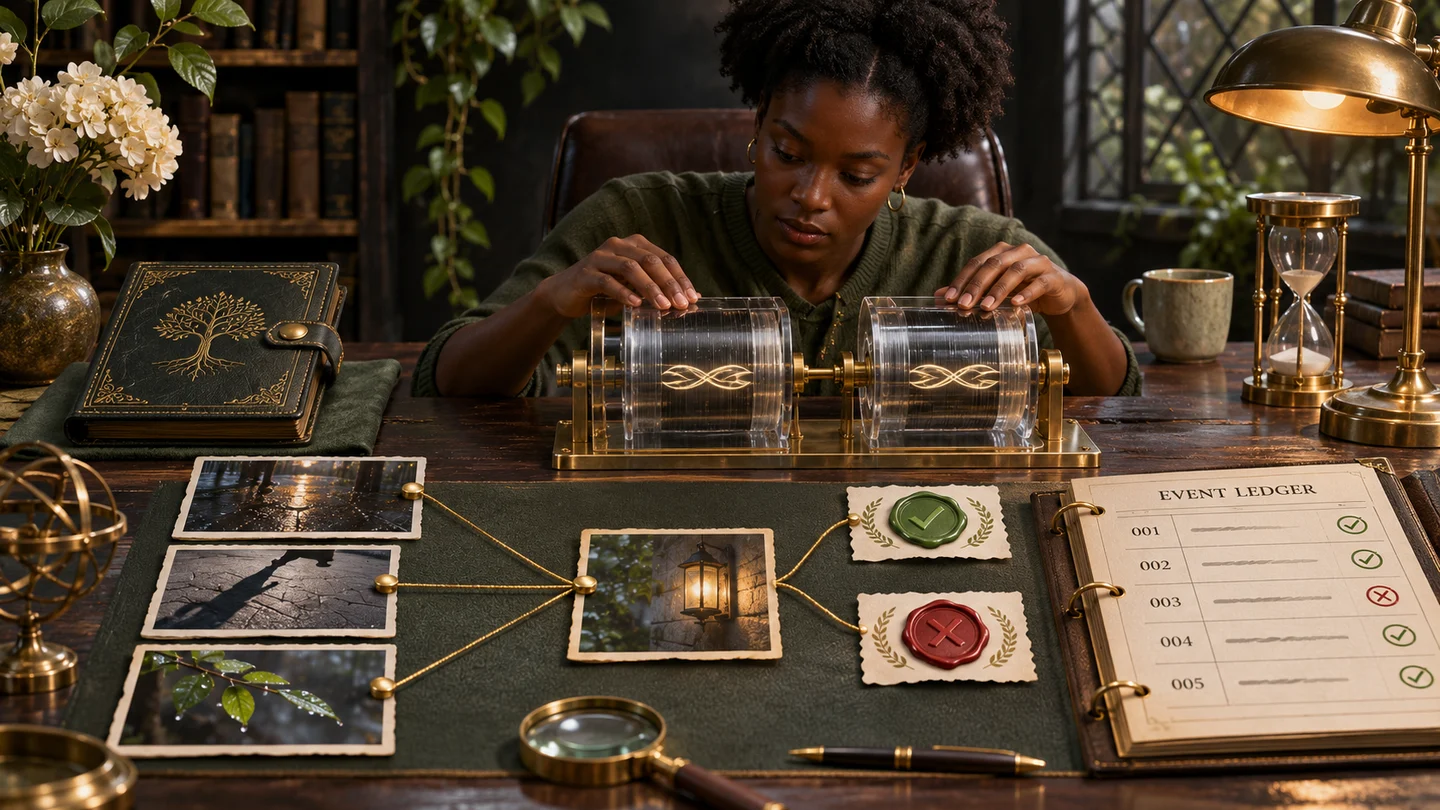
Causal inspection and replay comparison preserve the run's history while authored canon remains separate.
The research behind the experiment
LoreSim carries a pinned reference checkout of Stanford's Generative Agents implementation in a separate research area. It informs questions about memory, perception and believable autonomous behaviour.
The current incident runtime is its own local, dependency-free slice. It does not execute a large model for each character or become Stanford's implementation because the reference code is nearby.
Keeping that provenance visible matters to me. A useful research influence deserves credit, and original implementation work deserves a precise description of what it actually does.
The wider architecture leaves room to explore more scenarios and richer systems. For now, this bounded junction is where those ideas have to earn their usefulness. I have a weakness for ambitious worlds; a small deterministic incident is a helpful antidote to planning three continents before anybody can cross the road.
What LoreSim has sharpened
The implementation uses JavaScript ES modules, HTML and CSS, with a small Node.js static server. The deterministic engine stays separate from the editorial dashboard.
That modest stack puts the difficult work in the domain: defining observations, capabilities, permission, consequences and replayable state.
LoreSim has strengthened how I translate an authored universe into rules without flattening its characters into omniscient calculators. For a writer or game designer, that is a useful way to test the consequences of a power or information gap. I can see what a character attempts, what the world allows and what follows. A character should be able to want something the world refuses.
The most useful strength is connecting narrative intent to inspectable mechanics. When a run surprises me, I want to trace the surprise through evidence and decisions, rather than excuse it as the cost of having agents.
LoreSim: Heroes of Accra, non-canon incident slice.
Let uncertainty belong to the character
LoreSim makes a small fictional incident carry several believable realities at once. Responders disagree, civilians react, information spreads and the world resolves what the proposed actions can actually do.
The character can be wrong. The operator can investigate why. The world keeps the receipts, so the mystery remains a story instead of becoming an accounting dispute with lightning.
Back to the story’s beginning ↑
Project details
A deterministic, non-canon Accra market-junction simulation with responders, civilians, validated actions and reviewable event records.
Inside the workflow
Set the scene, choose responder actions and inspect how the simulated situation and its event record change.
Have something in mind?
Bring the problem, the audience and what you want to make possible.
Discuss your project