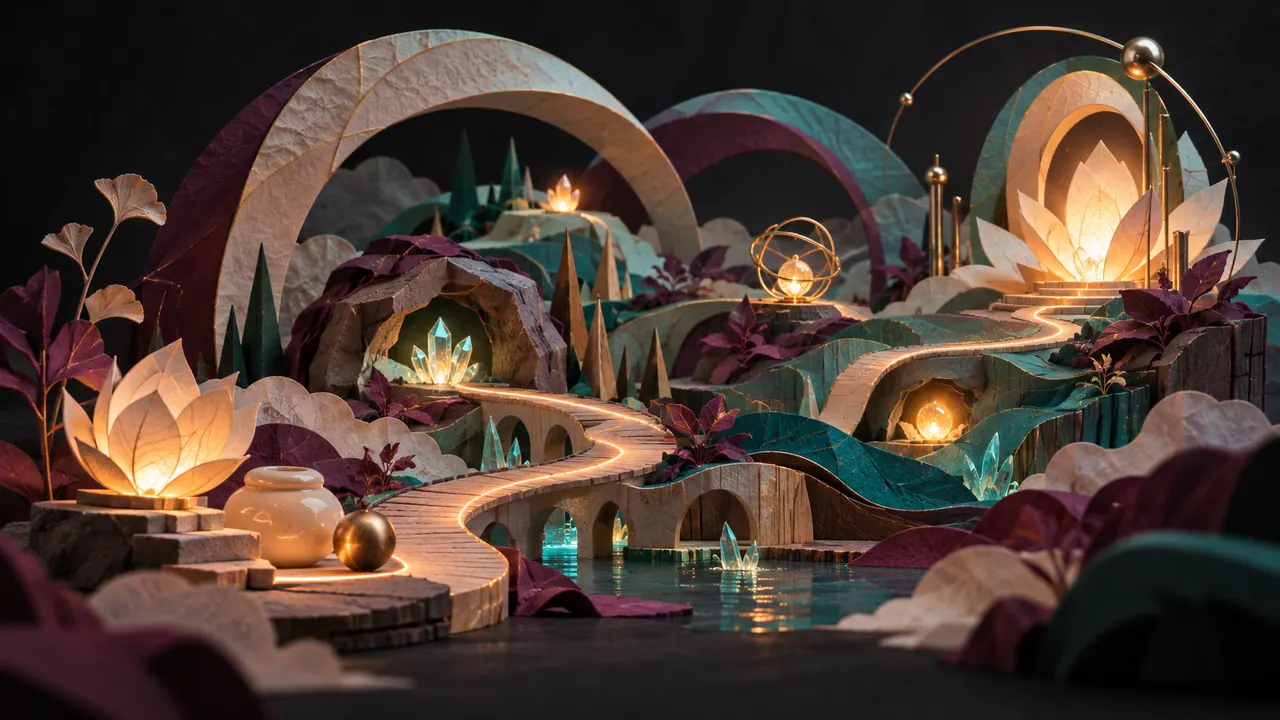
Games & Worlds · ICUNI Games
Luminae
A game concept built around discovery, atmosphere and imaginative play.
The build story 6 minute read
Luminae: Live a Life Where the Dream Changes with Your Days
At a glance
- Purpose
- A game concept built around discovery, atmosphere and imaginative play.
- The build
- A game experience focused on exploration and a distinct visual world.
In this story
By Menelek Makonnen · ICUNI Games
A LoreMaker life-simulation workspace where daily attention, social comfort and a city's approaching fracture become systems the player can inhabit.
Luminae lets you explore a fictional life where your daily choices can nourish a dream or gradually pull you away from it. It is a first-person, low-poly life-simulation workspace: leave school, find your place in a hidden city, practise abilities and wake each morning to another decision about what matters.
A dream written on a character sheet is easy to maintain. It sits politely in a box while the player does everything else. Luminae asks a less convenient question: what happens to that dream when the life around it keeps offering another way to spend the day?
I built Luminae within the LoreMaker universe, in a hidden city of magically empowered Archumans. For somebody drawn to life simulations and worlds with internal rules, the appeal is the connection between an ordinary day and a purpose that changes through living it. A more comfortable life may make a different choice tempting tomorrow.
The fiction describes a city of two million. The simulation seeds a much smaller cast of roughly two hundred characters. Those are different scales: one establishes the world, while the other is a manageable model for exploring its behaviour.
Leave school with a consequential choice
The opening places the player at Verrun Secondary on the threshold of adulthood. At that stage, the visible dreams are tiny motes. The player can explore and speak to figures before leaving through the school gate.
The coin ceremony then introduces a central social choice. The coin's role belongs to status, comfort and the truths beneath the city; it does not select a combat class or unlock the right to have a dream.
That separation is important to the design. Social standing can affect the pull of a daily decision without becoming a magical permission slip for every other system.
The workspace moves from that opening into a city with contrasting districts: the warmth of Il and the colder, more prosperous Ninth Spire. The environment and interface give the player a context for the numbers, rather than asking a character sheet to carry the whole world.
Decide what the dream gets from this day
Each Morning Question returns the character to their dream. Drift, comfort, prosperity, mood and the nature of that dream influence whether they follow it today. For the player, the choice has a history: yesterday’s comfort or neglect can shape the pull of the next morning.
That creates a loop rather than a one-time personality selection. A character is not permanently defined by clicking “ambitious” at the start. Daily conditions can pull them towards or away from their dream.
At night, reconciliation accounts for what happened. Conjuring after a day of following the dream can improve its health and reduce drift. Strained reconciliation and missed conjuring have different effects.
Grower dreams can increase in scale; Shifter dreams accumulate catalytic pressure. Those mechanics give the dream a state that can change through lived behaviour.
The system is deterministic given its seed and choices. It does not require a model to invent the consequences every time a character goes to sleep. That makes the causal relationships something I can examine and refine.
Let practice and purpose develop separately
The workspace also has Energis abilities: Kinergis and Potengis, developed through use. Movement and pulse controls give that progression a physical expression.
Dream progression remains a separate axis. The design does not require a class selection, and one system does not mechanically gate the other.
I wanted that distinction because a person's talent and their purpose are related without being identical. A game becomes more interesting when it can represent both without compressing them into one score.
The city adds factions, careers, districts and a calendar moving towards a fictional civil conflict. These systems give the player's routine a wider pressure. The world is not simply standing still until the next personal milestone.
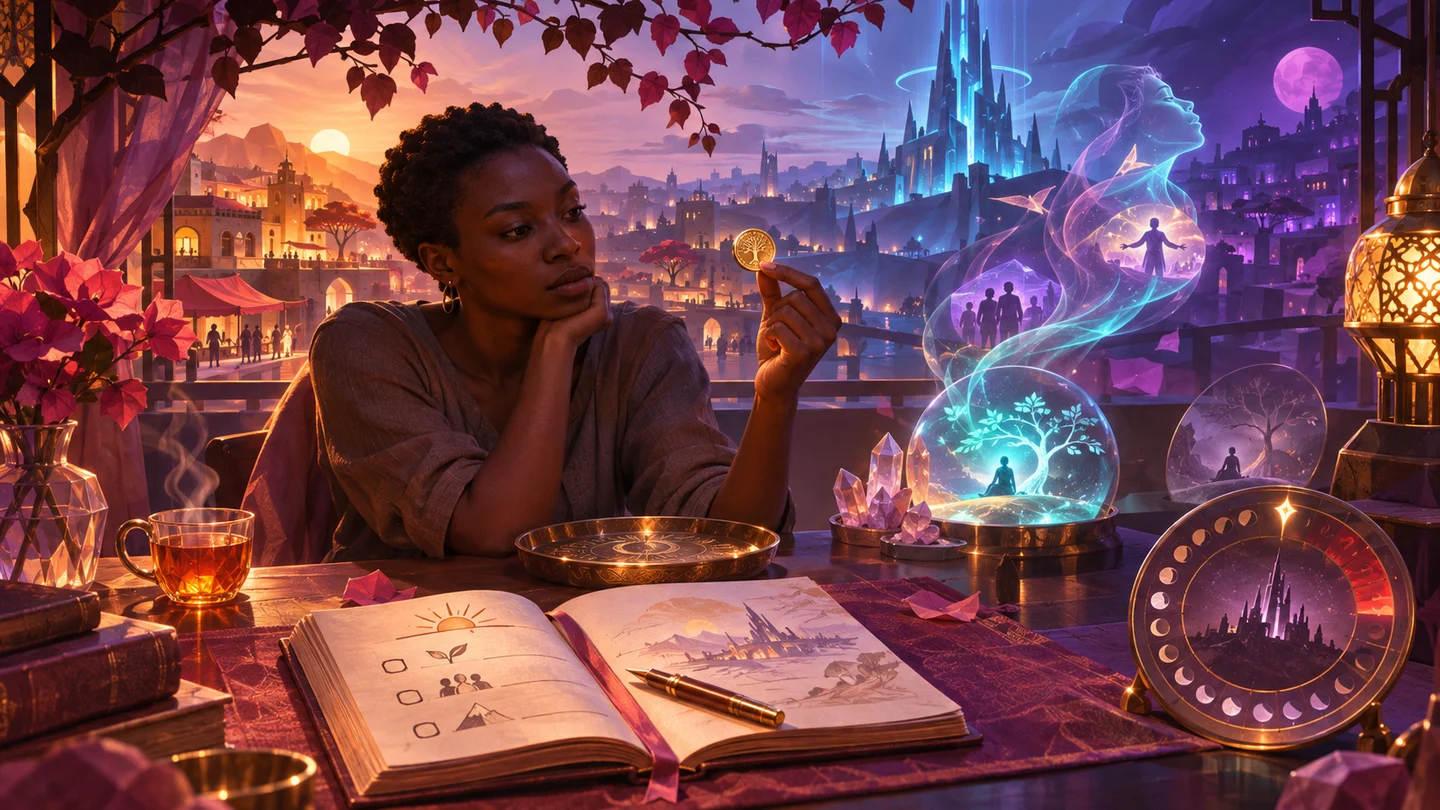
Daily choice, practice and night reconciliation within a changing city.
See the life changing around you
The Three.js layer constructs the city and its low-poly forms in code. Daylight, fog, lanterns and windows change with time, while dream visibility follows the character's state.
The opening limits a younger character's vision to motes. Later visibility broadens, but night and drift still matter. A dream can therefore be present in the simulation while the player cannot see it in the same way.
That is the sort of connection I value in game development. A visual effect becomes more meaningful when it expresses a rule the player is living with, rather than being a separate decoration.
The interface uses dark purple glass, gold, rose, ember and dream-cyan accents. Dream health, skills, standing, journal and event feed give the player ways to inspect the life behind the scene.
Give the world rules beyond what the camera can see
The simulation lives in a headless JavaScript ES module. Characters, dreams, factions, districts, economy and calendar are data and rules before they become geometry.
The browser layer combines that core with a game script and HTML shell. The build process is intended to embed the same core into the single-file artifact, while browser storage supports continuing a saved life.
That separation helps me build the life before polishing its view. The core can describe a day without needing a camera; the renderer can express it without becoming the authority for what happened. It also lets me ask whether a dream’s change follows from the character’s choices, rather than whether the glow looked convincing. I am susceptible to a good glow. The rules should remain less impressionable.
LoreMaker's canon boundary also matters. The game draws from authored world rulings under my creative authority. A simulation outcome should be understandable as an outcome of play, rather than silently rewriting every underlying rule of the universe.
The result is a concrete loading limitation: that artifact is not fully self-contained or reliably offline, and the offline build cannot currently complete from the files present. Earlier WebGL captures and test records do not supply the missing dependency.
I keep that limitation alongside the simulation story because the player's first experience includes whether the game can load. A strong core deserves an equally coherent package.
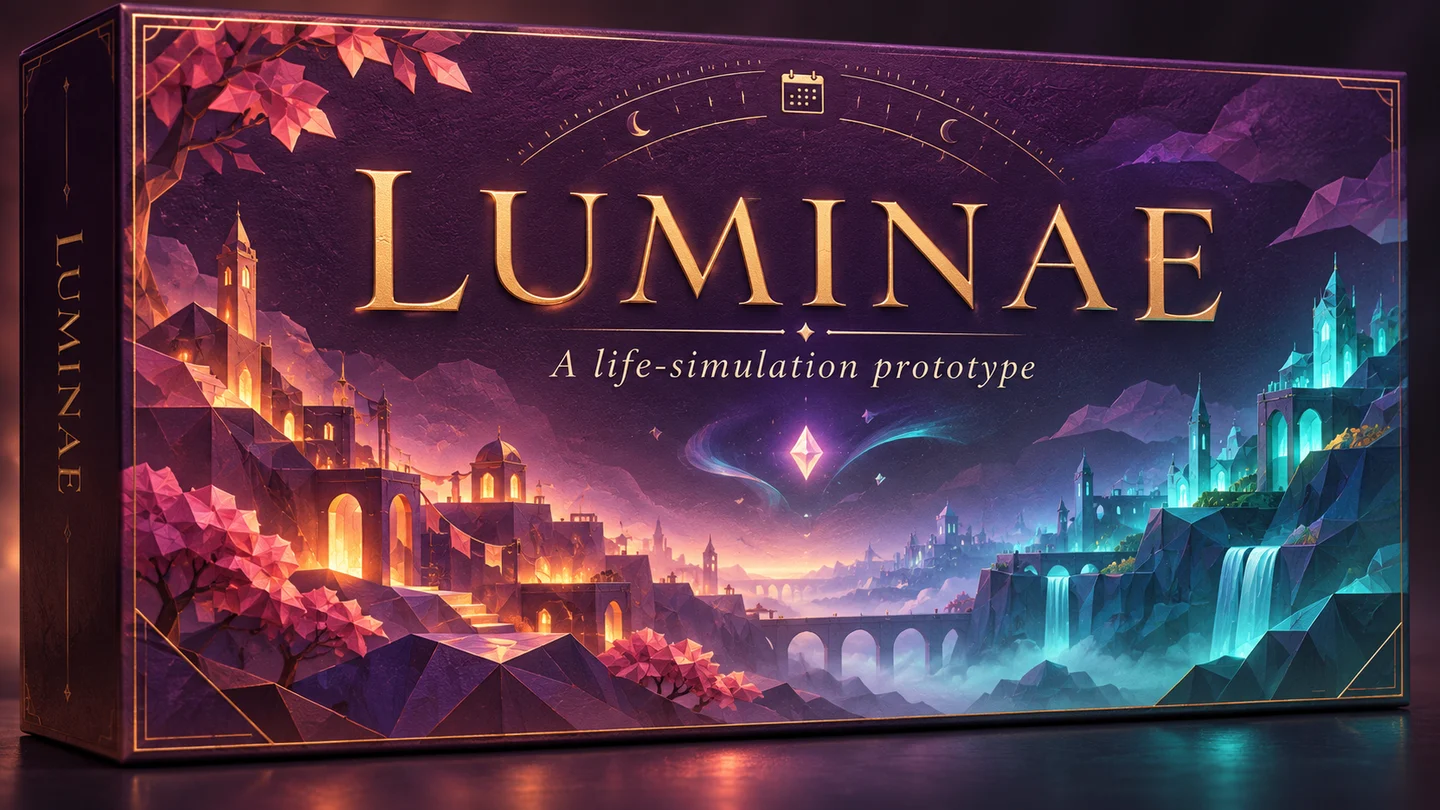
Luminae: a life-simulation workspace.
Give the dream a day to survive
Luminae explores a life through repeated decisions: leave school, choose a social position, practise, follow or neglect a dream, reconcile at night and wake into a city that has also moved.
The dream no longer sits safely in a character-sheet box. It has a day to survive, and that is where the interesting game begins.
Back to the story’s beginning ↑
Project details
A game experience focused on exploration and a distinct visual world.
Inside the workflow
A game experience focused on exploration and a distinct visual world.
Have something in mind?
Bring the problem, the audience and what you want to make possible.
Discuss your project