Business Systems · ICUNI Consult
Mina Hair Sensation
A branded hair-shopping experience that helps people find the right product and variant.
The build story 6 minute read

Mina Hair Sensation: Find Your Style and Keep the Choice Yours
At a glance
- Purpose
- A branded hair-shopping experience that helps people find the right product and variant.
- The build
- A hair storefront with variant pricing, a deterministic product finder, guest/account checkout, payment verification and role-scoped operations.
In this story
By Menelek Makonnen · ICUNI Consult
Mina Hair Sensation helps customers find hair products that fit their preferences, compare suggestions, choose a configuration and continue into checkout without losing those choices. I built a boutique shopping experience with a guided Finder, product options, favourites and guest or account checkout.
A customer may know the texture or feeling they want before knowing a product name. They may also want to browse, save a possibility and return later. I designed those behaviours into the journey, bringing the visual care of a boutique to the practical work of choosing and ordering.
Then comes the less photogenic part: the software must remember which texture, length and quantity the customer selected. My gold typography is committed to looking sophisticated. It has declined responsibility for arithmetic, so I built the product and payment state to do that work.
Start with the style you want, even before you know its name
The Finder asks about texture, desired wearing feeling and price range. It then scores the bundled catalogue and returns three suggestions, with reasons drawn from matching attributes and displayed price.
A shopper can use those suggestions as a starting point, then inspect the options rather than accept an unexplained “perfect match.” The ranking is local and rule-based: texture, tags, everyday stock suitability, budget brackets and featured status contribute. Budget is a preference in that score, not a guarantee that every suggestion falls inside a strict cap.
That makes the feature useful to explain. A customer can begin with how they want the product to feel instead of knowing the exact catalogue name. The application gives that preference a route into the collection without pretending to analyse a face or summon an AI stylist from behind the mirror.
The visual entry effect has its own role. HairReveal draws procedural straight or curly strands on a canvas. It is an animated introduction, with skip and release behaviour, rather than a virtual try-on or camera feature. Keeping the distinction clear lets the interaction remain playful without acquiring imaginary technology.
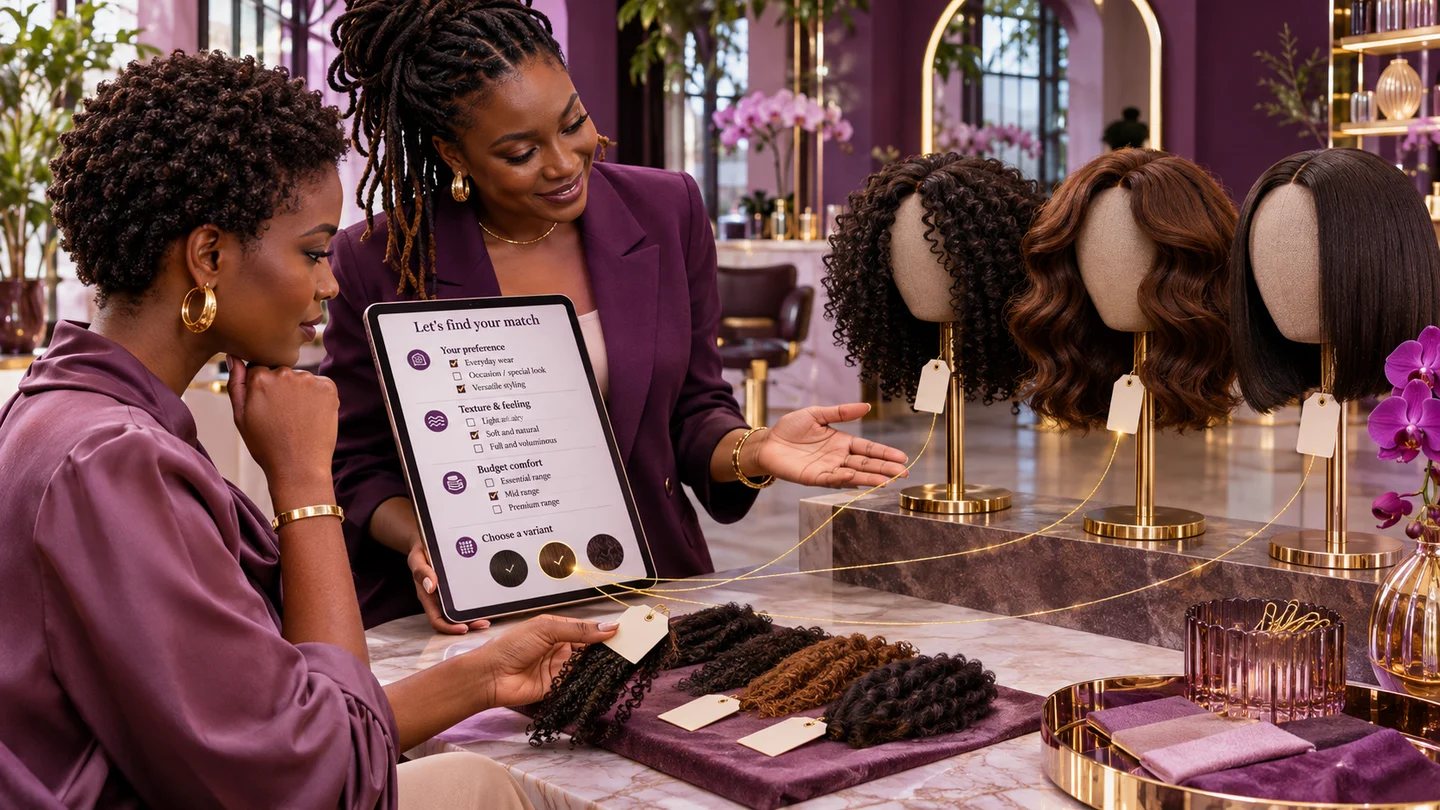
Discover a direction, compare suggestions and choose a configuration.
Compare, save and return without losing your choices
Product options begin with defined defaults, and variant-price rules match the selected values where a corresponding combination exists. The cart identity combines the product and its selections.
That means two different configurations can remain separate lines, while adding the same configuration increases its quantity. It is a small piece of state modelling with a direct commercial purpose: “another one” and “another version” are different requests.
Cart, wishlist and guest-order context have browser-local persistence, and recently viewed products remain bounded. Authenticated wishlist changes can update immediately and roll back if the request fails. Local continuity and an account-owned record have different responsibilities, even when the heart icon looks the same.
That supports a real shopping rhythm: open an item, try its options, keep a favourite, compare another and come back. The cart retains the specific choice rather than merely remembering the product photograph. I want the system to listen beyond the moment when the customer clicks a very attractive card.
Take the chosen configuration through to checkout
Live checkout begins by creating a payment intent from the cart and contact context. The server resolves current products, validates allowed selections, calculates the price and adds the configured delivery fee. The interface's displayed amount is not the final authority merely because it is in a larger font.
The saved intent carries that checkout context forward. Paystack opens through its access code, and the application polls verification within a bounded wait. A pending or processing result remains pending; order creation waits for the paid result.
For the shopper, the important part is knowing whether to wait or continue. Verification checks the processor response, reference, exact minor-unit amount and currency; an uncertain result asks the customer to retain the reference. I do not want a missing acknowledgement to teach someone that payment is a button-mashing minigame.
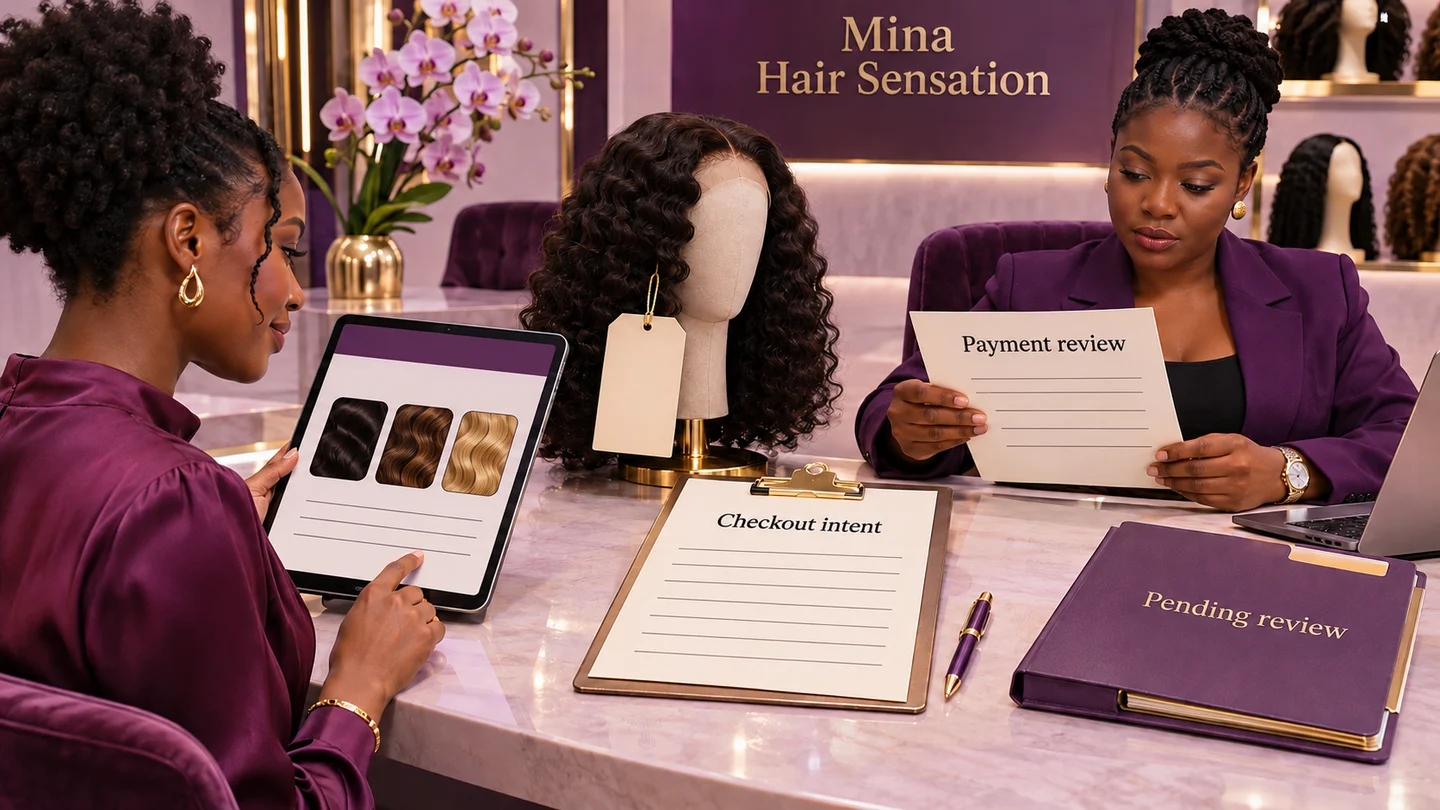
Preserve the choice, verify the required payment state and create the corresponding order.
Buy as a guest and keep a path back to your order
Sign-in is optional for checkout. Delivery details and the email supply the working context, and a later authenticated account using the same normalised email can link eligible guest orders.
That removes an unnecessary interruption from the shopping journey while preserving a path into repeat use. A customer can decide on the product before deciding whether to maintain another account and another set of tabs dedicated to remembering the account.
Payment status remains separate from fulfilment status. Product availability also uses labels such as in stock, low stock or made to order; this implementation is not a demonstrated quantity-reservation warehouse engine.
One content connection remains to finish: the shopper currently sees a bundled catalogue, while staff editing endpoints and a catalogue API exist separately. Connecting those updates to the public view is further integration work. Until then, staff edits should not be described as automatically refreshing what a shopper sees.
What I learned building a boutique beyond its homepage
I used TypeScript, React and Vite for the interface, with Google Apps Script and Google Sheets supporting commerce and operations. Paystack supplies the configured payment-processing route. Role-aware backend operations distinguish public shopping from staff actions and settings.
The visual system pairs Playfair Display and Inter with pale orchid, deep violet and gold. The existing hair-like SVG identity, mobile bottom navigation, cart drawer and checkout modal make it a boutique experience rather than an anonymous catalogue with a new heading pasted over it.
There is also a separate demo lane. It can create a local sample order without spending money.
Building this taught me to follow the customer's decision past the beautiful part. Recommendations need reasons, two configurations need distinct cart identities and a payment result needs to belong to the same order. Brand design includes how those moments feel. I enjoy giving the interface character, then doing the state modelling that helps it keep listening.
Keep listening after the choice
Mina Hair Sensation gives shoppers a way to discover a style, compare possibilities and carry a specific choice into checkout. The Finder makes starting easier; saved favourites and configured cart lines support the decision; guest checkout removes an unnecessary interruption.
The gold typography can keep its job. The checkout has its own work to do, and it needs to remember what the customer chose.
Back to the story’s beginning ↑
Project details
A hair storefront with variant pricing, a deterministic product finder, guest/account checkout, payment verification and role-scoped operations.
Inside the workflow
A hair storefront with variant pricing, a deterministic product finder, guest/account checkout, payment verification and role-scoped operations.
Have something in mind?
Bring the problem, the audience and what you want to make possible.
Discuss your project