
Business Systems · ICUNI Consult
MoMo Statement
Making mobile-money messages easier to turn into clear, reviewable records.
The build story 6 minute read

MoMo Statement: Turn Mobile-Money Messages into a Record You Can Search and Share
At a glance
- Purpose
- Making mobile-money messages easier to turn into clear, reviewable records.
- The build
- Provider-specific parsing turns Ghanaian mobile-money SMS text into reviewable records. Deduplication and filtered exports are separate steps, with storage-failure recovery and an explicitly started Messages Web capture option.
In this story
By Menelek Makonnen · ICUNI Consult
MoMo Statement helps you turn Ghana mobile-money messages into a searchable record of the transactions those messages describe. Paste SMS text, import an XML backup or use the optional paired Messages Web helper, review the candidates and choose what belongs in your local statement.
If you need to find a payment from three weeks ago, a long message thread makes a poor filing cabinet. The amount might be memorable. The date might be approximate. Your phone has faithfully kept everything and would now like you to scroll through the entire geological record of your lunch purchases.
I built MoMo Statement to give those messages a more useful second life. You can find records by text or date, inspect incoming and outgoing flow, and export the scope you have reviewed. The original message stays attached so you can check what a row is based on. It is your reconstructed record, not an official carrier statement, and it does not move money.
Get the supported messages into a reviewable statement
The parser handles explicit MTN, Telecel and AirtelTigo message patterns. It reads known amounts, counterparties, references, fees, tax and reported balances. Sender information can select the provider first, with fallback across the supported parsers.
Promotional filtering removes certain messages that lack transaction signals. Unsupported formats remain a coverage limitation. A parser should be confident about the patterns it recognises without awarding itself fluency in every sentence a provider may ever invent.
Source dates are retained when supplied and usable. Missing timestamps remain marked inferred or unavailable. That matters when a record is filtered by date or an insight depends on the time of day. The system should not give an undated message today's birthday simply because it arrived in the parser today.
Before commit, the import screen stages candidates with their raw source and review reasons: missing dates, balances, counterparties or references, and possible similar payments. The user chooses what to add. Review labels are advisory; new rows begin selected, so the person's inspection is still consequential.
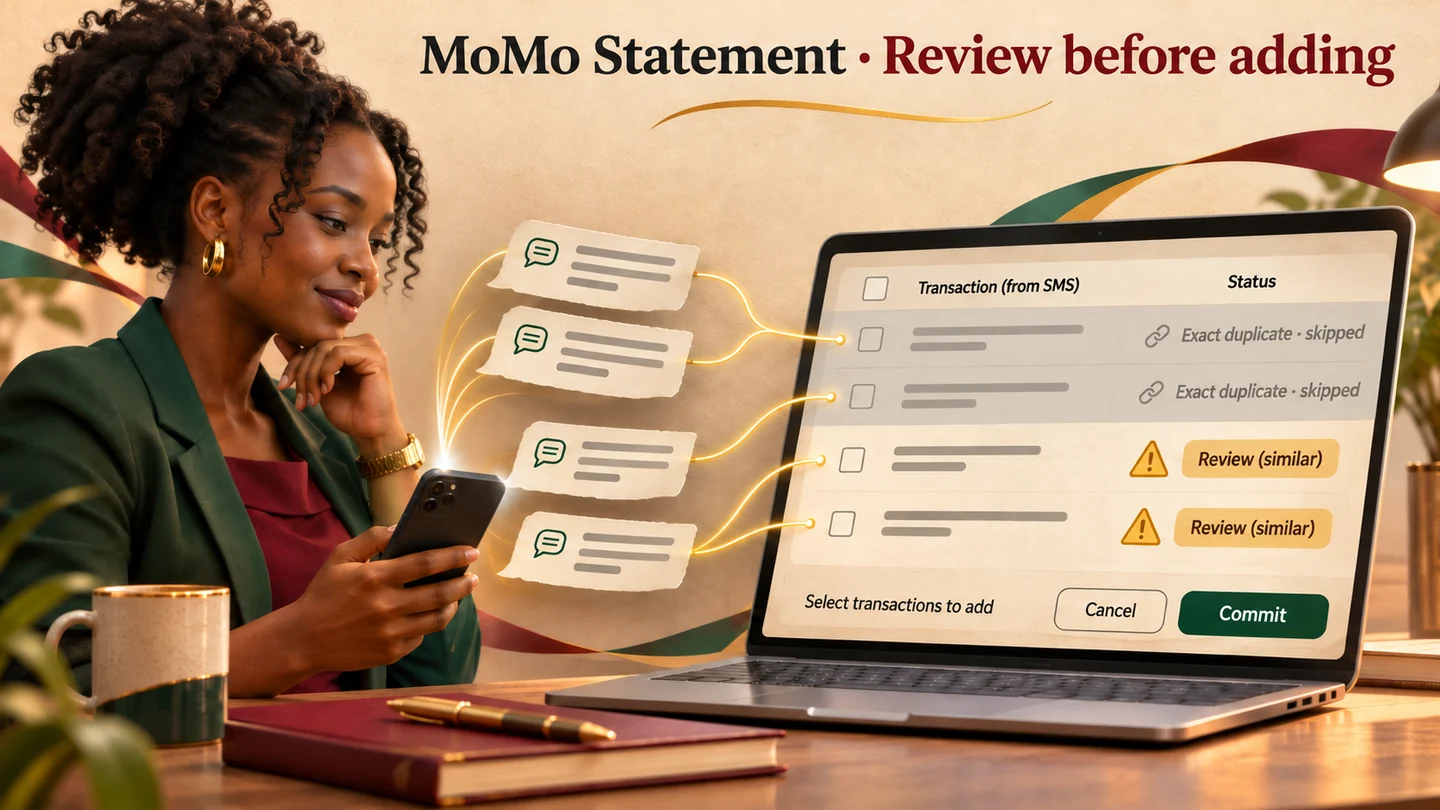
Import workflow: parse supported messages, inspect the source and review selected candidates before adding them.
Keep real repeated payments while finding duplicate records
Exact duplicates use provider and transaction ID. A repeated ID in the incoming batch or existing workspace can be skipped. Records without IDs use a similarity key, but a similar payment is flagged and retained.
That distinction prevents a tidy-looking deduplication routine from quietly removing legitimate repeated payments. Two equal amounts to the same person can mean the same record twice. They can also mean you paid the same person twice, an entirely different conversation with considerably less enthusiasm.
Categories help a user look through the record without reading every message again. Explicit rules suggest treatment for credits, airtime and some merchant names. Amount and genuine-source timing conditions can flag unusual activity for a closer look. These are sorting aids and review prompts, not fraud detection or an authoritative classification of a business expense.
Bring paired message history into the same review process
The optional browser helper works after the user pairs Google Messages through Google's own page and explicitly starts capture. It loads rendered conversations, traverses relevant message containers within bounds and sends local batches into the same parser.
The app keeps pending candidates separate from the statement. Completion or stopping preserves them for the user's selected commit. A traversal ending means that bounded capture ended; browser changes, virtualised history and its limits can leave gaps.
I wanted capture to reduce the burden of moving messages into the workbench while preserving the point where the user decides what belongs. Automatic collection and automatic acceptance should not accidentally become the same button.

Messages Web workflow: explicitly start a paired, bounded capture, then review pending rows before commit.
Keep your work available when browser storage fails
MoMo Statement stores its transaction workspace in the browser. If the original storage read fails, it permits in-memory work while blocking writes that could overwrite uncertain stored material. If a later save fails, the active rows remain visible with an unsaved state.
The layout keeps Retry save and Export now available. Recovery rereads stored records and reconciles them with the current session before trying persistence. This was an important product decision: an honest warning with recoverable work is more useful than either a disappearing table or a triumphant toast.
Browser storage remains plain local storage. The separate account/backend surfaces do not currently protect, isolate or synchronise these financial records. Local processing has a specific meaning here, and the interface needs to respect its limits.
Find the payment, then share only the scope you intend
Statement filters cover provider, type, category, search and date boundaries. Search includes the source text. The selected set drives incoming, outgoing and fee summaries; net describes imported flow, rather than an independently reconciled account balance.
Export explicitly chooses the current filters or entire workspace, then a date range. CSV protects against formula-like leading characters. JSON retains raw messages and parser metadata as a full backup. The paginated PDF carries selected records with scope labels.
For a user checking a payment or keeping a personal record, choosing the scope is part of the value. You can export the relevant period rather than hand over the whole workspace. JSON is a fuller backup and includes raw messages, so it deserves careful handling. Every output is limited by what was imported: a polished PDF cannot summon an unsupported SMS from the afterlife.
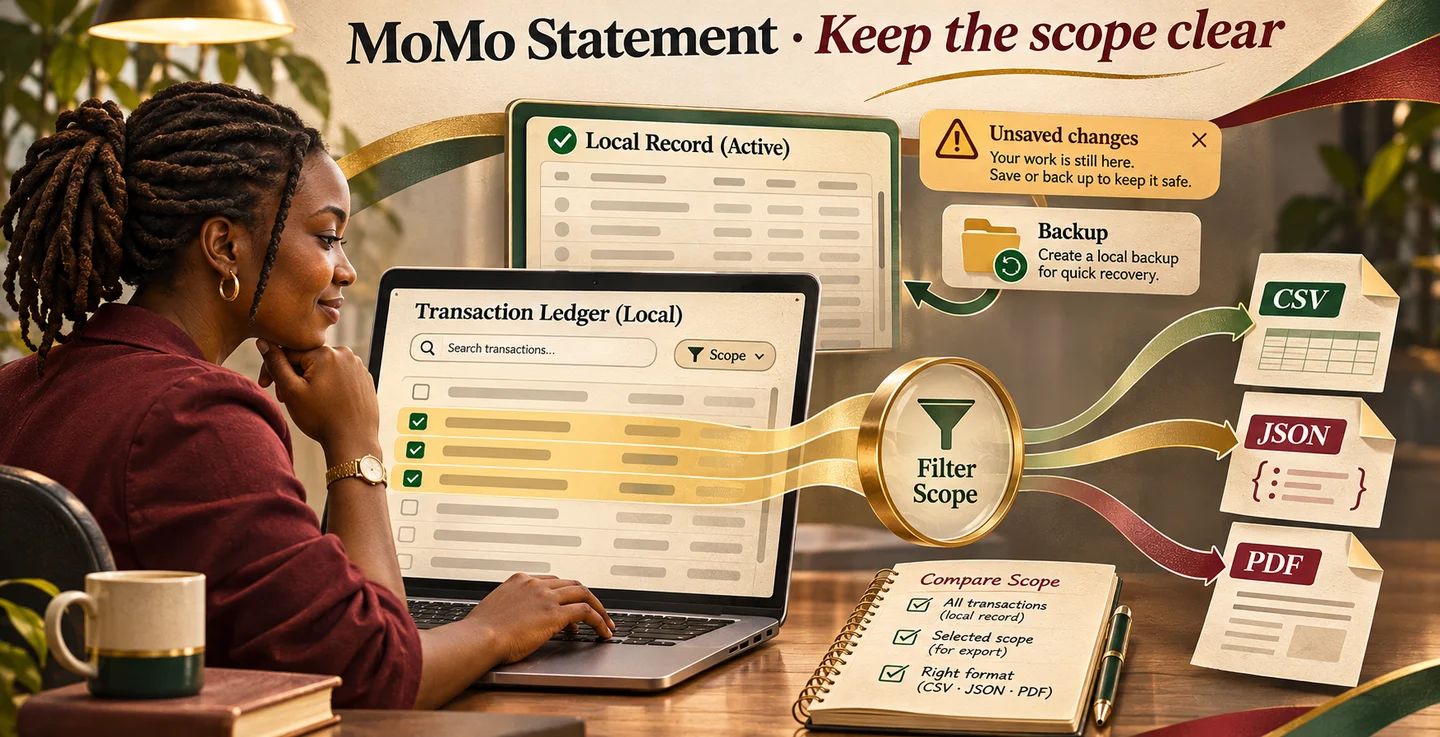
Review and export: select the record scope, inspect its summaries and choose an output, with unsaved work kept visible.
How I built a local record from message text
I implemented the app with JavaScript, React, Vite, React Router and Zustand, using provider-specific parser modules and jsPDF for summaries. The optional helper is a Manifest V3 browser extension. Warm paper, charcoal, gold and a shield/check mark give the record-focused interface its identity.
Spend less of the conversation looking for the message
MoMo Statement is for someone who has the messages but needs a record they can actually use. It turns supported text into rows you can inspect, search, filter and export while preserving the source and your choice about what to retain.
My aim was to make the phone's memory easier to work with, without dressing it up as official financial truth. The messages can keep their place in your history. Finding the right one should no longer require an archaeological qualification.
Back to the story’s beginning ↑Project details
Project context: Ghana
A local Ghana mobile-money SMS workbench with provider-specific parsing, reviewable deduplication, filtered exports and storage-failure recovery.
Design and technical decisions
Provider-specific parsing turns Ghanaian mobile-money SMS text into reviewable records. Deduplication and filtered exports are separate steps, with storage-failure recovery and an explicitly started Messages Web capture option.
Inside the workflow
A local Ghana mobile-money SMS workbench with provider-specific parsing, reviewable deduplication, filtered exports and storage-failure recovery.
Have something in mind?
Bring the problem, the audience and what you want to make possible.
Discuss your project