
Creative Tools · ICUNI Labs
Sloverb
A listening and visual-making space built around slowed music and reverb.
The build story 8 minute read

Sloverb: Shape the Track’s Mood and Build a Visual World Around It
At a glance
- Purpose
- A listening and visual-making space built around slowed music and reverb.
- The build
- A local-media player and slowed/reverb studio with YouTube import/streaming surfaces and a separate space-video pipeline delegated to MMMedia Ender.
In this story
By Menelek Makonnen
Sloverb helps listeners and music creators shape a track's speed, reverb and tone, then keep the result connected to a local library and optional music-video workflow. The Studio is for listening and audio treatment; Space Cinema builds an audio-reactive visual world around chosen local sound.
It is useful when an original track needs a different atmosphere, when I want to compare treatments or when music deserves a visual piece beyond a static cover. Presets offer a start, and direct controls let the ear do the deciding.
Slowing a song can turn three minutes into a small emotional weather system. I built Sloverb because I wanted to shape that weather deliberately, rather than export a series of files that all sound vaguely heartbroken and have no useful names.
The application brings together a player, processing Studio, acquisition tools and the separate video route. Listening, offline rendering and final video delivery still have different checks. The reverb may dissolve into the distance; I would like the job to keep a working sense of identity.
Start with a track, not a thesis in signal processing
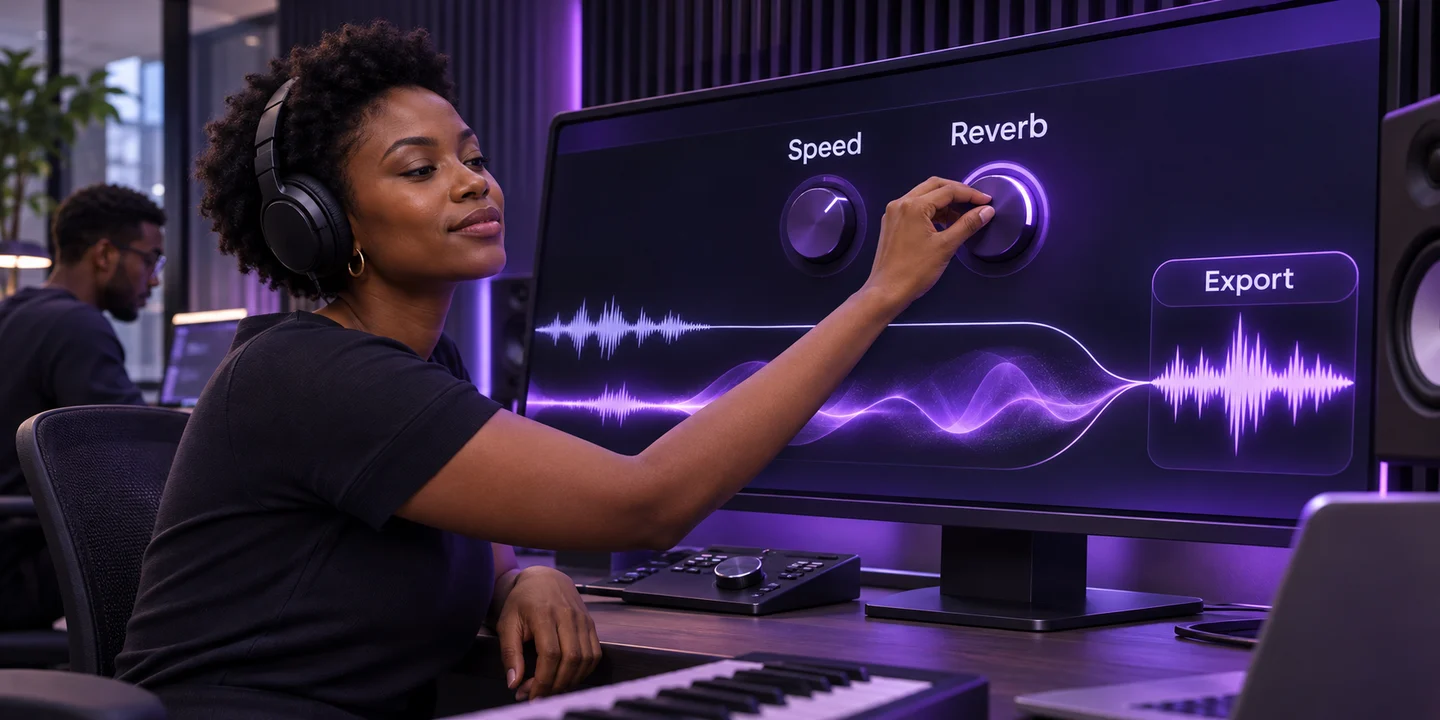
In the Studio, I can drop in a local audio file or choose one through the picker. A video source can have its audio extracted with FFmpeg before decoding into the Web Audio workflow. The first decisions are recognisable: speed, reverb mix, decay, room size, bass and warmth. Stereo width, pre-delay and vinyl texture allow finer changes. Presets provide starting positions.
The interface uses midnight surfaces and violet highlights to let the waveform and controls carry the attention. React handles the working state inside Electron. Underneath the controls, Web Audio supplies the signal graph. This is an audio application built from explicit processing stages, not a button claiming to understand a song’s soul. Songs have enough people making that claim already.
A practical use case is a creator preparing an alternate mood for an original track: reduce the playback speed, bring in a long room, then pull back the wet level so the vocal remains intelligible. Another is exploratory listening, comparing a preset with a small manual change rather than exporting a succession of anonymous guesses. The tool gives the ear an adjustable instrument panel.
Give the atmosphere an actual signal path
Sloverb’s live processing includes bass shaping, warmth filtering and compression, generated convolution reverb, stereo handling and filtered noise for the vinyl effect. Dry and wet paths matter because an effect needs to be mixed with the source, rather than merely declared present by a glowing knob. Decay and room choices shape the generated impulse response, while pre-delay changes the relationship between the direct sound and the reflected sound.
Slowing playback can mean dropping the pitch or trying to keep the original voice. Sloverb treats those expectations differently: live pitch preservation uses an HTML audio element, while simple buffer playback follows the Web Audio route. The technical choice is there because the listener has asked for a different result, not because I gave one knob two incompatible job descriptions.
For export, an OfflineAudioContext renders the processing into audio data. The WAV path writes 16-bit PCM; optional FFmpeg routes produce MP3 or remux processed audio with the original video into MP4. Desktop exports are saved through the application’s file workflow, while browser behaviour uses a download.
This also explains why I treat presets as recipes, rather than mastering certificates. An effect setting can be repeatable without making every source recording sound good. A clipped input remains a clipped input with more expensive echoes. The creative decision still belongs to the person listening.
Acquisition should end in a usable library
The route offers MP3, WAV and MP4 choices and saves into the Sloverb music area. It uses the media identifier and requested format to avoid repeating an existing item, finds the actual output and records it in the library. A failed thumbnail should not invalidate a usable audio file. The playlist flow first lists items and lets the user choose a subset, then processes that selection serially and reports partial results rather than turning one failure into a fictional clean sweep.
From there, local tracks become player material, with queue ordering, drag-and-drop and native desktop controls. Windows media buttons, tray behaviour and media keys serve different interaction contexts. The collapsible sidebar reduces to a narrow rail; its edge has a resize-style cursor, but the implementation is a toggle rather than a free-width drag. I describe the interaction the product actually provides, because a cursor should not write the feature list.
For a music creator, that library is the useful connection between experiments. A source track, a slowed variation and a visual treatment can remain part of a working collection instead of scattering into whatever folder the operating system offered last Tuesday.
Space Cinema is its own production workflow
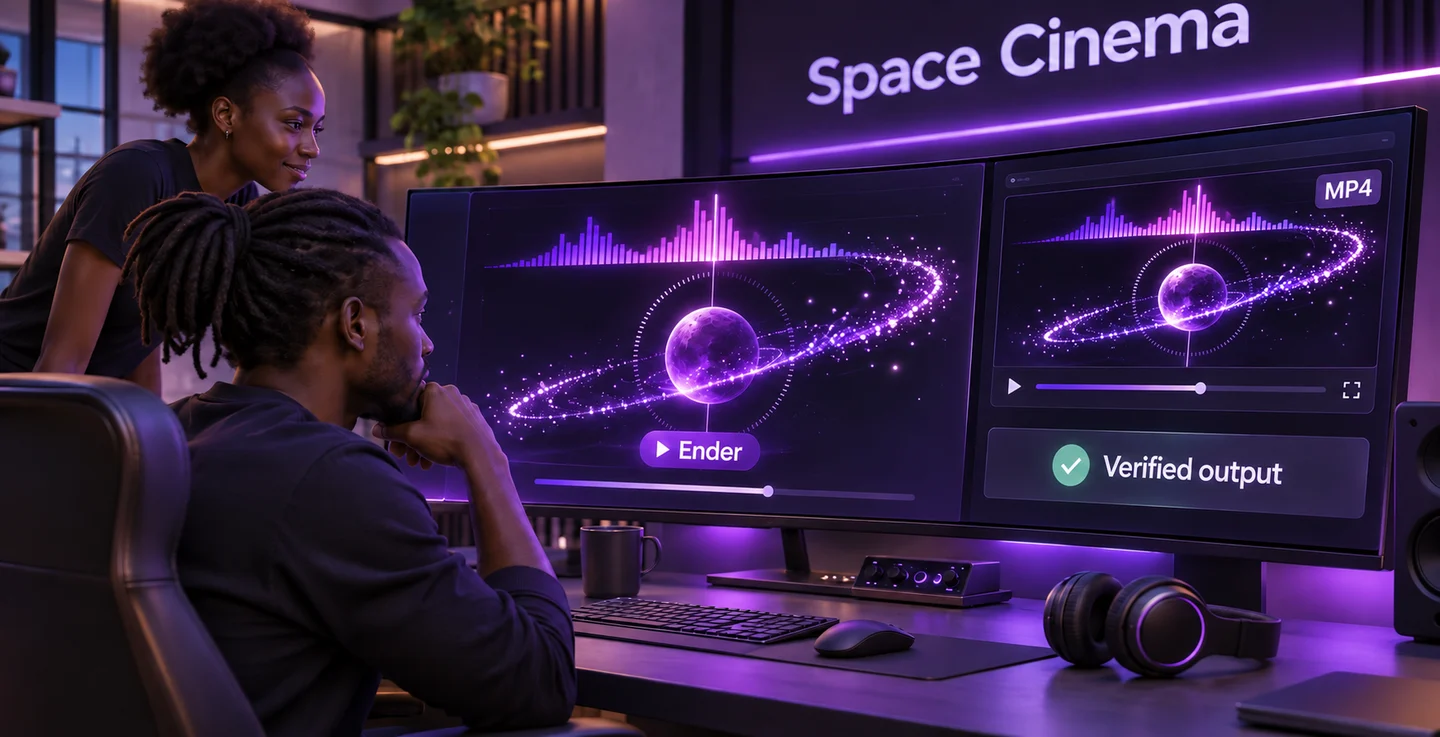
Space Cinema takes local audio from the current track, the library, deduplicated downloads or a native picker and uses it to drive a music-video scene. It has four canvas visualizers, portrait and landscape choices, resolution options, flight routes, event controls and credits. The creative surface is about movement through an audio-reactive world, not merely placing a waveform beneath a static cover.
I keep its production path separate from casual playback. The chosen file becomes a scoped source token checked against its canonical path, size and modification time. The output folder has its own checked token. Expired or changed sources, invalid output paths, excessive activity and a conflicting active Ender job are conditions the workflow can reject before writing a misleading result.
FFmpeg prepares stereo PCM audio at a defined sample rate. An immutable job specification pins the inputs, a seed and relevant hashes. Spectrum data is derived from the actual PCM and used on a fixed frame schedule. The canvas scene is rendered frame by frame, with WebCodecs encoding an IVF intermediate in supported VP9 or VP8 forms. Chunks stream into the owned workspace under a size cap, rather than requiring the complete encoded movie to sit in memory until the end.
That is a different engineering problem from making an animation look attractive during playback. A repeatable render needs a defined clock, a defined source and an output whose dimensions and frame count can be checked. The scene’s movement can be imaginative; the job’s accounting should be painfully literal.
Conceptual music-video workflow.
A handoff needs evidence on both sides
Before the Ender handoff, Sloverb checks the intermediate’s dimensions, frame rate, frame count and codec. The handoff pins the job specification, PCM and intermediate hashes together with the reserved destination. Ender is responsible for the final H.264/AAC video. Sloverb then tracks the job rather than equating “request sent” with “movie finished.”
The completion path expects a compatible Ender receipt with matching destination and provenance. It also performs final decode, audio and master checks and checks that the output has not changed while it is being accepted. The resulting receipt identifies the final file by hash. Only after completion should the application offer that result as a finished video to reveal.
Cancellation is another real part of this workflow. Local work can abort the browser encoder, terminate FFmpeg, close the output handle and remove the workspace owned by that job. Prepared handoffs can be recovered through the registry, while malformed provenance is a reason to fail rather than a cue to improvise trust.
What the combination taught me
Building Sloverb brought together React interaction design, browser audio, native files, command-line media tools, canvas animation and encoding. I enjoyed making those disciplines serve one recognisable intention: hear a track differently and, where appropriate, make a visual piece around it. The integration is useful when the person can follow that intention to a particular output.
It also sharpened my judgment about boundaries. A live effect has a listening contract. An offline export has a file contract. A video handoff has a provenance contract. Sharing a violet interface does not make those contracts interchangeable. I want the application to feel coherent because those responsibilities fit together, rather than because a single success toast has been asked to cover an alarming amount of ground.
The current implementation still deserves the ordinary scrutiny of audio and video work. A load failure can clear processing without providing the strongest explanation, and quality depends on the source, treatment and accepted output. Those are concrete product lessons: make failure legible, keep the artifact traceable, and leave aesthetic judgment with the listener.
Let the atmosphere linger
Sloverb gives me a place to listen, slow, colour and organise sound, with a separate path for making an audio-reactive video. I can start with a preset, make the treatment particular and keep the media connected to the process that produced it.
Building it reinforced how creative control and exact delivery support each other. The ear chooses the atmosphere; the job records which source and settings became the file.
The reverb is welcome to linger long after the note ends. The application should still remember which note it was.
Back to the story’s beginning ↑Project details
A local-media player and slowed/reverb studio with YouTube import/streaming surfaces and a separate space-video pipeline delegated to MMMedia Ender.
Inside the workflow
A local-media player and slowed/reverb studio with YouTube import/streaming surfaces and a separate space-video pipeline delegated to MMMedia Ender.
Have something in mind?
Bring the problem, the audience and what you want to make possible.
Discuss your project