
Games & Worlds · ICUNI Games
Smartphone Dare
A party game concept that turns phones into prompts for playful challenges.
The build story 6 minute read

Smartphone Dare: A Phone-Themed Party Game with Room to Pass
At a glance
- Purpose
- A party game concept that turns phones into prompts for playful challenges.
- The build
- A social game workflow for presenting challenges and guiding group play.
In this story
By Menelek Makonnen · ICUNI Games
A mobile-first party game about drawing a challenge, choosing your response and keeping control of your own phone.
Smartphone Dare gives friends a phone-themed party-card game: choose a session, draw a challenge and decide whether to accept, skip, pass or leave. It is a mobile-first local game about anticipation and shared reaction. The app does not inspect the contents of anyone’s phone.
A phone can arrive at a party carrying years of messages, photos and questionable app choices. That does not mean it has volunteered to become the evening’s public exhibition.
I built it for that familiar moment when a group wants a shared activity without learning a complicated rulebook. Setup decides which kinds of challenge belong in the room; each reveal leaves space for the person to choose their response. The phone is the theme, rather than a collection of evidence the game demands to see.
The important design choice is that participation remains voluntary. A limited skip is part of the game economy. Pass is a separate action, without penalty or an explanation requirement. An immediate exit clears the visible challenge and returns to the splash screen.
The game can create anticipation without making access to someone's private life the entry fee.
Set the room before drawing the card
Setup offers modes, categories, a heat range, player names and custom dares. Modes provide different category and intensity presets; a custom setting gives the group more direct control.
The categories use familiar parts of a phone as their organising theme. That makes setup a meaningful conversation before the first reveal, rather than a series of surprises the group never agreed to encounter.
The opening notice gives that conversation a clear boundary: keep your own phone, and do not expose private, intimate, financial, location, security or non-consenting third-party material.
That notice is not a technical guarantee about the whole experience. The app cannot know what is on a participant's device or make a room respect a boundary. It can make the choice visible and avoid turning refusal into a loss condition.
I wanted the interface to treat those decisions as part of starting the game, rather than bury them after the exciting button.
Draw from the kind of session the group actually chose
The deck combines the authored collection with saved custom entries, then filters by selected categories and heat. Eligibility also requires safety metadata that does not mark the card as disallowed.
A Fisher–Yates shuffle randomises the eligible cards. Drawing advances through that deck and records which cards have appeared; exhaustion leads to the session ending.
Reshuffling affects the remaining cards rather than quietly recycling the ones already drawn. That preserves the shape of the session: a new order is different from pretending the group has forgotten what just happened.
The authored deck classifies dare text through explicit pattern rules. That is a useful filter, not a comprehensive judgement of every possible context or custom contribution. I would not call a rule match a universal safety review.
For the group, setup needs to change what appears next. A category or heat preference should shape the deck, rather than decorate a screen the game immediately forgets. I am capable of ignoring my own settings; the software should at least make an effort to remember them.
Reveal, then leave room to decide
The draw action reveals the next card with its category and heat styling. An animation guard prevents conflicting actions while that reveal is in progress.
Accept closes the current card and returns to the next draw state. The application does not inspect their phone to verify it.
Skip consumes the configured finite allowance. Pass clears the visible challenge without spending that allowance. The message is direct: no reason is needed.
That separation is the core mechanic I care about. If the only way out of an uncomfortable prompt consumes a scarce resource, the game has attached a cost to a personal boundary. A dedicated pass keeps the social choice separate from the tactical one.
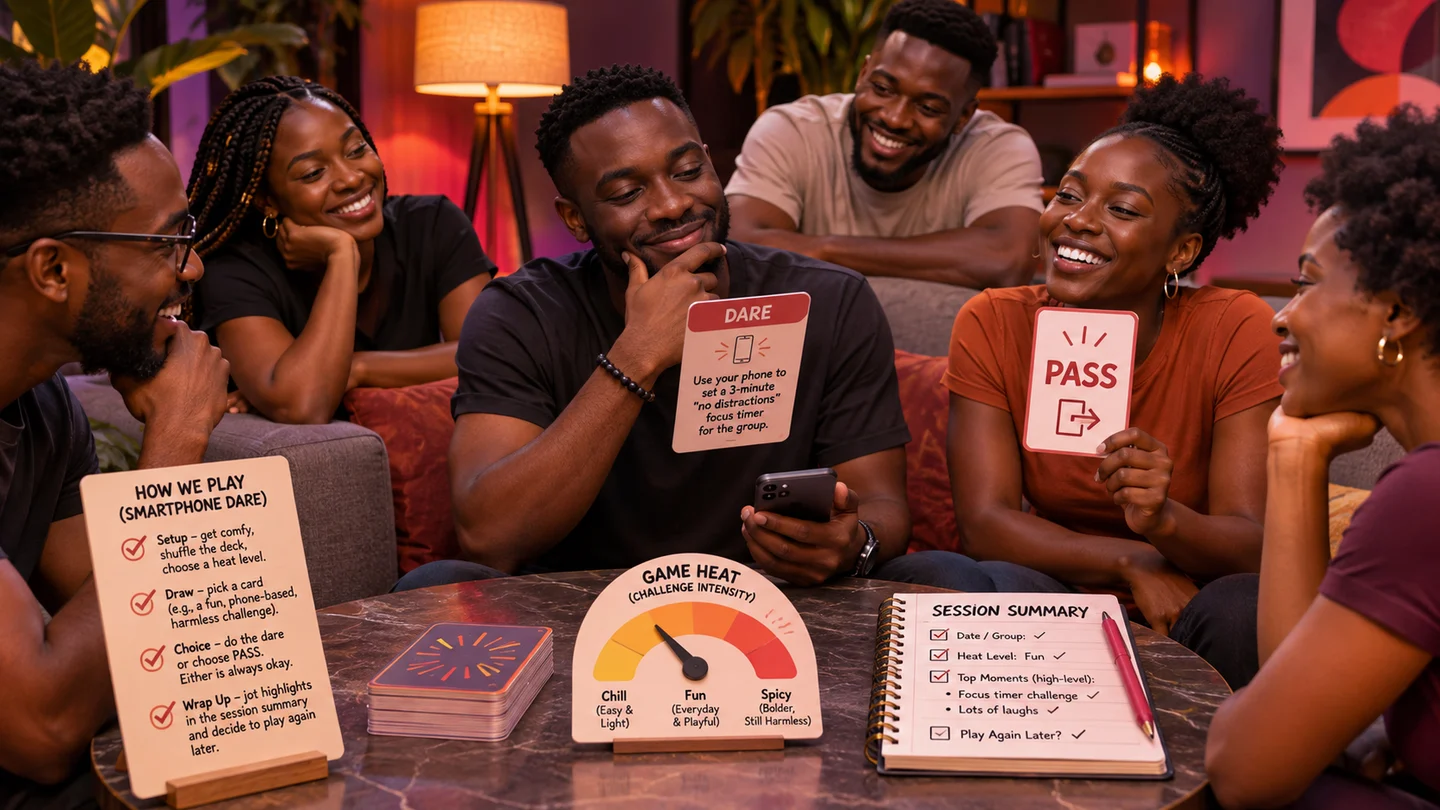
Choose the session, draw a challenge and keep acceptance, skip and pass distinct.
Make the exit easy to find
The panic control is visible during gameplay. It clears the current dare, stops the active game and returns to the opening screen.
That is more useful than an exit that requires a participant to navigate through a settings menu while everyone waits. A social tool should be quick to stop when the social situation changes.
The normal end path produces a summary of cards drawn, skips used and the heat/category mix. Those are session statistics. They are not a record of proven completions, personal disclosures or anyone's bravery.
This helped sharpen the game's vocabulary. “Drawn” is a statement the software can support. “Completed” would require evidence it deliberately does not collect.
A small local game, with clear limits on what it records
Smartphone Dare uses HTML, CSS and JavaScript with separate modules for deck rules, setup, storage, icons, animations and the main controller. It does not need a framework or a server to express this local card-game loop.
Browser localStorage retains settings, custom dares, player names and aggregate statistics. The game does not read or upload phone contents. The CSS still requests Google Fonts, so the static application should not be described as making no network requests at all.
The visual identity uses a phone-and-flame SVG, warm red, orange and yellow gradients, a dark nightlife canvas and heat-sensitive accents. Animated cards create the moment of reveal; the hierarchy keeps the response controls close.
Building it reinforced how closely interaction design and state changes depend on one another. Saying “you can pass” is only useful if Pass clears the card without consuming a skip. Saying “exit” is only useful if the game actually stops. The person should feel the choice working, not be asked to admire my intention.
The practical lesson
A party game can be playful and precise at the same time. Its appeal comes from anticipation and shared reaction; its boundaries come from giving people useful choices throughout the loop.
The controls are implemented, but a current runtime review and a full review of the challenge content remain necessary before broader release or suitability claims. Pattern-based eligibility is a useful filter; it cannot understand every group or custom contribution.
Smartphone Dare: draw, choose, pass.
Keep the exhibition optional
Smartphone Dare makes a phone-themed challenge the start of a decision, rather than an instruction the room can enforce. The player can accept, use a skip, pass freely or leave.
The phone can keep its private collection. The party has enough material without appointing itself curator.
Back to the story’s beginning ↑
Project details
A social game workflow for presenting challenges and guiding group play.
Inside the workflow
A social game workflow for presenting challenges and guiding group play.
Have something in mind?
Bring the problem, the audience and what you want to make possible.
Discuss your project