Games & Worlds · ICUNI Games
The Boarding School
A fictional Ghanaian boarding-school life sim where relationships, clubs, houses and daily choices shape a season.
The build story 10 minute read
The Boarding School: Win the Audience, Back Your House, Survive the Timetable
At a glance
- Purpose
- A fictional Ghanaian boarding-school life sim where relationships, clubs, houses and daily choices shape a season.
- The build
- A deterministic school-life and reality-competition simulation with an adult cast, dorms, classes, clubs, house points and viewer voting.
In this story
By Menelek Makonnen · ICUNI Games
A Ghanaian boarding-school social-strategy simulation where the player has to survive the institution, the audience and their own increasingly complicated reputation.
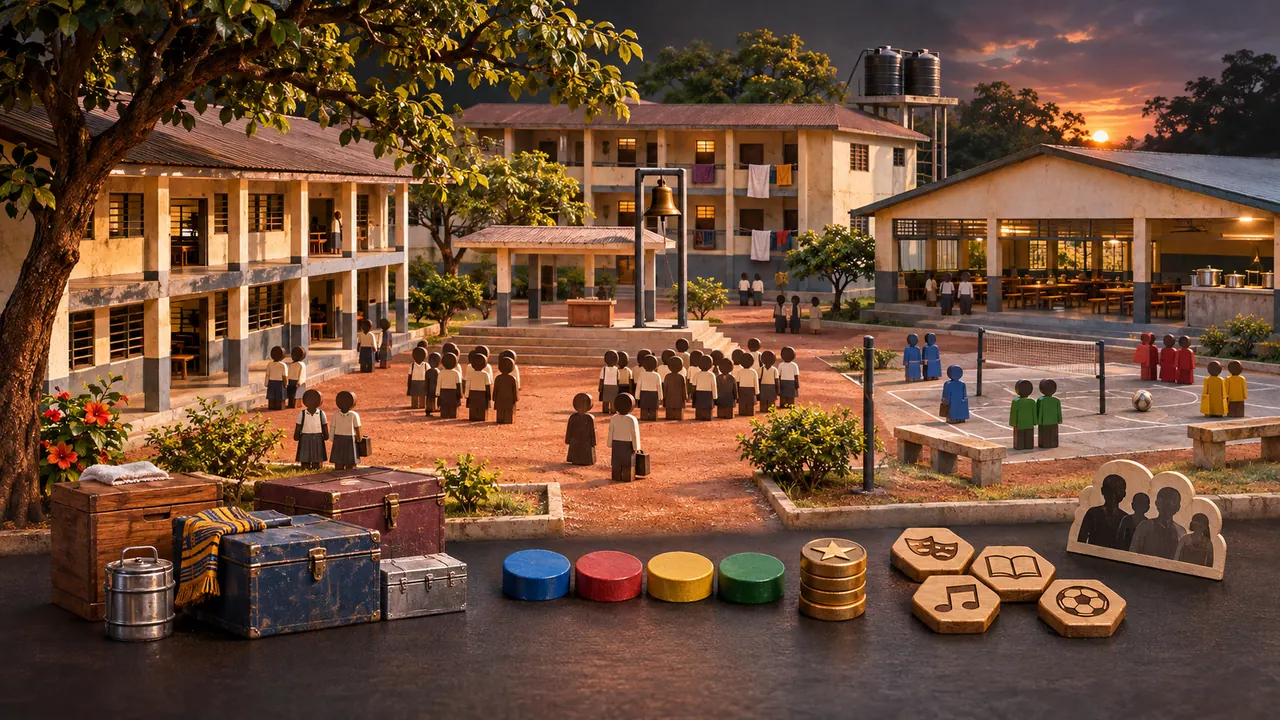
The Boarding School — Old Students Edition lets you compete through a fictional school season where friendship, house loyalty, discipline and public support do not always agree. You play an adult contestant returning to an invented Ghanaian senior high school: choose how to spend the day, manage relationships and decide which version of success you are prepared to pursue.
Returning to school with adult ambition is a dangerous combination. You remember how the rules work, and now you know how to form a committee about them.
I built the game around that collision of a life simulation and a reality competition. The adult contestants live in houses, attend classes, form alliances, face discipline and campaign for support across a compressed season. For someone who enjoys social strategy, the interest is choosing between pressures rather than finding one universally correct move.
The player is not simply trying to pass exams. They are trying to survive the school, win the audience, protect their house and build a legacy. Those four aims are deliberately capable of disagreeing.
A good day for the House Cup might be a poor day for a friendship. A moment that wins attention might attract discipline. The player needs a strategy, but the school has given everyone else one too.
Choose who you are before the school starts judging
Character creation asks for identity, house, school-year and class context, background, traits, a flaw and a personal goal. These choices put a person into the system rather than dropping an interchangeable token onto the campus.
The season has thirty contestants, including the player, across Sankofa, Ananse and Asase houses. The other twenty-nine contestants have authored starting identities and seeded routines.
They are simulated opponents and companions, not remote language-model sessions. Their behaviour follows the game's rules and state. That makes their reactions part of a system the player can learn, while leaving room for different relationships and emerging stories.
The fictional-school boundary matters. The houses, characters and campus support a game, not a recreation of an actual school's pupils or an allegation about a real institution.
The setting can draw on familiar rhythms of school life without borrowing real people's private histories.
Make a choice inside the day
Time moves through blocks such as dawn, assembly, classes, meals, preparation, entertainment and late-night activity. The player chooses actions within that rhythm.
Study, socialising, sharing food, campaigning, performance, scheming and breaking bounds create different pressures. They can affect energy, skills, relationships, reputation, tokens, discipline and house standing.
The action system considers more than a button's label. Skills, mood and energy contribute to a check, while seeded variation keeps the outcome inside a reproducible run.
Rest is a meaningful action too. It restores energy and mood instead of pretending that the most strategic player is the one who never needs to stop.
That is a useful tension for the design. The player can want to do everything, while the timetable and their own capacity insist that choosing one thing has a cost.
The time block also gives the world a rhythm outside the player. Assembly, house competition, entertainment, nominations and other scheduled events are not just pages in a menu. They arrive as the season advances.
Friendship is not one number
The relationship model has several axes, while reputation is read by several audiences. That gives the same action different social meanings.
A contestant can become useful to someone without becoming trusted. A public gesture can change how an audience sees the player while a private relationship moves in another direction.
Rumours and social memory carry events beyond the moment of the action. A successful intervention in one conversation does not reset the whole school's account of the person who made it.
The authored cast's traits, routines and starting context give those reactions somewhere to land. The simulation does not need every contestant to be equally aggressive, loyal or sociable.
After acting, you can read the feed and inspect relationships and reputation before choosing whether to reinforce or repair the position. The game gives you somewhere to look beyond the dramatic message: who now trusts you, which audience noticed, and what might the next choice cost?
That feedback is where the strategy becomes social. The question is not simply “did my score rise?” It is “who now thinks what about me, and what does that make possible?”
Give the house its own stakes
House points create a shared competition inside the personal one. The player can benefit from collective success while still having individual relationships and ambitions.
Clubs, skills, food, tokens and the chop box add smaller resources and affiliations to daily life. They make the campus something to manage and inhabit rather than a backdrop behind nomination results.
The mystery Trunk introduces moral dilemmas. Its choices belong to the same consequence system as ordinary activity, so a dramatic event should leave a trace in the season.
Discipline provides another authority. The school can respond to behaviour independently of whether the audience finds it entertaining.
This is why I did not want one master popularity meter to decide everything. A player might become well known, unpopular with teachers, useful to an ally and expensive to their house at the same time. That is a more interesting problem than a universally admired winner.

Daily choices meet relationships, house loyalty and audience judgement.
Survive being watched
The viewer system has ten clusters with conflicting preferences. A performance that appeals to one group need not satisfy another.
That gives public perception a structure. The player cannot assume that a single approved personality will please everyone, and the game does not need to invent a unanimous audience for convenience.
Personas emerge from behaviour. They are the accumulated reading of the player's choices, rather than only a label selected at the start.
Nominations and viewer evictions turn those perceptions into stakes. Campaigning becomes especially relevant when the player's name is on the board.
The season also includes graduation and a finale that considers the run more broadly. An exit can therefore have a different meaning from a simple failure screen.
This is the part of the design that gives the school its reality-competition pressure. The player lives inside an institution and performs for an audience, while neither audience nor institution has complete ownership of what a good outcome means.
Check the diary when the drama gets complicated
The interface presents the simulation through a digital school diary: timetable, house competition, relationships, reputation, tokens, clubs, chop box, Trunk, viewers, nominations, discipline, season and cast.
Those destinations serve a practical purpose. A feed can carry the drama, but a strategy game also needs places to inspect the state behind it.
The low-poly campus is a living backdrop built with Three.js through React Three Fiber. The broader application uses React, TypeScript and Vite, with Zustand and Immer for state and Framer Motion for interface movement.
Paper and navy panels, house accents, illustrated SVG crests and seeded portraits make the diary feel related to the school. They do not require a heavy texture library to establish the setting.
The important relationship is between the calm campus and the active social state. The scene supplies place; the diary supplies legibility; the rules decide the consequences.
Look back at the season you actually played
The Season Chronicle is a separate reflection workflow over the same game state. It gathers the player's position, house standing, nominations, discipline and notable log entries into a cause-and-consequence record.
It does not invent a second storyline to make the run sound more exciting. A nomination, rumour or punishment should remain connected to events the simulation recorded.
The chronicle derives a season code from a fingerprint of selected state and event identities. That helps give a particular account a recognisable reference without claiming cryptographic proof of a player's honesty.
The player can copy a recap or download a local checkpoint. Those actions are different products: one is a readable story to review or share, while the other carries the game state needed to preserve the run.
The copy control reports success or unavailability. The checkpoint download creates a local JSON file; it does not upload the season on the player's behalf.
This workflow matters because an emergent game can produce a story worth remembering, but memory benefits from an actual account. The player should not have to reconstruct every alliance from the last few lines of a scrolling feed.

Review the season, copy a recap or preserve a local checkpoint.
Save the run separately from sharing its story
Local saves use a versioned checkpoint envelope with a checksum, seed and day information. Loading checks the basic state shape and consistency before accepting the envelope; the code also supports older raw-state saves.
The checksum helps detect accidental changes. It is not an anti-cheat system or an assurance that every possible input has been exhaustively validated.
Browser storage can be unavailable. The live season may continue in that case, but continued play and durable saving remain different outcomes.
Let optional language stay optional
The whole season runs through seeded rules. An optional host-supplied language-model hook can enrich text, but it is off unless a host registers it.
If no hook exists or enrichment fails, authored text remains the fallback. A model is not required to decide the week's consequences or create a playable season.
I value that structure because it keeps the social game accountable to its own state. Flavour can help express an event without acquiring permission to invent a different result.
The same principle connects the chronicle, the feed and the engine: tell the story of the run that happened.
What the build sharpened
The Boarding School strengthened my ability to design conflicting systems that remain readable together. Relationships, public perception, discipline, resources and house competition each need a purpose.
It also sharpened my judgement about simulation storytelling. Drama becomes more convincing when several reasonable pressures collide, rather than when the game announces a surprising event without a cause.
The technical work is in those connections: deterministic actions, scheduled events, derived personas, persistence and a chronicle grounded in the actual season. The creative work is making the consequences feel like people living together. I can write an eloquent event description, but if nobody remembers it five minutes later I have built a very talkative goldfish, not a social world.
The game remains a development simulation. There is a substantial model to refine, and the player’s invested time is a good reason to be precise about those remaining checks.
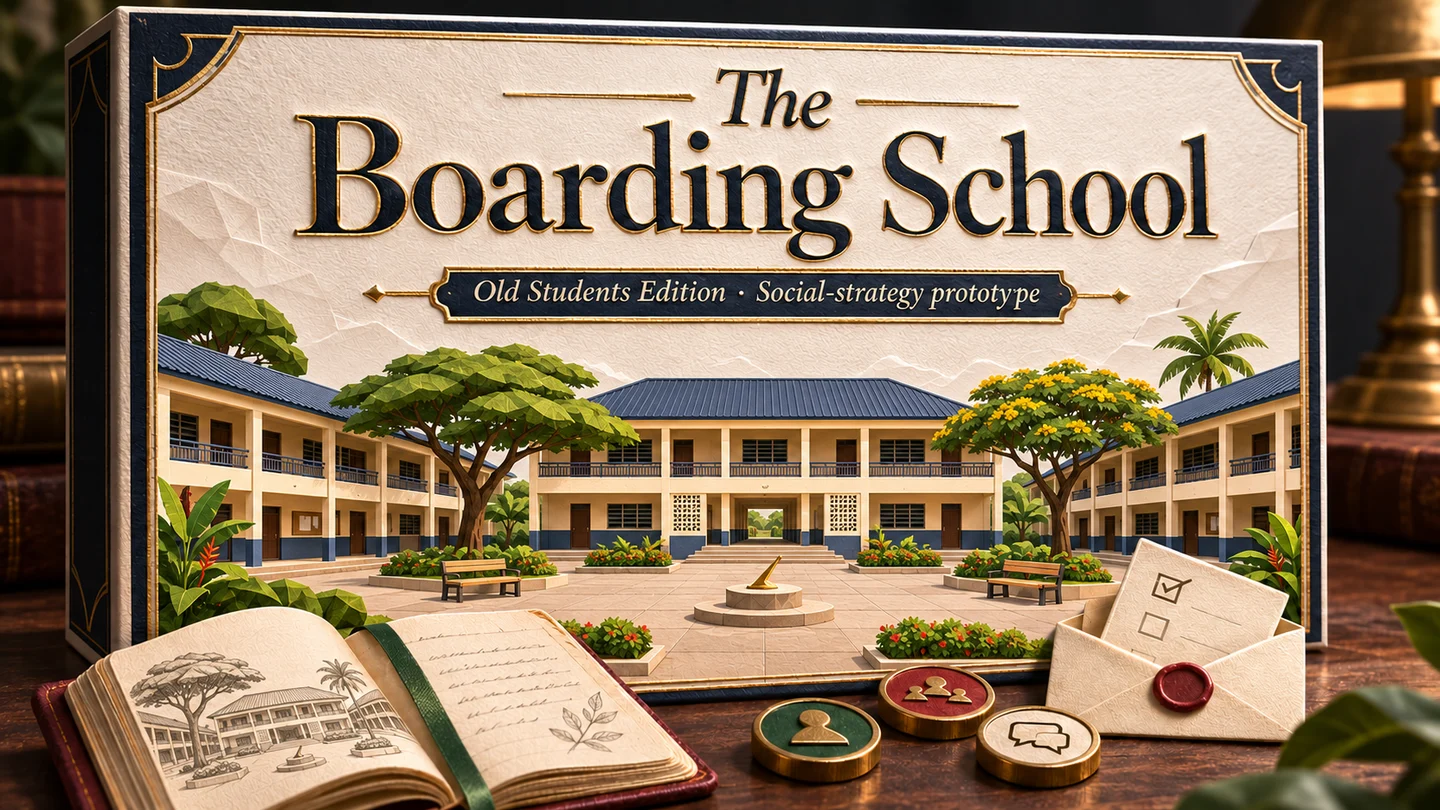
The Boarding School: Old Students Edition, social-strategy workspace.
The bell still gets the final word
The Boarding School gives adult ambition a timetable, a house, an audience and several people who remember what happened yesterday.
A committee might help with the plan. It cannot guarantee the vote, repair every friendship or stop the next assembly. That is what makes returning to school a strategy game rather than an unusually elaborate reunion.
Back to the story’s beginning ↑
Project details
A deterministic school-life and reality-competition simulation with an adult cast, dorms, classes, clubs, house points and viewer voting.
Inside the workflow
Create a character, move through the school calendar and make choices that change relationships, reputation and house participation.
Have something in mind?
Bring the problem, the audience and what you want to make possible.
Discuss your project