
Creative Tools · ICUNI Labs
Vigilant
A local credential-vault study focused on deliberate access and clear security boundaries.
The build story 8 minute read

Vigilant: Keep Credential Use Deliberate, Recoverable and Understandable
At a glance
- Purpose
- A local credential-vault study focused on deliberate access and clear security boundaries.
- The build
- A Windows credential-vault beta with generation, health checks, CSV migration and optional exact-origin browser autofill. It is unsigned and requires independent security review.
In this story
By Menelek Makonnen · ICUNI Labs
A local credential-workflow beta built around deliberate use, recoverable records and boundaries that remain visible when something goes wrong.
Vigilant brings credential creation, recovery, reviewed imports and deliberate browser use into a Windows desktop vault. I built it to make those everyday actions more understandable to the owner: what is being saved, which record will change and where a selected login is about to go. Its current role is an unsigned local beta for synthetic and owner-controlled evaluation, not a production credential product.
A password vault is one of the few applications where “surprise me” is a terrible feature request. The interesting design work happens around the secret: who can reveal it, which record changed, what an import will add and whether a browser handoff still belongs to the page the owner chose.
The value I am working towards is less guesswork around sensitive work: a recovery route the owner can follow, a preview before migration and a clear distinction between filling a website and submitting its form. Independent review remains part of the work ahead.
Make returning to the vault part of creating it
Vault creation starts with a confirmed master passphrase and a native readiness check. The system derives key material with Argon2id, wraps a random root key using authenticated encryption and derives separate keys for different purposes. Records bind their encrypted contents to object and revision identity.
Those are implementation choices, not an independent cryptographic audit. They establish a model I can explain and test, while the quality of the complete product still depends on how every boundary behaves around it.
Recovery has its own workflow. Creation provides a one-time recovery kit, and the native save path refuses to replace an existing destination and reads the file back. Recovery uses the earlier kit and a new passphrase, saves and checks the replacement before rotation, then leaves the vault locked.
I wanted recovery to be a first-class decision rather than a dramatic paragraph at the bottom of a settings page. A credential product needs an account of how the owner returns, including what the software can confirm and where it must stop.
Edit and use a record without losing a later change
The vault supports several kinds of protected record, including logins, secure notes, identities, authenticator material and recovery-code records. Each has a defined shape rather than being an arbitrary bag of renderer data.
The editor carries the parent revision when saving. If another change has already moved that record forward, Vigilant preserves an encrypted conflict branch rather than silently replacing the later version. The owner gets a conflict to resolve instead of an unexpectedly tidy history.
Search uses unlocked record metadata, while protected values remain masked until a deliberate reveal or copy. A reveal has a short interface timeout. Clipboard copies have a lease, and cleanup checks whether the app still owns the clipboard contents before clearing them.
That last condition matters. A tool trying to remove its own copied secret should not erase the new thing the owner copied afterwards. Good intentions do not grant custody of the entire clipboard.
Generate deliberately, describe the estimate honestly
The generator offers passwords, PINs and passphrases with explicit options. Password generation uses cryptographic random bytes and rejection sampling, with the enabled character groups represented in the result. A PIN can retain a leading zero instead of becoming a smaller integer by accident.
A local strength estimate presents assumptions about attack rates. It is an estimate, not a breach check and not a promise that a particular secret is safe. Saving still requires a title and an HTTPS origin so the generated value becomes a meaningful login record.
A failure or conflict stays unsaved. The application should not rotate the displayed value and suggest it has been stored when the native boundary refused the write. The owner needs the acknowledgement to belong to the record they actually meant to keep.

The local vault journey: create, preserve, reveal deliberately and keep recovery separate.
See what an import will add before committing it
The Norton import path begins with a native file selection while the vault is unlocked. It accepts a bounded supported CSV format and validates eligible records. The interface receives an inventory of counts, rather than the imported secret contents.
The preview has a short-lived identity tied to the window and lock state. Commit requires native confirmation, rereads the selected file and compares its fingerprint with the reviewed version. A changed file or expired preview stops the import.
The batch is add-only. Possible duplicates can be counted while existing records remain intact, giving the owner a specific result to inspect without inventing a merge decision on their behalf.
For the owner, that makes the question concrete: these counts, from this file, adding records without replacing the existing collection. I have learned to bind the decision to the input somebody actually reviewed. “Import” should describe a controlled change, not a small data migration with theatrical confidence.
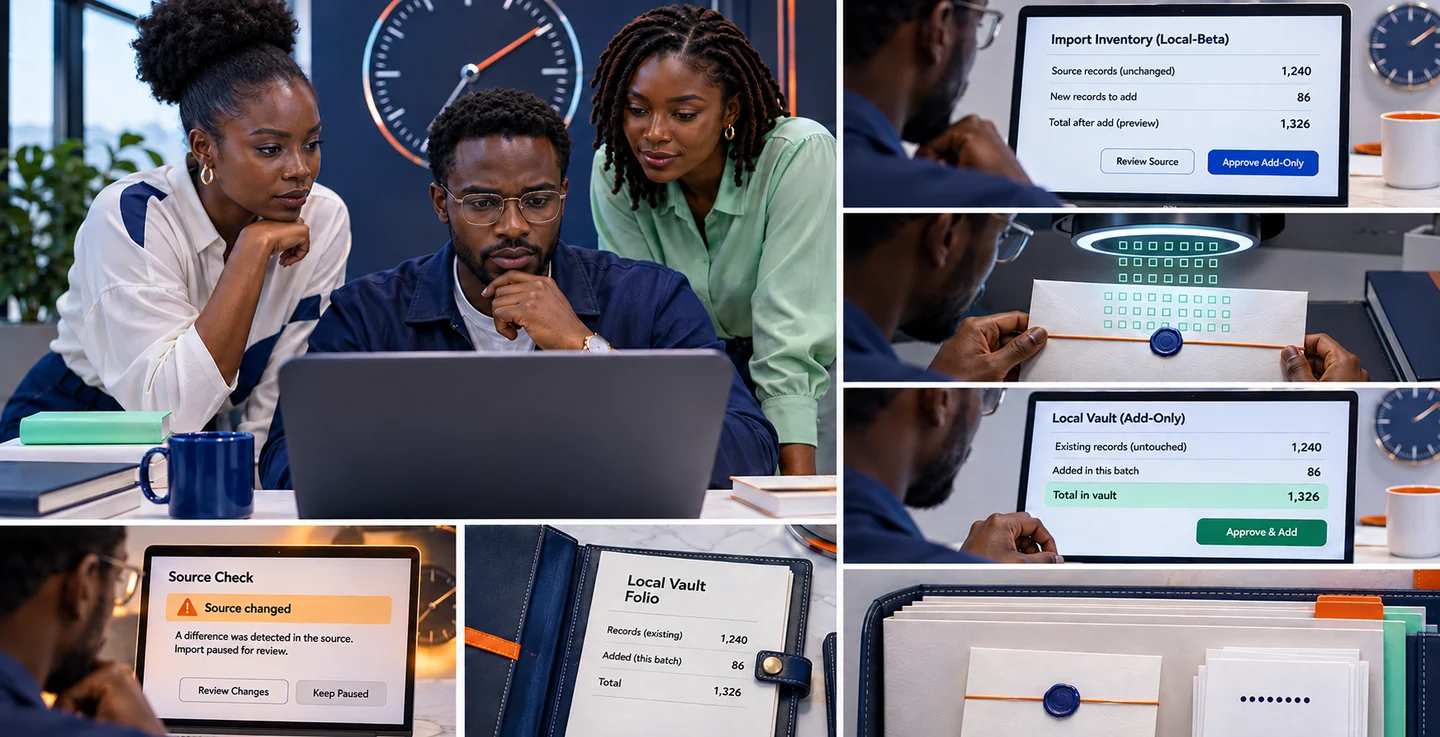
Migration: review the bounded input, confirm the same file and add without replacing existing records.
A browser request belongs to one origin
The Chrome handoff is another distinct workflow. The owner acts on the current HTTPS origin, selects a login and grants the requested permission. The background and native broker recheck the relevant page, document, lock state and selected record.
The content script fills visible username and password fields with form submission disabled. Filling is the requested action; submitting the website form remains separate. Navigation or origin changes invalidate the earlier request.
That is the useful intent behind the design: this credential, for this selected page, through this deliberate interaction. There is no single atomic transaction spanning those environments, so the handoff needs its own operating evidence.
The browser bridge is therefore part of the beta foundation, with release and acceptance gates kept visible. A permission dialog is a beginning, not a certificate for everything that follows it.

Autofill intent: bind the selected credential to the intended origin and leave submission separate.
See which tools are available and what their answers mean
Security Centre puts capability state into the interface. Some tools operate locally; others require a provider, local setup or release evidence. An unavailable capability should look unavailable rather than borrowing authority from the word “security”.
Scam Shield performs local URL-structure checks and returns advisory signals. A deliberate breach-check action is different: it hashes the candidate locally and sends a short prefix to a range service, keeping the full value local. If the service cannot answer, the result is unavailable, not clear.
The selected-file scanning path is bounded and on demand. Cloud synchronisation, signed updating, native integrations and installation-related work have their own provider and assurance boundaries.
Those distinctions make the interface more useful. A watch dial can organise the view, but its confidence must come from the state beneath it. Decorative vigilance is an excellent way to produce a clock. A credential workflow needs more.
Vigilant's release work binds package identity, source state, artifacts and evidence to explicit gates. Independent cryptographic review, external testing, clean-machine operation, durability and provider behaviour cannot be manufactured by a local passing label.
The current ceiling remains the unsigned beta. The next assurance work needs independent and real-environment evidence, with findings corrected and retested.
I keep those boundaries visible because they are part of the engineering. A security-sensitive product should be able to describe what is blocked without treating the admission as an interface defect.
What the build sharpened
The application uses TypeScript and React inside Electron, with JavaScript/Node.js services for the vault and process boundaries. Native Windows companions use C#/.NET for selected integration work. Established cryptographic libraries and browser APIs supply primitives; implementing a workflow around them does not make those primitives my invention.
Vigilant has made me more exact about the awkward joins people should not have to think about: a renderer request entering a native service, a reviewed file becoming an import, a revision becoming an encrypted write and an origin receiving a browser fill. If I describe the owner’s intention clearly but lose it at the handoff, the nicest screen in the world will not repair the result.
Each join asks what can still change, what the owner actually approved and which acknowledgement proves the next state. That discipline applies to many products, but a credential vault gives it very little room to be casual.
Vigilant local beta: deliberate credential use.
Save the surprises for something else
Vigilant is a development foundation for more deliberate credential use, with recovery, migration, revision and handoff decisions made explicit. Its current role is controlled evaluation while the independent assurance and release work continues.
That is the kind of boring a vault should aim to earn: the requested record, the intended page and an outcome the owner can understand. Surprises can have the desktop wallpaper.
Back to the story’s beginning ↑
Project details
A Windows credential-vault beta with generation, health checks, CSV migration and optional exact-origin browser autofill. It is unsigned and requires independent security review.
Inside the workflow
A Windows credential-vault beta with generation, health checks, CSV migration and optional exact-origin browser autofill. It is unsigned and requires independent security review.
Have something in mind?
Bring the problem, the audience and what you want to make possible.
Discuss your project