
Business Systems · ICUNI Consult
ZenjiFinds
A curated shopping experience that connects discovery with the work behind an order.
The build story 5 minute read

ZenjiFinds: Choose the Goods, Send a Clear Request, Confirm the Details
At a glance
- Purpose
- A curated shopping experience that connects discovery with the work behind an order.
- The build
- A retail storefront with discovery and cart state, backed by order requests, a stock ledger and role-scoped operations.
In this story
By Menelek Makonnen · ICUNI Consult
A curated storefront that turns a considered shortlist into a server-priced order request, with confirmation kept honest.
ZenjiFinds helps customers discover curated goods, build a shortlist and send a clear pickup or delivery request for the business to confirm. It connects a considered shopping experience with the practical conversation about availability, fulfilment and payment that still needs to happen.
The shopping basket is one of software’s most optimistic objects. Add a lamp, a notebook and a blender, and it is ready to declare your life reorganised. The person arranging availability and delivery may appreciate a brief conversation first.
I developed ZenjiFinds around household, lifestyle and practical creative goods, with a concierge confirming the arrangements. Somebody can consider an item, hold it in a wishlist and assemble a request before settling the remaining details. The interface should support that conversation rather than claim it has already happened.
For the customer, the benefit is being able to explore and explain the order without starting that conversation from scratch. For the business, product identities, quantities, contact details and fulfilment choice arrive together. A well-structured request is useful even while the sale still needs confirmation.
Make discovery feel considered
The catalogue combines search, categories and price sorting. Product details carry tags, price and a stock cue. A local wishlist lets the customer hold onto a possible choice without committing it to the basket immediately.
I gave that journey a warm visual identity: cream and espresso themes, peach, gold, rose and sage accents, and a source-defined hexagonal box mark. Product illustrations use CSS shapes, giving the preview catalogue a consistent look without pretending those drawings are photographs of stocked items.
The interaction has a practical rhythm. Explore, inspect, shortlist, choose a quantity and assemble the request. The loaded stock snapshot caps ordinary basket quantities, while the server still has to make the authoritative decision. A number seen on a card is useful context, not a reservation with diplomatic immunity.
The local shortlist and basket survive within the browser session. They are different from a fully synchronised customer account. That keeps the present experience clear while leaving room for a stronger repeat-order journey later.
Submit a request the business can use
Checkout gathers contact details, pickup or delivery choice, an address when needed and an optional note. The request sends product identities and quantities so the backend can resolve the price from its own records.
That is an important join. The browser can explain the current basket, but it should not decide what the business charges simply by supplying a persuasive total. The backend loads active products, checks quantities and available stock, calculates line prices and returns its receipt.
The resulting order waits for confirmation, with payment not started. This is the state the customer needs to understand. They have asked for the goods; availability, fulfilment and payment arrangements still need the business's next action.
Failed calls preserve the form. A successful receipt clears the basket and presents the backend amount. The current local delivery estimate and configured backend fee can diverge, so keeping the final acknowledgement authoritative remains important.
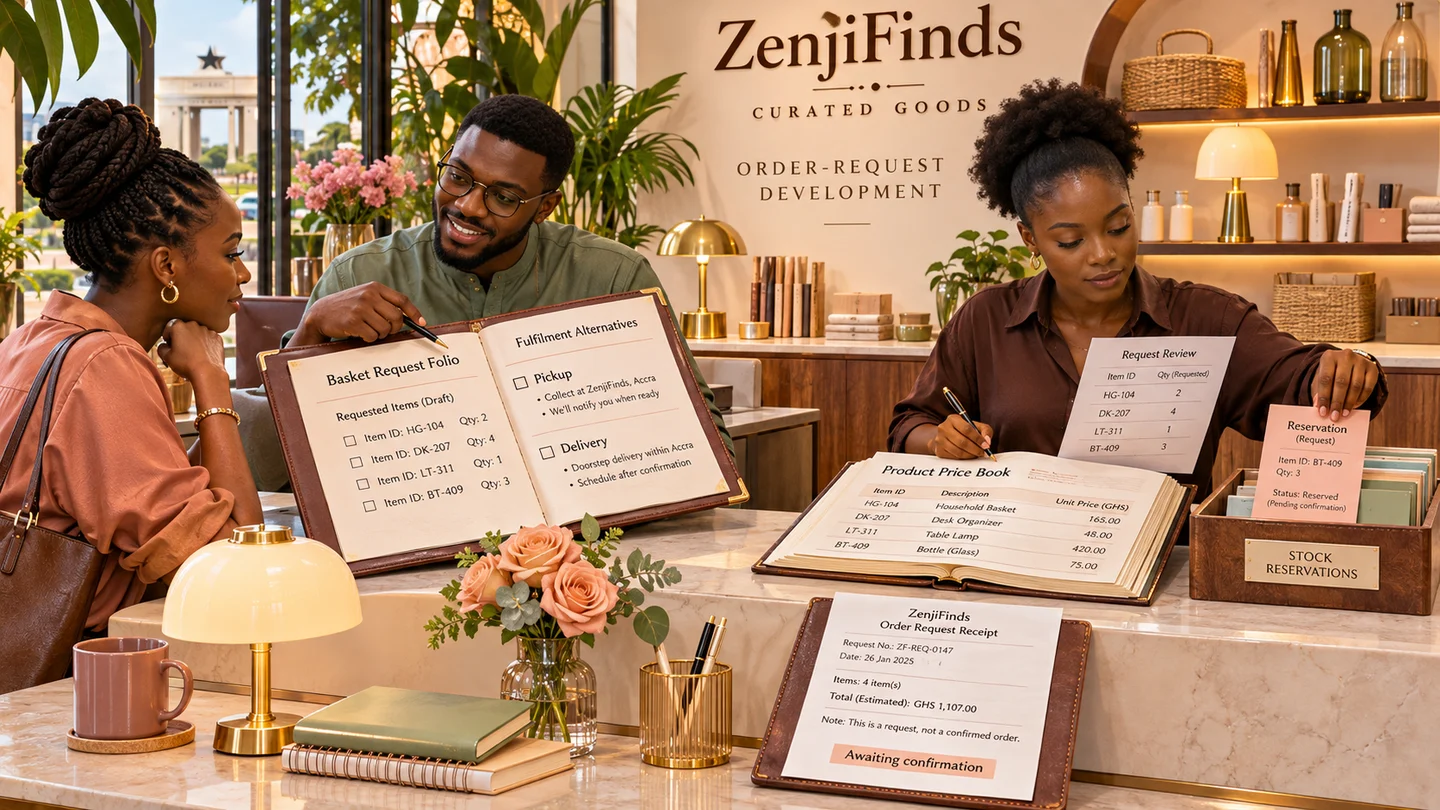
The working journey: shortlist the goods, submit the request, calculate the authoritative total and keep confirmation explicit.
Keep the requested goods and the stock movement connected
The backend records reservation movements when an order request is accepted. Its stock calculation combines receipts, adjustments, releases, issues, losses and reservations. A cancelled request releases its reservation. Completion replaces the reservation's availability effect with a final issue.
That is more informative than overwriting one stock number and hoping everybody remembers why it changed. The movement has a reason, and the order's stage supplies context.
The backend also models confirmation, packing, readiness, completion and cancellation, with manual payment records kept separate. The present staff screen mainly reads operational summaries, so the deeper lifecycle actions still need fuller interface work before they form a complete clickable staff journey.
Familiar tools behind the shop and order records
The frontend uses TypeScript, React and Vite. Google Apps Script routes backend actions, while Google Sheets holds catalogue, order and stock records. Established variable fonts support the typography, and SVG/CSS provide the visual language.
The default adapter uses a local preview catalogue.
The build sharpened how I follow a commercial choice from the customer into the operation: the customer selects, the server prices, the stock ledger reserves and the business confirms. Keeping those responsibilities clear helps me see what each person needs next instead of asking one cheerful checkout screen to impersonate the whole business.
That is how I like to design operational interfaces. A friendly surface should make the next step clear enough that the person doing the work does not have to correct its enthusiasm. I can get carried away by a good basket too; the stock ledger deserves a more restrained personality.

ZenjiFinds: curated choices, clear requests.
Leave room for the useful conversation
ZenjiFinds gives a customer a considered way to choose and a business a structured request to handle. Its value sits in the continuity between discovery, authoritative pricing, stock movement and confirmation.
The basket can remain optimistic. It just needs to know when to hand over to the concierge. The lamp, notebook and blender may improve the day; the receipt should at least describe what has actually happened.
the header mark is an existing SVG identity.
Back to the story’s beginning ↑Project details
A retail storefront with discovery and cart state, backed by order requests, a stock ledger and role-scoped operations.
Inside the workflow
A retail storefront with discovery and cart state, backed by order requests, a stock ledger and role-scoped operations.
Have something in mind?
Bring the problem, the audience and what you want to make possible.
Discuss your project