Game
Ampe
Games & Worlds · ICUNI Games
A Ghanaian playground game reimagined as a lively digital experience.
Released
The build story 8 minute read

Ampe: Bring the Ghanaian Foot-Clap Game to Your Browser
At a glance
- Purpose
- A Ghanaian playground game reimagined as a lively digital experience.
- The build
- A game experience built around Ampe’s rhythmic turns, movement and playful competition.
- See it
- Visit project
In this story
By Menelek Makonnen · ICUNI Games
A Ghanaian foot-clap game translated into a browser: choose your role, read the rhythm and commit to the step.
Ampe lets you play the Ghanaian foot-clap game in your browser: choose a role, follow the rhythm and challenge an opponent with a foot choice. It gives people familiar with the game a digital way to return to it, and newcomers a tutorial and readable match setup to learn through play.
There is nowhere to hide in a game with two feet. You can bring strategy, confidence and a very convincing explanation of your last mistake. Eventually, one foot has to go forward. The explanation is rarely awarded points.
The three-dimensional setting brings characters, locations and different match formats around that small decision. O’Contour and O’Straight give each player a role to pursue. Ampe and Ampey name the same game; the tradition itself is older than my implementation.
The appeal is immediate: two players face each other, make a foot choice and discover which assigned role wins. The design challenge is everything needed to make that moment readable, responsive and worth repeating. A simple rule still needs a complete player journey.
Learn the relationship before chasing the score
The game resolves the feet by a clear rule. If both players choose the same foot, the result is Contour. If they choose different feet, the result is Straight. The player assigned the matching role wins the step.
Because the players face one another, matching their own left feet does not look like matching the same side of the screen. That is a small spatial distinction with a large effect on whether a newcomer understands what happened. The tutorial and role selection give the rule a place in the setup rather than leaving the first loss to explain it.
Choose O'Contour or O'Straight, then play the relationship. Your role gives the same two inputs a different purpose. You can settle into a habit, try to break a pattern or second-guess the opponent. The game does not need a hundred attack buttons to make hesitation interesting. Your left foot is perfectly capable of becoming a strategic liability on its own.
I keep the rule resolution separate from the presentation. A small logic module validates foot and role choices and returns the result. The scene can then celebrate it, but particles and camera movement do not decide who won.
Build the match you want to play
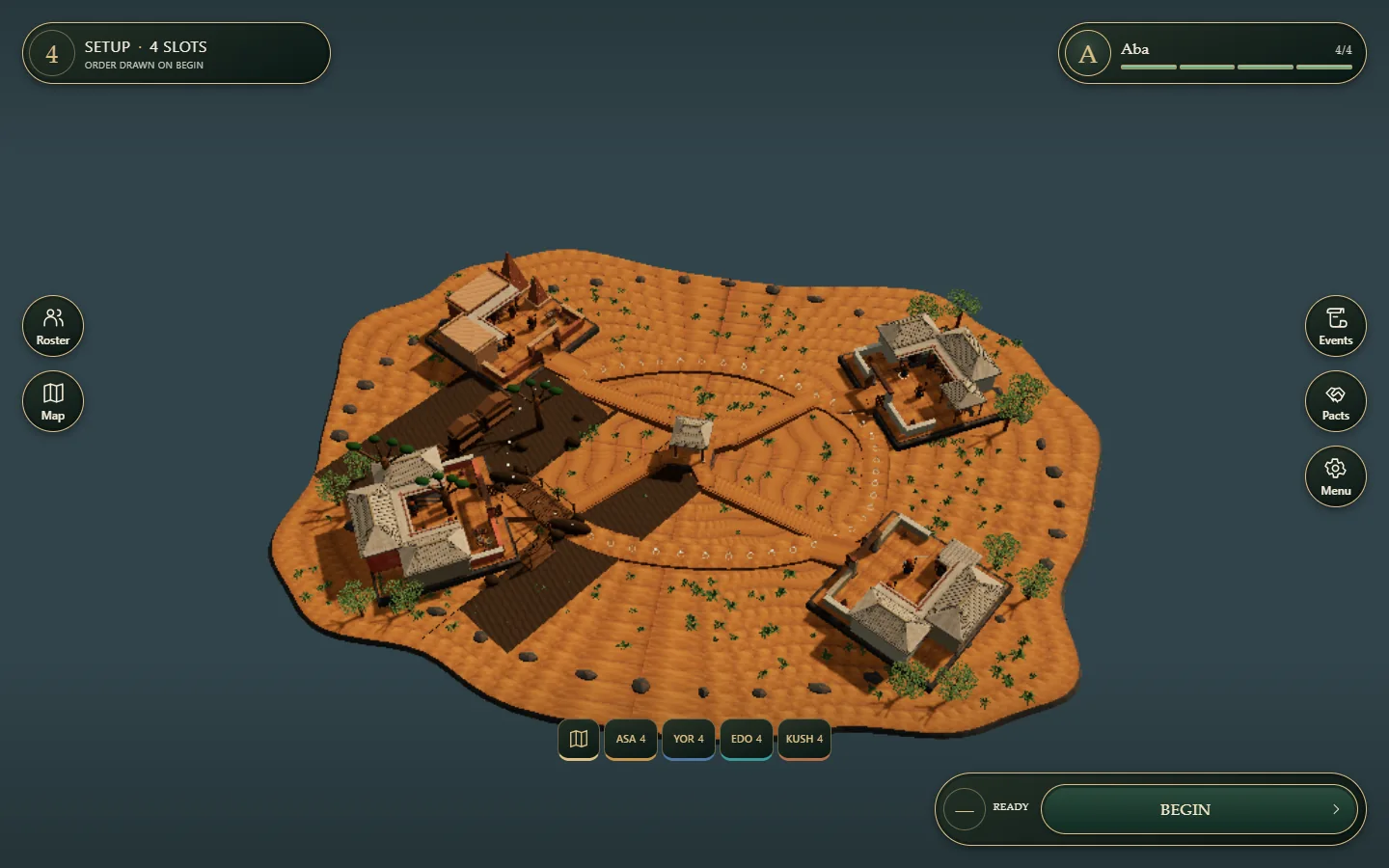
The setup moves through the chosen mode and match length, player or team details, character selection, role and location before entering play. Local Duel provides a direct way to learn. Other implemented flows include Teams, Free-for-All, Gauntlet, Daily Ampe and Online, alongside the tutorial and settings.
The active roster offers seven characters. I keep additional character definitions outside that selection while they need further work, so the choice presented to a player stays deliberate. My development folder is allowed to have ambitions; the selection screen needs a clearer employment policy.
Character, role and arena help the match feel personal. The visual language uses gold and dark surfaces, Ghanaian red and green, and violet and cyan for the opposing roles. Schoolyard and other location settings give the game a familiar physical context. The character meshes are built procedurally in Three.js, with natural hair, uniforms, posture and silhouette all contributing to readability.
That readability has real work to do. The player needs to recognise a character at selection scale and then understand the body at gameplay scale. A detail that looks impressive in isolation can become a hat-shaped misunderstanding from the match camera. The correct response is to inspect the actual view, not congratulate the polygon count.

The duel: learn the role, follow the rhythm, choose a foot and read the reveal.
Rhythm creates the moment of commitment
The gameplay rhythm moves through claps, jump, landing and the foot-choice beat. The input window and timing grades give the player a moment to act. Keyboard controls support Q/E for one local player and comma/period for the other; touch play offers large left and right choices. Mouse and visible controls provide other paths in the input system.
Input handling must distinguish playing the match from interacting with the interface. Clicking a menu or a control should not accidentally become a foot choice. Equally, a valid human choice should not disappear between the input event and the next rendered frame. Those are the unglamorous joins that decide whether a rhythm game feels fair.
The match then reveals the feet, resolves the role relationship and updates the score. Timing can contribute mastery points, while round wins remain separate. That prevents a perfect-timing bonus from quietly counting as two wins in a best-of-three match. The reward can celebrate skill without rewriting the format.
The source supports single-round, best-of-three and first-to-ten formats. They change the length of the conversation with the opponent: a short encounter, a small contest of adjustments or a longer run in which habits have time to become visible. The rhythm can accelerate, adding pressure as the match develops.
This is the kind of design I enjoy: a clear core rule with enough timing and feedback around it to produce a characterful result. Complexity earns its place by improving the decision the player is already making.
Different ways to return to the same rule
Teams and Free-for-All extend the duel into a broader group situation. The underlying step still needs the same clarity, but counts, active identities and the next participant become part of the presentation problem. A crowded match cannot borrow the duel layout and assume everyone's head will find somewhere to live.
Daily Ampe offers a seeded three-opponent challenge. A date-derived seed selects the progression, and local storage records the attempt. This gives the player a repeatable reason to return while keeping its present persistence boundary clear: local browser state is not a centrally enforced account record.
The computer opponent is a game-logic system. It blends character personality with analysis of the player's earlier foot choices, using seeded randomness and different difficulty weights. It does not consult a language model. An opponent can favour a pattern, counter a tendency or behave unpredictably through explicit mechanics.
That matters for both the tone and the engineering. A character's apparent temperament has a rule behind it. I can explain why the behaviour changes and tune the balance between personality and prediction. Calling every non-human move “AI” should not make its implementation disappear behind a fog machine.
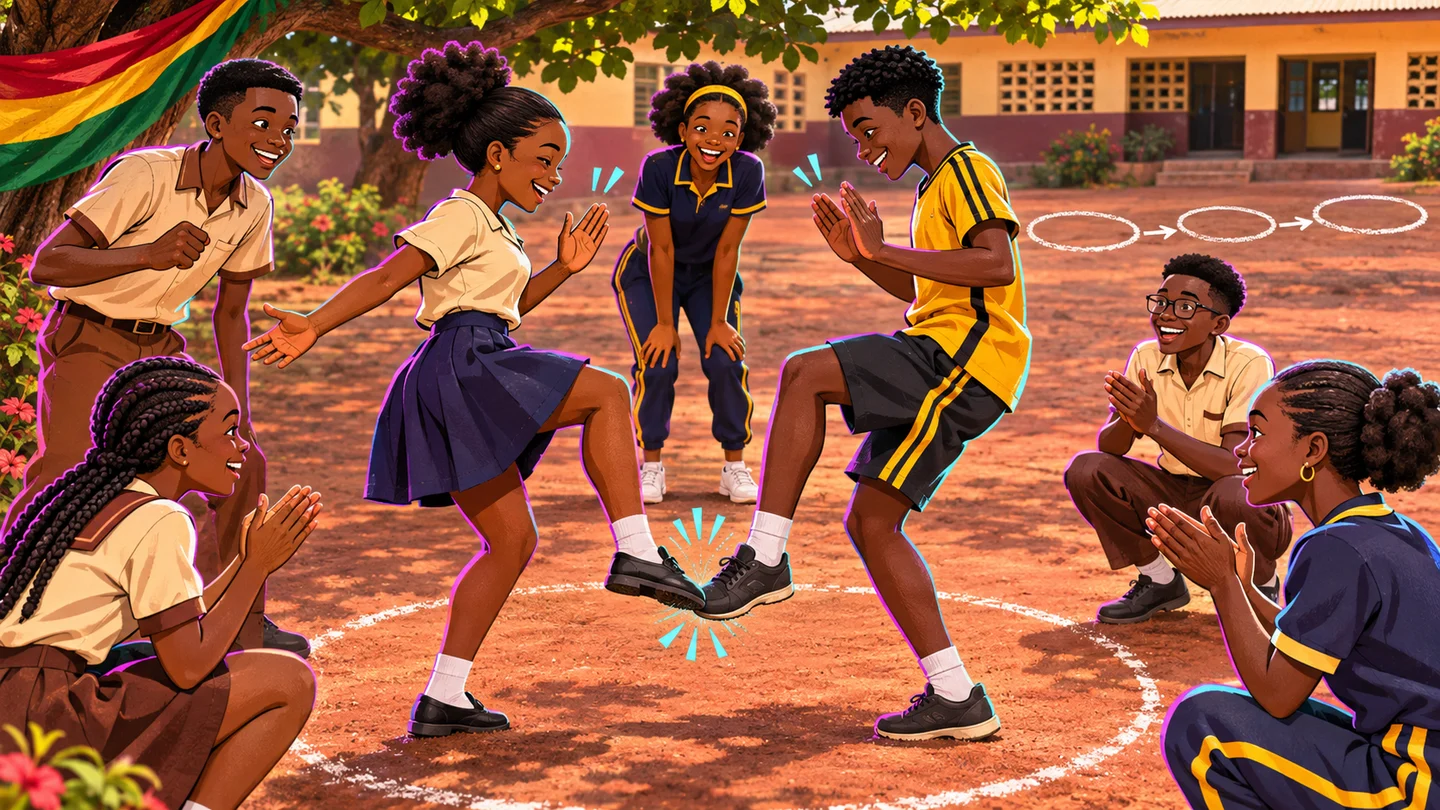
Return paths: group play and daily challenges extend the same central foot-choice rule.
Online play asks a different fairness question
Local players share a moment. Network messages arrive in an order. If a player could see the other choice before committing, the rule would have acquired an extremely tedious loophole.
For online play, I implemented a commit-and-reveal mechanism. Each player first sends a fingerprint of their choice combined with random material and round information. After the commitments are in, the choices are revealed and checked against those earlier fingerprints. The timing grade is also bound into the current commitment format.
In plain language: seal the choice before opening the envelopes. It is a useful mechanism for preserving simultaneous intent across sequential messages.
Online availability still depends on a working relay and a checked connection. The local match and daily challenge tell their own gameplay story; I do not want an Online menu to promise a match the service cannot currently deliver.

Online intent: commit first, reveal together and verify the earlier choice.
A game people can read while they play
On 16 October 2026, I brought the curated seven-character build together at the M151 checkpoint, with archived gameplay, responsive-view and publication checks. That checkpoint captures a stage of development. The many character and presentation experiments leading to it belong to the work of making this one game clearer.
The lesson from that history is that source correctness and visual acceptance answer different questions. A test can check a rule, an input path or a framing constraint. Somebody still has to inspect the rendered player journey: the character selection, the revealed feet, the identities, the score and the touch controls.
Further character art and device checks still matter. I would rather keep improving the view a player actually sees than describe the game as finished because a milestone number looks reassuringly large. The camera is a merciless reviewer, and unlike me it cannot be distracted with a better project name.
The engineering beneath the clap
JavaScript and Three.js provide the game logic and three-dimensional scene; Vite supports development and bundling. Procedural geometry, animation, camera work, input handling, audio and event-driven state changes meet inside the browser. Browser storage retains settings and statistics. Separate Google-backed analytics and online relay surfaces extend beyond the local match.
I separate pure rule decisions from the moving scene so each can be reasoned about clearly. The same habit appears in roster admission, lifecycle handling and the distinction between timing bonuses and match wins. Visual care then makes the rules legible to the person actually playing.
Building Ampe has strengthened that combination: cultural translation, interaction design, game-state engineering and the patience to inspect what the player sees. A culturally grounded game deserves familiar context and serious attention to its mechanics. Recognition should be the beginning of the experience, with a satisfying decision waiting underneath it.
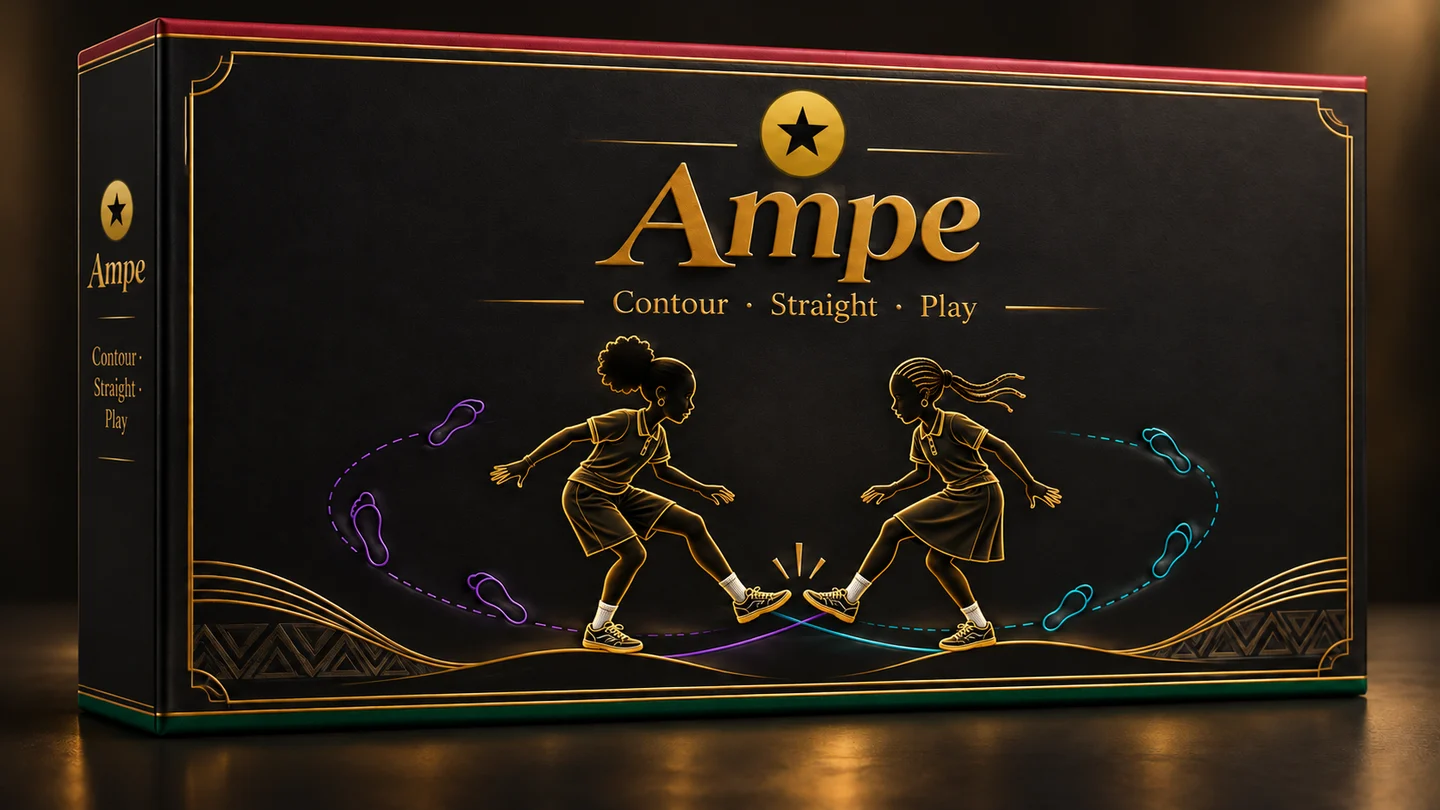
Ampe: Contour, Straight, play.
Put a foot forward
Ampe turns a small physical relationship into a complete browser-game journey: learn the rule, choose the role, meet the rhythm, commit the foot and respond to the result. Different modes give that decision room to become a contest, a group moment or a daily challenge.
The work continues through careful development and visual review. The centre stays refreshingly direct. Two feet. One choice. All the confidence in the world, followed by a result that has read none of your excuses.
Back to the story’s beginning ↑
About the work
A Ghanaian playground game reimagined as a lively digital experience.
A game experience built around Ampe’s rhythmic turns, movement and playful competition.
Connected work
Game
Ludo Conquest
A competitive take on Ludo built around tactical play and progression.
Playable online