Game
Ludo Conquest
Games & Worlds · ICUNI Games
A competitive take on Ludo built around tactical play and progression.
The build story 9 minute read
Ludo Conquest: Make Every Cast Matter in a Living Tactical World
At a glance
- Purpose
- A competitive take on Ludo built around tactical play and progression.
- The build
- A Ludo game experience centered on strategic turns, competition and player progression.
- See it
- Visit project
In this story
By Menelek Makonnen · ICUNI Games
A private tactical RPG workspace that makes deployment, movement, capture and exact arrival answer to Ludo beneath an inhabited fictional world.
Ludo Conquest aims to give players a tactical adventure where an inhabited fictional world still obeys the exact decisions of Ludo. Choose how to deploy and move champions, spend the casts you actually rolled and work towards Home through terrain, encounters and rival positions. The promise is an adventure you care about with rules you can understand.
A champion can have a magnificent backstory, a beautiful silhouette and a speech ready for the gates of Home. The die remains unimpressed. One square short is still one square short.
I built the workspace for that relationship between adventure and exact rules. Its African civilisation-and-pantheon direction gives the journey a fictional world; the die, legal routes and exact arrival give the player consequential choices within it.
The current project is a private, blocked work in progress. Solo Preview is its playable-first development path; a complete ordinary match, coherent native capture sequence, exact recovery and device acceptance remain open. A substantial rules implementation is not the same as a finished game.
For somebody who enjoys Ludo’s positional tension and wants a larger world around it, that is the intended appeal. Making the living adventure and strict rules remain true to each other is the work still in front of me.
Care about the champion while reading the route
The governing promise is more demanding than placing elaborate characters on a conventional board. The player should navigate an RPG world, while deployment, exact movement, formations, protected routes and arrival remain decisive underneath.
Four current fictional domains give the workspace distinct identities, terrain and champion groups. Their framing draws on African settings and design research, but original fiction, historical knowledge and living traditions must remain clearly separate.
I do not treat generated imagery as historical evidence or a fictional portrait as a reconstruction. Cultural and rights review remain part of the project's open responsibilities.
That separation gives the world room to be original without claiming that every dramatic design choice is a documented tradition. The game can have its own fiction and still be precise about where that fiction begins.
For the player, the intended result is a world worth traversing. For the rules, a path must still be an exact sequence rather than scenery that can bend around a cinematic moment.
Begin with the next legal decision
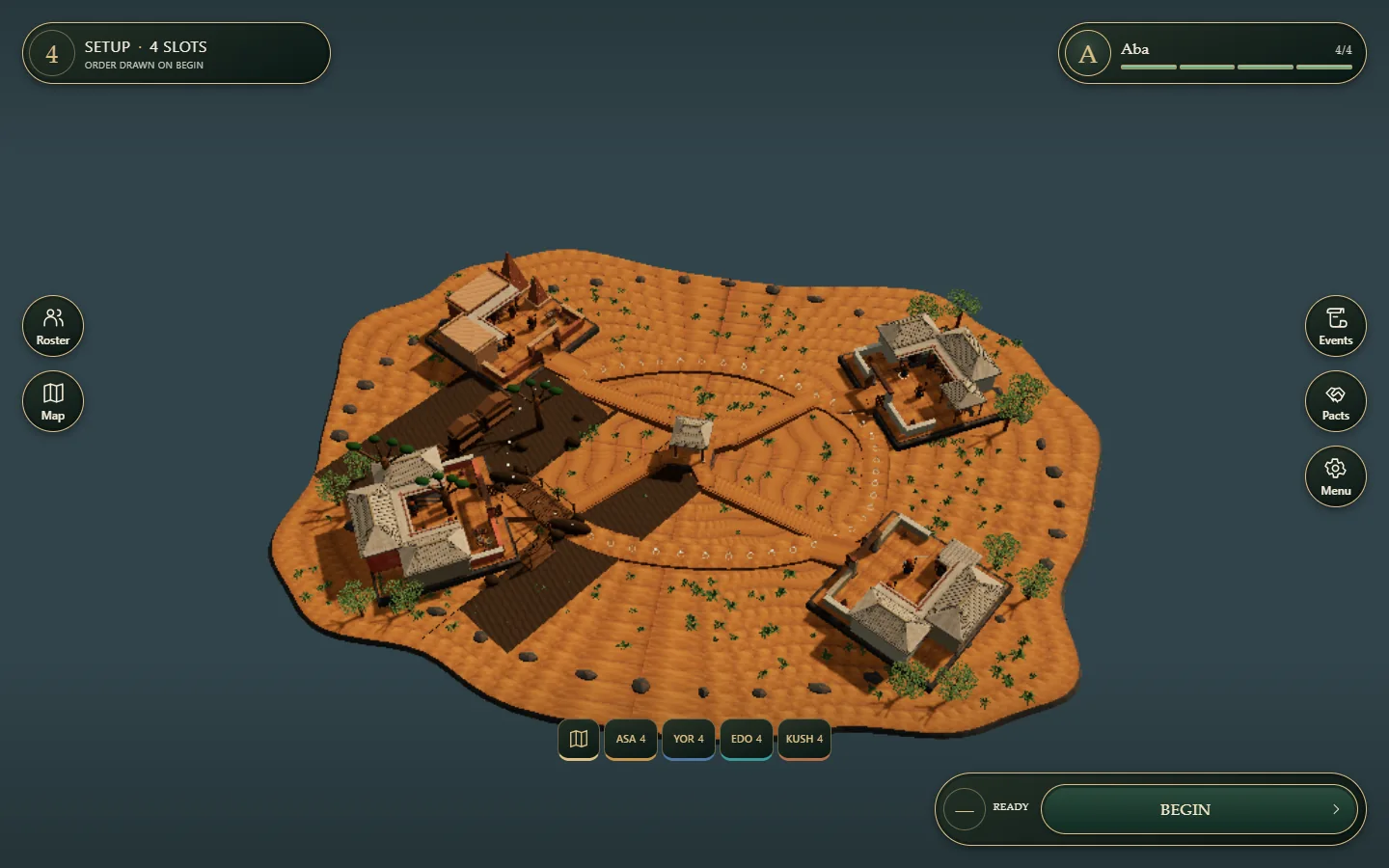
Solo play brings the active faction, selected champion, vitality, die and phase into one gameplay frame. The intended interface keeps the legal next action visible while deeper roster, diplomacy, encounter and save views remain contextual.
The map is not meant to become one panel in a vertically scrolling stack. The player navigates the world through touch or pointer gestures while essential turn information stays present.
That is an important design constraint across phone, tablet and desktop. A small screen changes presentation; it should not change the rule or hide the action the person needs to take.
The current browser implementation uses JavaScript and Three.js, with a retained Canvas2D fallback. Local assets and font delivery support the project's bounded runtime direction.
Bank the casts before spending them
The current banked-turn rules preserve a full consecutive-six streak before the player spends it. A human explicitly chooses Roll Again. The first non-six closes casting and makes allocation the next decision.
A sequence such as six, six, three therefore has a history and a set of whole casts to account for. The player can spend whole casts separately or combine them where the legal move permits.
That is different from treating the total as loose change. The system retains which casts were actually rolled and which have been consumed.
The distinction gives the player a tactical decision without weakening the governing rule. Which champion should receive which part of the bank? Is deployment more useful than spending that six elsewhere? Which legal route produces the better position?
The implementation has to make those options readable while keeping the cast history exact. A convenient animation or automatic turn transition must not quietly become a bonus die.
Let a special case stay special
One of the more precise rules concerns a paired fresh-entry hunt. Both same-faction entry champions must be fresh and never moved. The allocated effective distance must be from one to six and land on a lone hostile.
A larger distance is rejected rather than clamped into a legal-looking value. Ordinary backward hunts do not acquire the paired Home approach merely because their movement looks similar.
This is a useful example of how a tactical layer can respect a board-game foundation. The special route has eligibility conditions, not just a dramatic name.
It also sharpens the implementation. “Almost the same move” is not a sufficient reason to apply the same outcome. Freshness, faction, distance, target and route context all matter.
The player does not need to read the code to understand that. They need the interface to offer the genuinely legal route and explain the relevant condition when a tempting one is unavailable.
Make capture a complete event
An accepted move commits the route. The presentation then has to complete the walk and any attack, impact, victim Fall and recall before the remaining bank is offered or the opponent progresses.
That sequence is part of making a rule legible. A player should see who moved, who was captured, what happened to the victim and when control returns.
The current native two-actor choreography and Fall pipeline remain blocked.
For the player, that gap is confusing. If the victim appears to remain standing after the rules have recalled them, there are two competing accounts of the same turn. I cannot ask somebody to plan the next move while the last one is still contradicting itself.
I want the engine and the scene to tell one story. The rules decide the outcome; the presentation has to express that outcome clearly before inviting the next action.
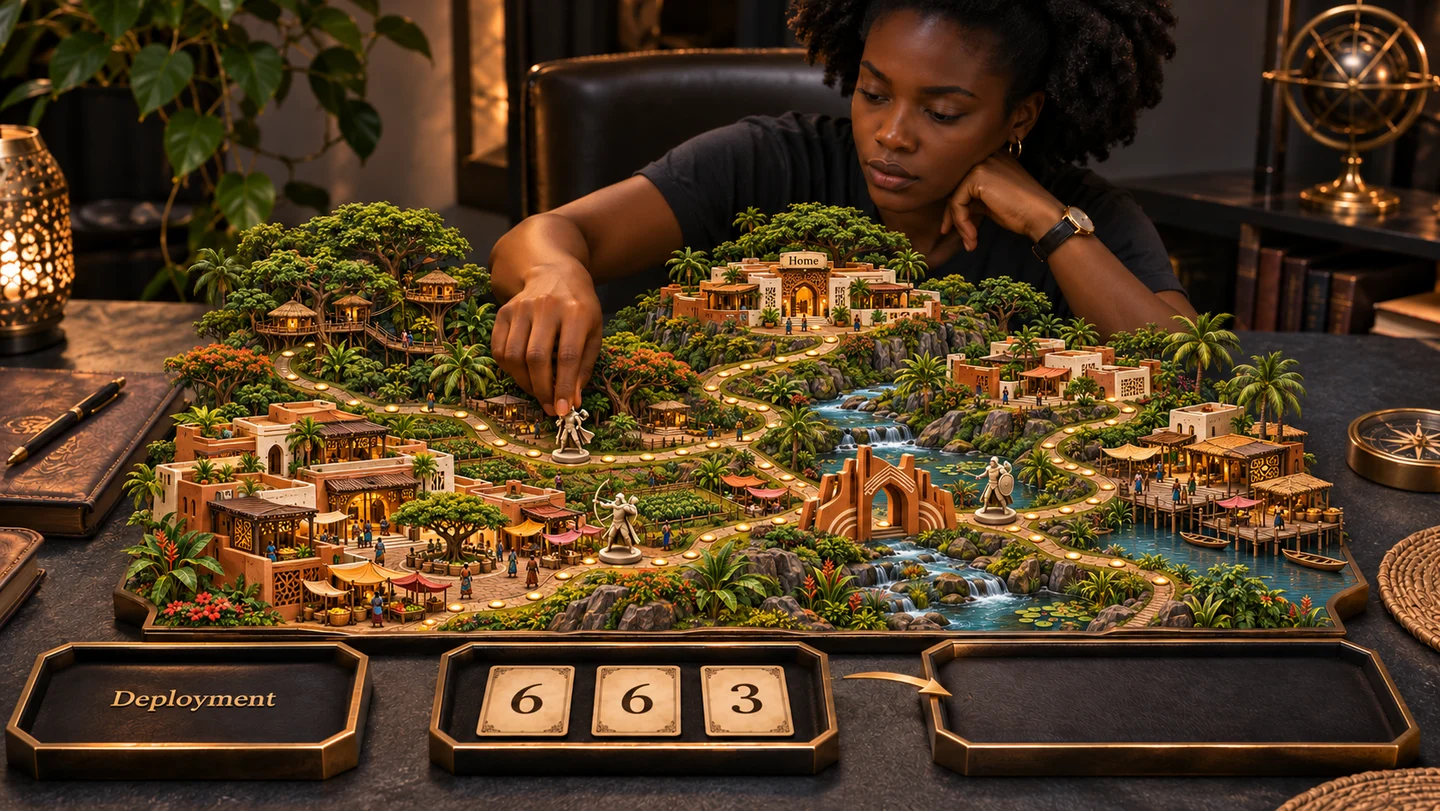
Bank casts, choose a legal allocation and preserve exact movement.
Add tactics without quietly rewriting Ludo
Formations, pacts, protected Return Roads and exact Home arrival remain authoritative. The RPG layer also includes bounded encounters and tactical utilities such as Essence and route-reading choices.
The important discipline is distinguishing fixed rules from proposed tuning. An upgrade cost or temporary utility value can be a slice default without becoming an immutable claim about the world.
That keeps iteration possible. I can adjust how a tactical choice feels while preserving the conditions that make deployment, capture and arrival recognisably governed by Ludo.
A legitimate winner needs four champions Home. Reaching a terminal result through an AI victory is a completed match with a human loss, not a player win to rename for a nicer headline.
Those definitions give development a concrete target. The game has to survive ordinary play all the way to an honest result.
Put the match down and return to the same decision
The V3 persistence path validates and serialises the state through explicit contracts. The replay path applies accepted commands through the same rules, keeping actions connected to the resulting state.
A compact recorder can retain accepted actions with periodic checkpoints while keeping the exact latest state. The checkpoint interval is a storage policy, not permission to discard meaningful interface fields or outcomes.
That is especially useful during a banked turn. If you stop after spending one cast, returning should give you the same remaining choices. A save therefore needs more than the champion’s approximate position: the remaining bank, phase, route state and consumed decisions all belong to that moment.
The integrity hashes detect accidental changes; they are not signatures or authentication. A local checksum should not be promoted into a security guarantee because it resembles a long piece of official-looking text.
The intended player workflow is straightforward: save, reload and continue the same match. Proving that experience requires an actual reload and comparison, not merely confirming that a file was written.
Treat offline recovery as its own result
A browser can warm a cache while the full recovery path still fails. A successful packaging build can coexist with an unproven interrupted match.
The open acceptance therefore includes visible capture and recall, save/reload equality, offline reload and recovery on desktop and touch/mobile conditions. Multiplayer settlement and physical-device performance remain separate again.
That has sharpened a practical habit in my work: begin with the experience somebody needs to resume, then check whether the supporting parts actually provide it. I am very capable of being encouraged by a successful cache. The interrupted player is entitled to ask for the rest of their match.

Preserve the exact turn and verify recovery separately.
Keep authoring and game admission distinct
Ludo Conquest Forge supports editable identities, source history and candidate packages. It is a related authoring subsystem, not a separate release of the game.
That distinction protects both sides of the work. The artist can preserve and develop a source without pretending every revision is game-ready, while the game can demand coherent visible behaviour before admitting a candidate.
The privately preserved source and local art files remain under their own ownership and review boundaries.
What the build has sharpened
Ludo Conquest has strengthened my ability to connect exact state machines with an expressive visual ambition. It asks me to think about the die, route, turn, save and visible action as one experience.
It has also sharpened my judgement about the limits of a workspace. A performance target is something to measure. A Fall sequence is something to watch. A complete match is something to finish.
The sand, cyan and muted faction accents give the interface an identity, but visual confidence has to be earned through the same ordinary play the eventual player will expect.
The project remains blocked and private. I can explain the tactical decisions and the rules behind them; the next responsibility is making the ordinary playable journey meet that design, all the way through a complete match and a reliable return.
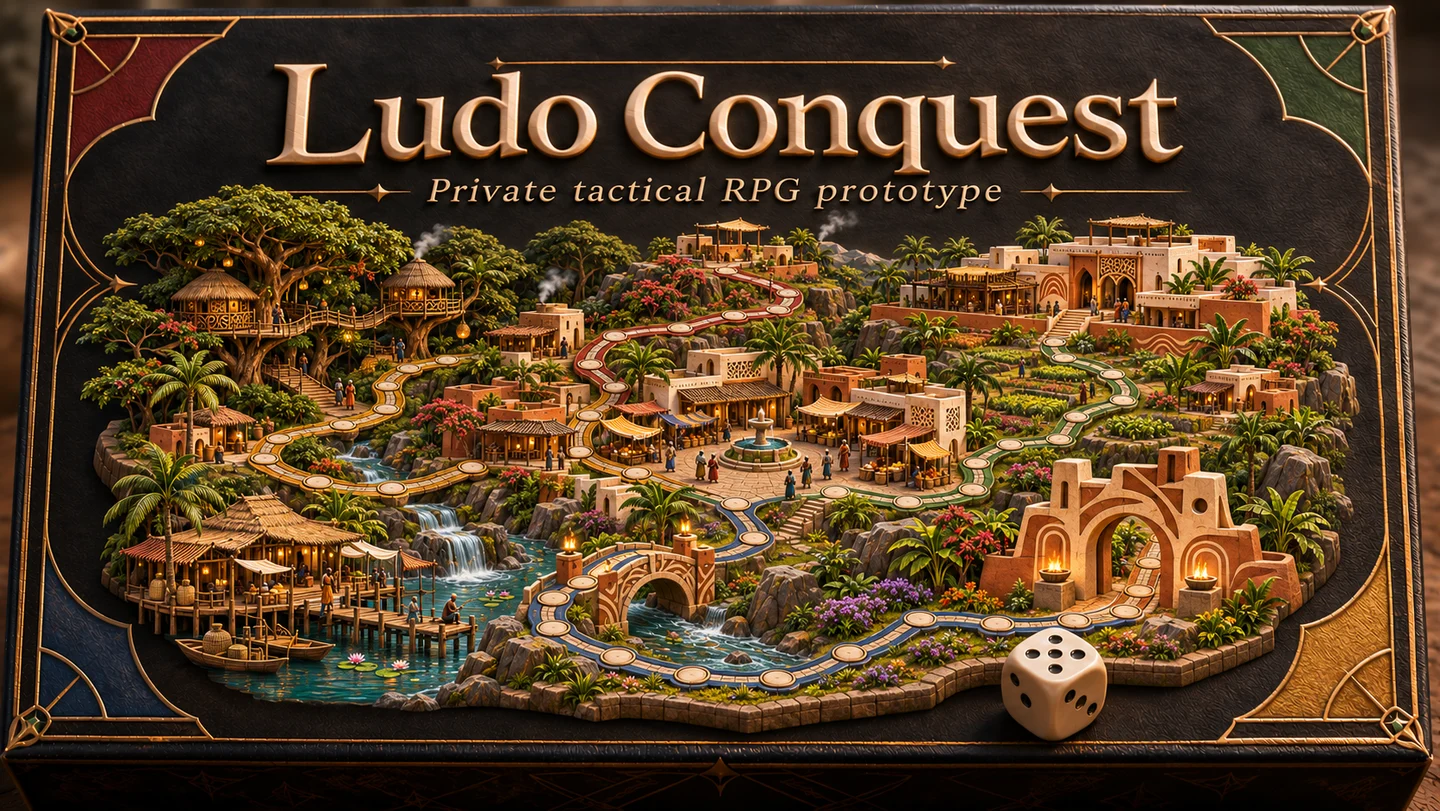
Ludo Conquest: private tactical RPG workspace.
Arrive by the rule
Ludo Conquest aims to make the journey feel like an adventure while keeping the arrival exact. The player should care about the champion and still understand why the next square is or is not legal.
The backstory can make Home matter. It cannot negotiate the last step. That is the promise I want the finished game to keep.
Back to the story’s beginning ↑
About the work
A competitive take on Ludo built around tactical play and progression.
A Ludo game experience centered on strategic turns, competition and player progression.