Games & Worlds · ICUNI Consult
Loremaker Pro
Exploring a universe through space, time and a field journal, without pretending every reconstruction is certain.
The build story 8 minute read

Loremaker Pro: Explore a World, Choose a Moment and Keep a Record of the Visit
At a glance
- Purpose
- Exploring a universe through space, time and a field journal, without pretending every reconstruction is certain.
- The build
- A browser-based 3D universe explorer with Atlas, Orbit and Surface views. Cosmic ages, Earth history, calendar years and story phases remain distinct.
In this story
By Menelek Makonnen · ICUNI Consult
Loremaker Pro lets a reader or world-builder explore places through time, compare how a destination changes and keep a field journal of the visit. Its browser-based 3D experience connects an Atlas, orbital views and local surfaces with destination search, chronology controls, source notes and guided journeys.
If you are following a complicated setting, a map answers only part of the question. What existed here at this point in the story? Can the visitor enter it? What is established reference material and what is an authored reconstruction? A beautiful landscape becomes far more interesting when it knows which part of the universe it is standing in.
I built Pro as the explorable application within my broader Loremaker world-building work. It gives visitors a route from large-scale context to a specific place and moment, then a way to compare or record what they found. The chronology can remain complicated. My aim is to stop it injuring an innocent spreadsheet every time somebody asks a reasonable question.
Find a destination that belongs to the moment you chose
A selection carries more than a place name. It includes the destination, view mode and time, with the appropriate epoch, calendar year, story phase or cosmic-age coordinate.
The domain resolver turns that selection into a world state: existence, access certainty, habitat, settlement, population context and source references. A destination can be present, absent or unresolved at a moment. Surface access can be withheld instead of quietly showing today's scenery in an earlier age.
That was a central decision. A map marker is not permission to invent a landscape. Sometimes the honest result of selecting a place is an explanation of why the visitor cannot enter that surface at that time.
The destination search retains the current time when the place changes. Results can therefore explain whether a destination exists in the chosen moment before the visitor enters. The hierarchy moves from larger structures into systems and local places, with the appropriate view selected for the destination type.
A world-builder can use this structure to inspect setting continuity. A reader can follow where the story takes place. A curious visitor can explore broad astronomical or historical context while seeing which part is reference and which part is reconstruction. Those are different ways to enjoy the same destination model, with the interpretation kept visible.
Move from the big picture into a local place
Atlas supplies the wider structure: galaxies, systems, regions and their relationships. Orbit gives the destination a planetary or celestial frame. Surface brings the visitor into a local scene with movement and collision.
I wanted those scales to feel connected without pretending they have identical precision. A broad catalogue view can help you find a system. A procedural surface is an interpretation of a place. They need a shared destination model, but they do not become the same kind of evidence merely because the camera can travel between them.
The surface renderer prepares terrain and collision before exposing the scene as ready. Terrain work runs through a worker scheduler with bounded queues, and scene generations prevent a late result from replacing the visitor's newer choice. Changing destinations quickly should not leave the interface in one world while the ground has finally arrived from another.
The canvas remains the centre of the interface. A floating inspector, compact top actions and chronology rail support it. Dialogs release world control, manage focus and return the visitor to the prior context. On smaller screens, the inspector becomes more like a bottom sheet and the time rail scrolls horizontally.
That structure keeps the application about visiting a place. A universe explorer should not require the traveller to fight an expanding collection of control panels for the privilege of seeing the universe.
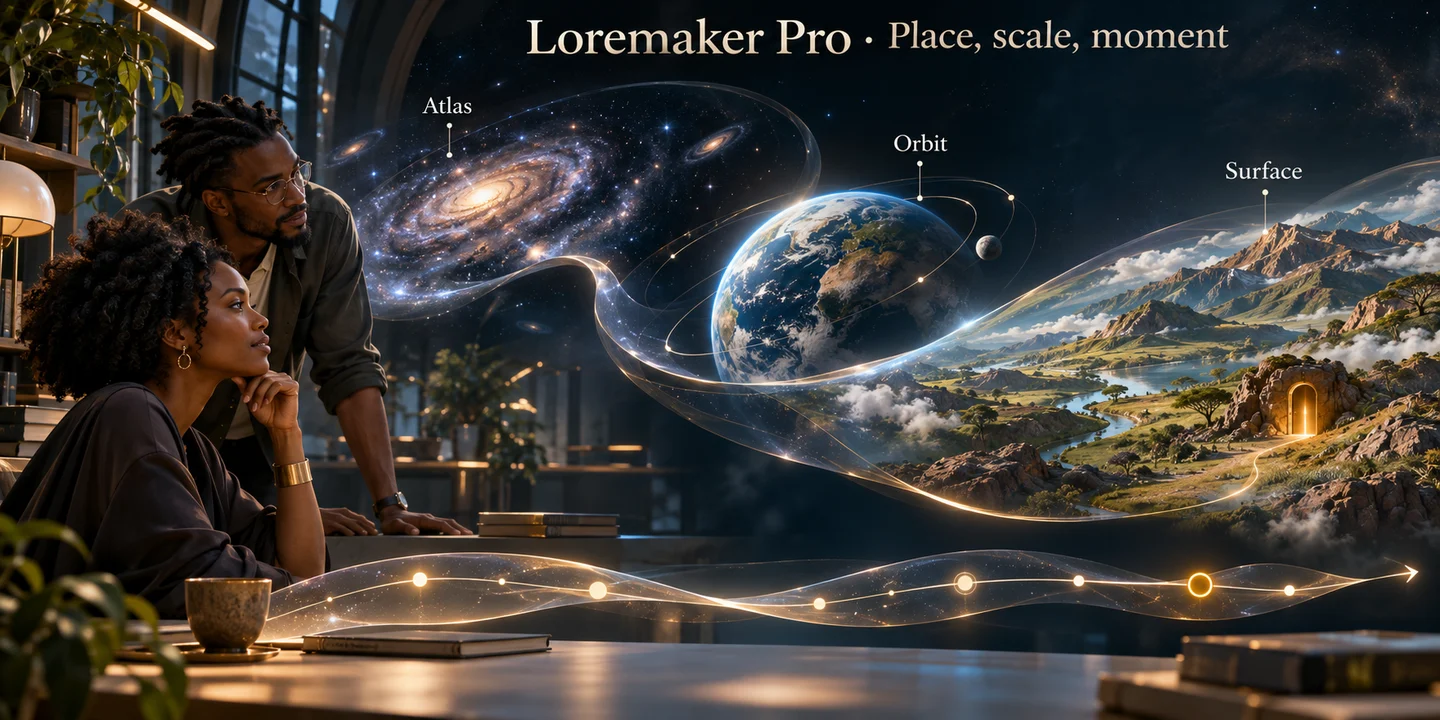
Exploration workflow: choose a destination and moment, move between scales and respect unavailable or unresolved world states.
Explore time without confusing story order with a calendar
Scientific cosmic age, geological or historical time and fictional story phase remain separate coordinates. An exact calendar year has its own validation; a cosmic clock has a different scale; narrative phases preserve their story ordering.
That separation avoids a surprisingly seductive mistake: placing every event on one smooth timeline and letting the visual continuity imply that every coordinate has the same authority. A story milestone may have an established sequence without an established calendar date. It should keep that distinction.
Local presentation time is another clock again. The visitor can change an allowed hour or weather mode without rewriting the world's chronology. A sunset is a lighting choice within the scene; it does not advance the saga because the sky was getting bored.
For unobserved exoplanet surfaces, the environment uses reference presentation instead of inventing a measured day length or climate. Orbital previews also identify their role. Some Solar paths are bounded fitted references; catalogue exoplanet motion uses its available periods with illustrative orientation; uncatalogued systems use seeded simulation.
I find those boundaries creatively useful. Stating what a model represents gives the visitor permission to enjoy it without asking the image to certify something it cannot know.
See what changed between two visits
Time Lens puts two moments of the same destination beside one another in the domain model. It compares existence, setting, habitat, settlement and life labels, marking what changed and what remained.
Character participation and source-backed capability states can also be compared. No recorded appearance stays precisely that. It does not become a death certificate, a known absence or a location invented to fill the gap.
The visitor can enter either compared moment. That makes the lens a navigation tool as well as an explanation. Instead of remembering a long inspector description while jumping back and forth, they can inspect the meaningful difference first.
For a reader, this makes comparison a way to understand the setting before entering it. For me as the builder, it demanded discipline about unknowns: no recorded appearance cannot silently become a death certificate. Fiction already creates enough dramatic biographies without the interface inventing one to fill a gap.
Follow a journey and keep observations you can revisit
Guided journeys provide ordered stops with destination, moment, observer state and a cue. Some include an encounter. Progress derives from matching journal observations, with a stop advancing only when the relevant place is open and recorded.
Recording is tied to a receipt from the ready engine. Destination, time, mode, manifestation, world identity, source revision, generation and a valid local position must still match. An encounter additionally needs the eligible character and a current in-range state.
That gives the journal a relationship with the scene. It records where and when the visitor was, which source revision described it and what observer state applied, with an optional note. The observation should not quietly attach itself to the next destination because a previous click finished late.
The browser journal supports search, filters, note editing, removal, revisit and JSON export. Repeating the same observation key replaces that moment's earlier entry rather than endlessly accumulating identical visits. Malformed stored records produce warnings; unavailable storage keeps work in the session and points the visitor towards export.
This is local fieldwork, with browser storage rather than shared account sync. It gives a reader or creator a way to follow an itinerary and retain observations without pretending the journal is a global coordinate service.
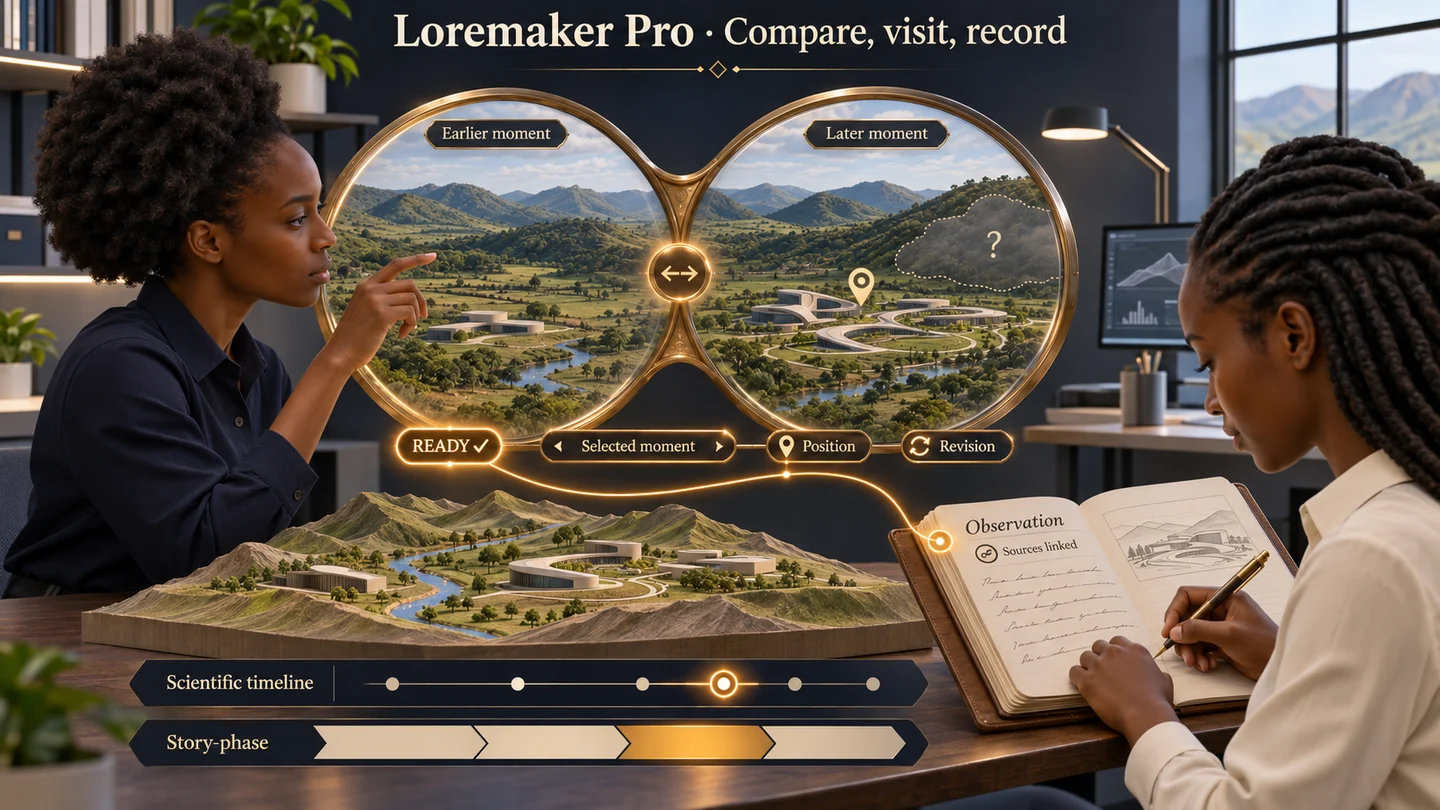
Fieldwork workflow: compare moments, enter the chosen scene and record an observation tied to that scene's state and source revision.
Experience a living scene with its interpretation in view
Surface scenes combine seeded terrain, habitats, structures, water, lighting, weather and local activity. Movement supports keyboard, mouse, touch and gamepad paths, with settings for speed, field of view and control preferences. Rapier supplies collision-aware local movement.
The important distinction is between a living interpretation and a claim of measured reality. Procedural landforms, anonymous residents, local routines and reconstructed history remain labelled according to what they represent. More detail can make the scene more expressive; it cannot manufacture source authority.
I used TypeScript and React around a Three.js renderer, with dynamically loaded scene modules, a terrain worker and Rapier physics. Local content modules provide destinations, epochs, source notes and journeys. Terrain generation and moment resolution run through the local domain and rendering logic.
The navy, ivory, muted blue-grey and brass interface gives the world an editorial frame, with source notes and chronology close to the experience they explain.
The current version still has broader source reconciliation, canonical art, historical depth and sustained high-detail performance work ahead. The application is an evolving explorer, with procedural scenes and orbital references bounded by the interpretation and precision they can support.
What exploration taught me about meaning and rendering
The most useful engineering lesson was that rendering and meaning have to travel together. A scene needs its selected moment, source revision and certainty. A journal entry needs its actual scene. A comparison needs to preserve the difference between unknown and absent.
Those relationships make exploration more interesting. The visitor can move from a broad atlas into a local place, then ask what changed, why it is shown that way and what can be recorded about the visit.
Leave with more than a beautiful view
Loremaker Pro is for exploring a place with its moment and meaning attached. Visitors can move between scales, compare changes, follow an itinerary and revisit observations instead of relying on memory after the camera has moved on.
The source reconciliation, canonical art, historical depth and sustained performance work remain part of its development. The purpose is already clear to me: make the universe easier to explore without pretending a vivid scene knows more than its sources. The map can keep being beautiful. It can also finally answer a follow-up question.
Back to the story’s beginning ↑Project details
A browser-based 3D universe explorer with Atlas, Orbit and Surface views. Cosmic ages, Earth history, calendar years and story phases remain distinct.
Part of the Loremaker family. Related versions and implementations have their own entries.
Inside the workflow
A browser-based 3D universe explorer with Atlas, Orbit and Surface views. Cosmic ages, Earth history, calendar years and story phases remain distinct.
Related work
Have something in mind?
Bring the problem, the audience and what you want to make possible.
Discuss your project