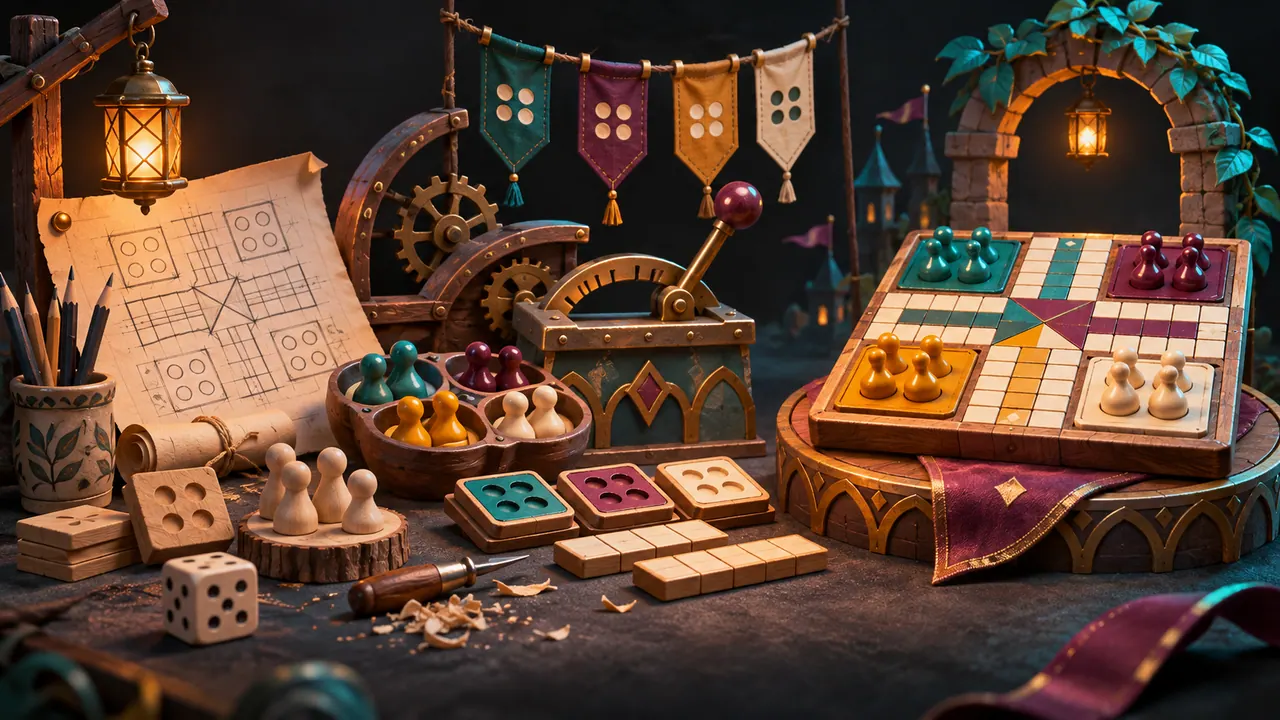
Games & Worlds · ICUNI Games
Ludo Forge
A creative tool for shaping the pieces and rules of Ludo experiences.
The build story 6 minute read

Ludo Conquest Forge: Keep Game Art Editable After “Final”
At a glance
- Purpose
- A creative tool for shaping the pieces and rules of Ludo experiences.
- The build
- Board, rules, scenario and tool workflows form an authoring subsystem for Ludo Conquest.
In this story
By Menelek Makonnen · ICUNI Games
A bounded asset-authoring studio where editable source, saved revisions and game-ready work have different meanings.
Ludo Conquest Forge helps me edit game identities, preserve their source files and return to earlier work without losing the history. It gives an asset author a place to try a draft, preview it, save a revision and prepare a candidate for review instead of treating the latest exported picture as the only surviving copy.
A file called final_final can be a touching expression of hope. Add one more correction and hope requires another underscore.
I built Forge for the point in a creative project when “make a small change” should be easy, but the surviving file has been flattened beyond negotiation. Editable paths, explicit drafts, saved revisions and preserved attachments keep the next change connected to the work that made the picture.
Its useful promise is narrower and more concrete: keep the creative work editable, make changes accountable and preserve a route back to the source.
Change an identity while keeping it editable
The initial library holds four current fictional domain insignia and sixteen champion portraits. These are original game identities developed through AI-assisted design work, not historical reconstructions or a completed library of every planned civilisation.
The author can select an identity, choose among twelve reaction states and inspect an animated or still presentation. Source mode exposes SVG paths, styling and named layers rather than flattening the asset into a picture.
Map, mesh, material, texture, animation and audio entries use structured JSON descriptors. Those descriptors are source and metadata contracts; their presence does not mean Forge contains working editors for every underlying medium.
This distinction keeps the scope useful. A vector identity can be edited directly. A mesh descriptor can organise a proposed asset without pretending to be a full modelling environment.
Preview before saving
Inspector edits and source changes remain drafts. Preview validation can check a draft without storing it as a new revision.
That gives the author room to think. A change can be visible and worth considering before it becomes part of the saved history.
The black, baby-pink and hot-pink workbench keeps Library, preview/source and Inspector close together. The toolbar remains fixed, side panels scroll independently and narrower windows expose the panels as separate drawers.
Selection uses a latest-request-wins pattern so an older read should not populate the editor after a newer choice. Failed reads and conflicts preserve the current draft.
These are small interface decisions with a practical purpose: the author should not lose work because a background operation finished at an inconvenient moment.
Save against the revision you actually read
If I edit through the native app and then use a connected IDE, both work with the same asset history. A shared Rust dispatcher and SQLite store keep the two surfaces from maintaining competing definitions of the thing I am trying to change.
A write includes the expected current revision. If another process has advanced the asset, Forge rejects the stale change rather than silently overwriting the newer work.
The author can then read the latest state, reconcile and save deliberately. Blindly repeating the same stale write is not a conflict-resolution strategy.
Restoring an older version creates a new revision. It does not erase the intervening history. Recoverable archive follows the same principle of preserving an account of what changed.
That is the centre of the product for me. A creative tool should make experimentation easier without requiring the author to gamble the only useful copy.

Editable drafts, explicit revision decisions and candidate output.
Return to the source when the next correction arrives
Forge also stores immutable Blender sources, GLBs, textures and source attachments beside the asset's revision history.
The source browser can list and verify these attachments. A continuation action returns verified metadata and a local owned path; it does not start Blender or execute embedded code.
The author can open the source manually and continue through Save As into a new working file. That makes a later correction possible while keeping the received original read-only. A small adjustment should not require betting the archive on my ability to remember which copy I opened.
That creates a useful distinction between keeping an artifact and continuing its development. The archive holds the source that was received; a new work file holds the next creative decision.
Imports are bounded to a deliberately staged workspace inbox. Attachments are treated as inert, untrusted data, not instructions for the application or an agent.

Verify, preserve and continue from source without replacing the archive.
Hand over a candidate with a clear history
Project validation precedes candidate export. Packages are immutable and hash-verifiable, so a reviewer can account for the bytes being considered.
Those remain separate decisions.
Saved roster SVGs can feed the game's identity bridge; production packaging uses a complete validated identity snapshot. Unsaved drafts do not quietly become exported game identities.
For a reviewer, that means knowing which saved work they are considering and where its source lives. For the artist, it means a candidate can wait for feedback without turning an unfinished revision into the game’s accepted identity.
Let the IDE share the same rules
The MCP interface gives a connected IDE typed operations for reading, creating, updating, restoring, validating and exporting within the selected workspace. In ordinary terms, the editor and the coding assistant can work through the same asset desk.
The adapter uses the official Rust SDK and forwards operations to the core dispatcher. It does not expose an arbitrary shell or a general filesystem browser.
There is also no silent generation or billing button. New design work remains an explicit commission through the author's chosen tools, followed by review.
The implementation connects Rust, SQLite, JavaScript, HTML and CSSaround the shared store. Native, visual and cross-platform checks still have to establish how that experience behaves outside its source contracts.
What Forge sharpened
Forge strengthened how I connect creative direction with maintainable tools. The path, the attachment, the draft and the saved version are different ways of helping the next person continue the work. Sometimes that next person is me, staring at a beautiful flattened image and wondering what I thought “temporary” meant.
The lesson is to preserve enough structure that another revision is possible. A beautiful preview is useful; the source and history make it maintainable.
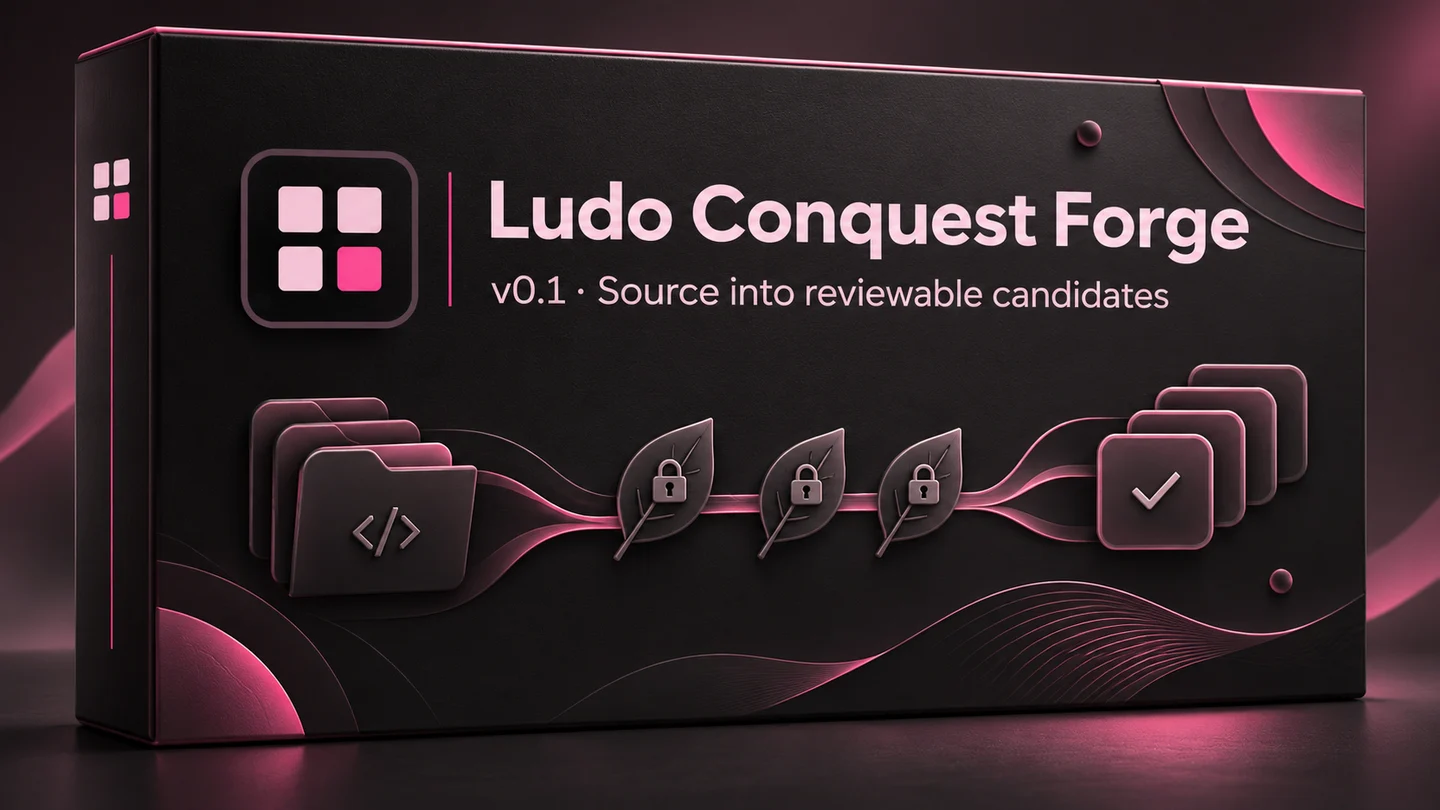
Ludo Conquest Forge: source into reviewable candidates.
Keep the history after final
Forge gives a draft somewhere to develop, a revision somewhere to persist and a candidate somewhere to wait for review.
Final can remain a creative opinion. The history does not need to share it, and the next correction does not need another underscore.
Back to the story’s beginning ↑
Project details
An authoring subsystem for creating and managing Ludo content.
Part of the Ludo family. Related versions and implementations have their own entries.
An authoring subsystem, rather than a separate standalone game.
Design and technical decisions
Board, rules, scenario and tool workflows form an authoring subsystem for Ludo Conquest.
Inside the workflow
An authoring subsystem for creating and managing Ludo content.
Related work
Have something in mind?
Bring the problem, the audience and what you want to make possible.
Discuss your project