
Creative Tools · ICUNI Labs
Ender Pro
A dedicated rendering workspace connecting editor handoffs, conversion and queue visibility.
The build story 8 minute read

Ender Pro: Prepare Video Deliveries Without Losing Track of the Job
At a glance
- Purpose
- A dedicated rendering workspace connecting editor handoffs, conversion and queue visibility.
- The build
- An authoritative local queue coordinates editor handoffs and direct-media conversion, with library and usage workspaces.
In this story
By Menelek Makonnen · ICUNI Labs
Ender Pro helps creators prepare video conversions, receive renders from editing tools and keep track of those jobs through interruption and delivery. Add a video, choose its orientation and encoding, or hand over a prepared edit; the queue gives the work a durable identity and an understandable state.
For a small production desk, that matters more than another animated progress bar. I need to know which revision is rendering, where the output belongs and what happens when the application closes unexpectedly. The output folder is a poor witness. It mostly stares at me and declines to elaborate.
I built Ender Pro as a separate development of the MMMedia Ender rendering foundation. Its own profile lets the Pro work develop alongside the existing app: a clearer queue, controlled tool handoffs and stricter native delivery paths without assuming it has already earned replacement status.
It is useful for preparing intermediates, correcting video orientation, managing local render handoffs and supervising assistant-requested media work. Experimental native timelines remain capability-dependent.
From Ender to an isolated Pro workspace
Ender Pro develops the MMMedia rendering foundation in a separate application checkout and runtime profile. It has its own bridge and mailbox defaults so it can be evaluated alongside the existing Ender.
The queue, editor handoff and local rendering relationship are inherited foundations. The Pro work develops stricter delivery paths, a Rust worker and MCP adapter, and a more explicit separation between render submission and queue control. Packaged security provisioning supplies a pinned local TLS connection and distinct credentials for those capabilities.
I kept that development isolated because a successor needs room to prove itself without quietly assuming the authority of the tool it may eventually replace. A product name containing “Pro” is useful typography. It is a remarkably poor migration strategy by itself.
The result is a workspace where the familiar render job can coexist with more tightly defined control and delivery operations. Replacement remains a separate acceptance decision.
Prepare a video deliberately
The direct-media studio is the shortest route into the application. Add a video, inspect its preview, rotate or flip it where needed, choose a delivery profile and prepare the output.
Batch settings provide a common starting point; individual cards can have their own choices. Container, codec, rate control, audio and scaling remain explicit. Profile normalisation handles combinations such as mezzanine codecs and their appropriate container or audio choices, instead of treating every dropdown as an unrelated opinion.
For a creator preparing footage for another editor, this is a practical job. A clip may need the correct orientation, a deliberate output size or a suitable intermediate. I want those decisions visible before the queue begins, with the source and destination kept legible.
The distinction between input types also matters. The focused workflow here is video orientation and encoding. A file picker accepting another extension does not automatically make the studio a complete editor for every media format. Software marketing has spent enough time mistaking a generous file dialog for a codec laboratory.
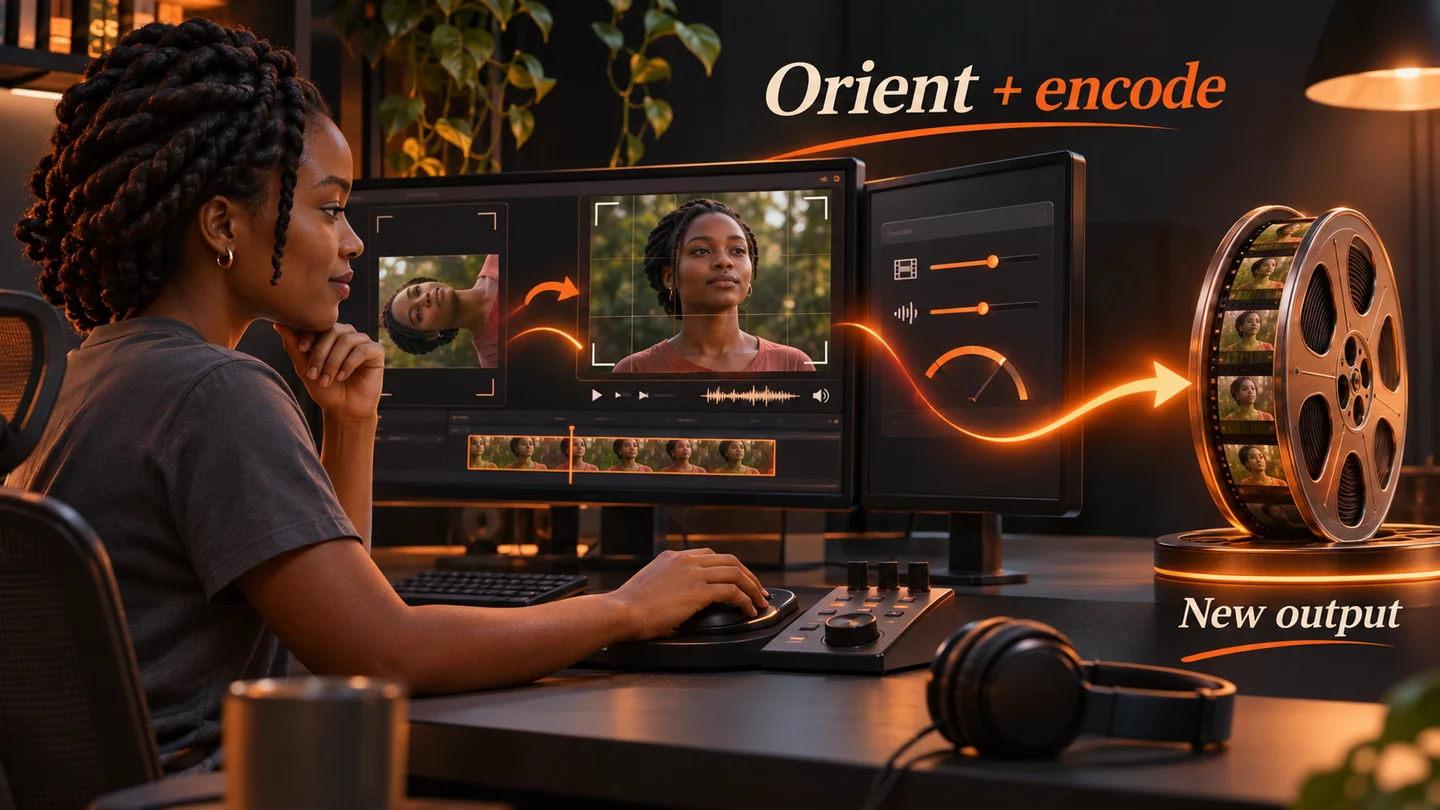
Direct media: inspect the video, choose orientation and encoding, then create the delivery job.
Give the handoff an identity
When I finish an edit in another tool, I want to follow it after the handoff. Ender's local bridge and durable mailbox both turn that submission into a validated, saved queue job with an assigned output. Acceptance tells me the queue has taken responsibility, so I can return to that job rather than wonder whether the editor merely threw a file over the fence.
Stable sender identities help keep retries meaningful. If an editor loses an acknowledgement, asking about the same job is different from submitting another one under a new name. A submission fingerprint can also reject a conflicting reuse of an existing identity.
This is useful after a generated edit leaves MMMedia or a motion composition leaves another creative tool. The sender can retain the job identity, the queue can report its state and the user can inspect the selected render. “Accepted” means the queue took responsibility for that job. It does not mean the video already exists.
The interface supports different ways to follow the work: operational activity, delivery details and a review-oriented view of completed results where the relevant receipt exists. The job inspector keeps the selected operation close to its logs and state.
Pause should mean pause
The queue stores versioned state and a separate live-progress snapshot. Its persistence selects a valid revision and uses staged writes with fallback slots where necessary. Rendering remains outside the UI thread.
For checkpointed render jobs, pause preserves intent before signalling the worker. Resume can continue from verified chunks, while startup recovery distinguishes interrupted running work from a job the person intentionally paused. That difference is important. An application reopening should not reinterpret “please stop” as a motivational challenge.
I can keep work lined up without treating every queued item as permission to start another encoder immediately. Queue admission is bounded, while the actual rendering load responds separately to weighted resources and live memory pressure. The point is to keep the desk usable while the machine does the heavier work.
For a small production desk, the benefit is visibility and continuity. I can see the active job, keep other work queued and preserve a defined route back after interruption. Ordinary errors remain errors, and retry is an explicit action rather than a claim that every failure will heal itself if ignored with enough conviction.
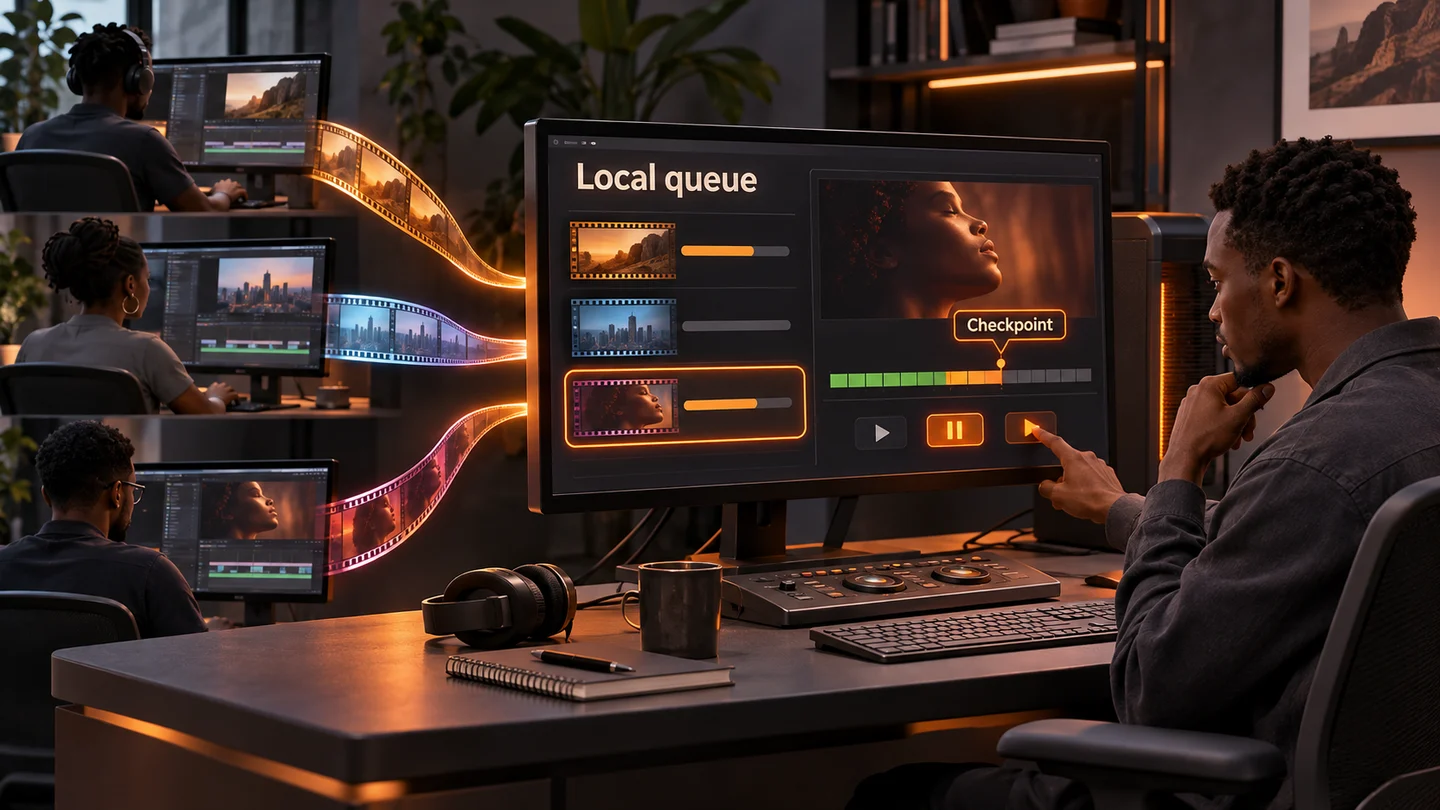
Queue and recovery: retain the job identity, distinguish accepted work from completion and preserve the relevant checkpoint state.
Control is a different permission from submission
The local MCP adapter lets an external assistant inspect queue state and request defined media operations. The reasoning comes from the assistant host; Ender supplies the local queue and media tools.
Submission and control have different credentials. A client that can hand over render work does not acquire permission to cancel or reorder the rest of the queue merely by introducing itself with a convincing application name.
The MCP path requires the configured local TLS connection and pins the exact certificate before sending credentials. Capability negotiation also matters: a native operation is offered according to what the installed worker reports, rather than what the source tree hopes a future binary will support.
For a supervised assistant workflow, that gives a concrete sequence. Inspect the state, submit an authorised job with a stable identity, query that identity and request separate control only within the granted capability. A queued acknowledgement remains an invitation to check the result.
I find this separation particularly valuable in a renderer shared by tools. The boundary is a product behaviour, rather than a paragraph asking every client to be unusually considerate.
A new output deserves a defined contract
The create-only media route is designed around one canonical local video and an explicit new output. It rejects an existing destination, input/output aliasing, invalid paths and incompatible extension choices.
The engine writes into staging on the destination volume, probes the output and fully decodes the required streams before creating the final destination without replacing an existing file. If another process creates that destination while the job is running, the publication step must not quietly overwrite it.
That is useful when preparing deliverables or intermediates through an assistant. “Create a new file” should remain the actual operation all the way through the final write. It should not become “replace whatever happens to be there when I finish”.
The separate Rust worker also contains experimental hard-cut and crossfade timeline paths with bounded ranges, output timing checks and advertised capability requirements. Their value is the explicit contract: source ranges, expected frames, codec choices and final output handling have defined rules.
Different rendering routes retain different verification. Full editor jobs have layered delivery checks covering the structural contract, timestamps and decode evidence. The ordinary manual conversion route has a different completion boundary. I keep those distinctions visible because a stronger verifier in one branch cannot certify every other branch by association.
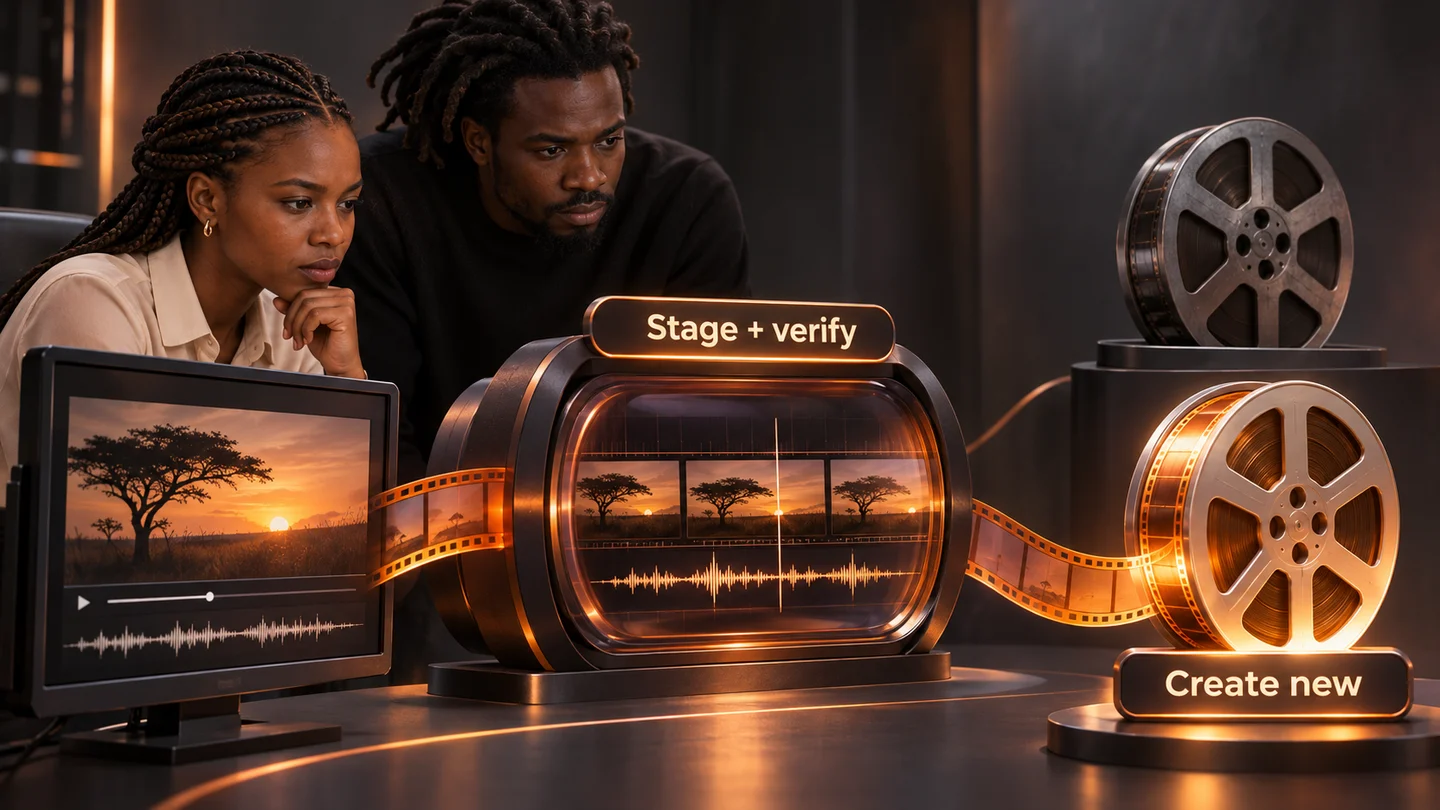
tool availability depends on the installed worker.
What the build taught me about endings
Ender Pro joins a React and TypeScript interface to an Electron and Node queue, local FFmpeg media work and Rust-native worker/MCP components. The main process owns authoritative job state; the renderer presents the work through a constrained preload boundary.
I built around those stages because each one answers a different question. A file that decodes can still be a terrible edit. A beautiful edit can still be the wrong revision. A correct revision can still be waiting in the queue.
That is the strength I want the engineering to demonstrate: a chain of specific responsibilities that remains understandable when the happy path gets interrupted.
A render needs a place to return to
Ender Pro is for the practical end of making video: prepare a suitable output, hand over the right revision, see the job's state and return to supported checkpointed work after an interruption. The stricter native route also keeps “create a new file” from becoming permission to replace an existing one.
Building it taught me that a useful delivery tool has to preserve the questions a creator will ask later. Which job? Which source? Which settings? Which result? Encoding bytes is part of the answer; viewing and hearing the output remains mine.
If the application closes, I want to come back to the job. The output folder deserves to retire from witness protection.
Back to the story’s beginning ↑
Project details
A local-first render application with an authoritative queue, editor handoff bridge, direct-media conversion and an experimental native worker.
Part of the MMMedia family. Related versions and implementations have their own entries.
Design and technical decisions
An authoritative local queue coordinates editor handoffs and direct-media conversion, with library and usage workspaces.
Inside the workflow
A local-first render application with an authoritative queue, editor handoff bridge, direct-media conversion and an experimental native worker.
Related work
Have something in mind?
Bring the problem, the audience and what you want to make possible.
Discuss your project