 Creative software · Built by Menelek
Ordinator
Creative Tools · ICUNI Labs
I built Ordinator to keep track of what’s true in a story, who knows it, and what a rewrite changes.
Why I made it
A small rewrite can change who knows a secret and make a later scene stop making sense.
In a fictional example, moving a confession forward would give a character information before they learn it. Put the changed scene and the character’s knowledge side by side, then decide whether to revise the scene or keep the reveal where it was.
Fictional revision example
- Proposed editMove the confession before the interview
- ReviewThe detective would know the secret too early
- DecisionKeep the reveal after the interview
The build story 10 minute read

Ordinator: Keep the Story Consistent as the Production Grows
At a glance
- Purpose
- Connecting canon, co-writing and continuity decisions to inspectable production artefacts.
- The build
- The local Rust studio connects revisioned canon, co-writing candidates and continuity modelling. Renderer jobs are tied to exact approved decisions and inspectable production artefacts.
In this story
By Menelek Makonnen · ICUNI Labs
Ordinator helps writers and filmmakers keep a story's approved facts, character knowledge and production decisions consistent as the work evolves. It connects reviewed prose, screenplay and storyboard candidates to source-linked production requests, picture editing and bounded sound work in one local studio.
It is useful when a story grows beyond a document: assistants propose passages, scenes move, boards change and an engine produces material from a particular revision. I want to know which decisions are established and which are still experiments before one attractive candidate quietly rewrites the world.
A character who knows the twist too early can ruin a scene with one helpful sentence. A mysteriously dry coat after a rain sequence is a smaller revelation, but the continuity department may still begin drinking at lunch. I built Ordinator to give those declared relationships somewhere more reliable than my memory.
The creator keeps the artistic judgement. The studio helps preserve what was decided, what depends on it and what needs another review when the story changes.
Give canon a different home from the draft
A project contains scenes, entities, facts, knowledge, dependencies, proposals, corrections, drafts and history. Those records serve different purposes. A proposed change does not become established narrative truth because an assistant described it persuasively.
The shared core receives a trusted actor identity from the service or transport. An assistant is bound to its project and can inspect context, save draft overlays or propose changes. Owner decisions such as approval, rejection, project creation and locks follow their own authority path.
Requests carry a stable identity and expected revision. Matching repeated requests can replay their recorded result; conflicting reuse is rejected, and a stale revision cannot quietly overwrite newer decisions.
Changes are validated against a candidate project state and committed transactionally. A pending proposal must still belong to its expected base when approved. Declared continuity issues introduced by a change require an explicit override with a reason.
That makes revision history more useful than a collection of snapshots named final, final2 and actual-final. The system can explain which actor made which decision, against which state, and what changed.
Separate chronology from revelation
A nonlinear story needs two timelines in the writer's head: when events happen and when the audience sees them. Ordinator keeps world time separate from presentation order so a flash-forward can reveal something to the audience without granting an earlier character supernatural access to the script.
Character knowledge follows world chronology and approved sources in scope. Audience knowledge follows presentation order. The author’s available facts remain separate from both. An omniscient planning packet should not accidentally grant every character a subscription to the author’s notes.
For a nonlinear story, this is practical. A later event can appear early as a flash-forward without making an earlier character aware of it. A withheld revelation can remain unavailable to the audience while still being established in the author’s world model.
Missing times, ambiguous equal-time events and conflicting same-time states produce warnings or withholding. The engine does not infer every semantic implication of prose.
Physical continuity extends that model to sourced conditions such as outfit, injury, wetness, possession and location. A state needs scope and evidence. Associating projects with one universe does not silently synchronise all their canon.
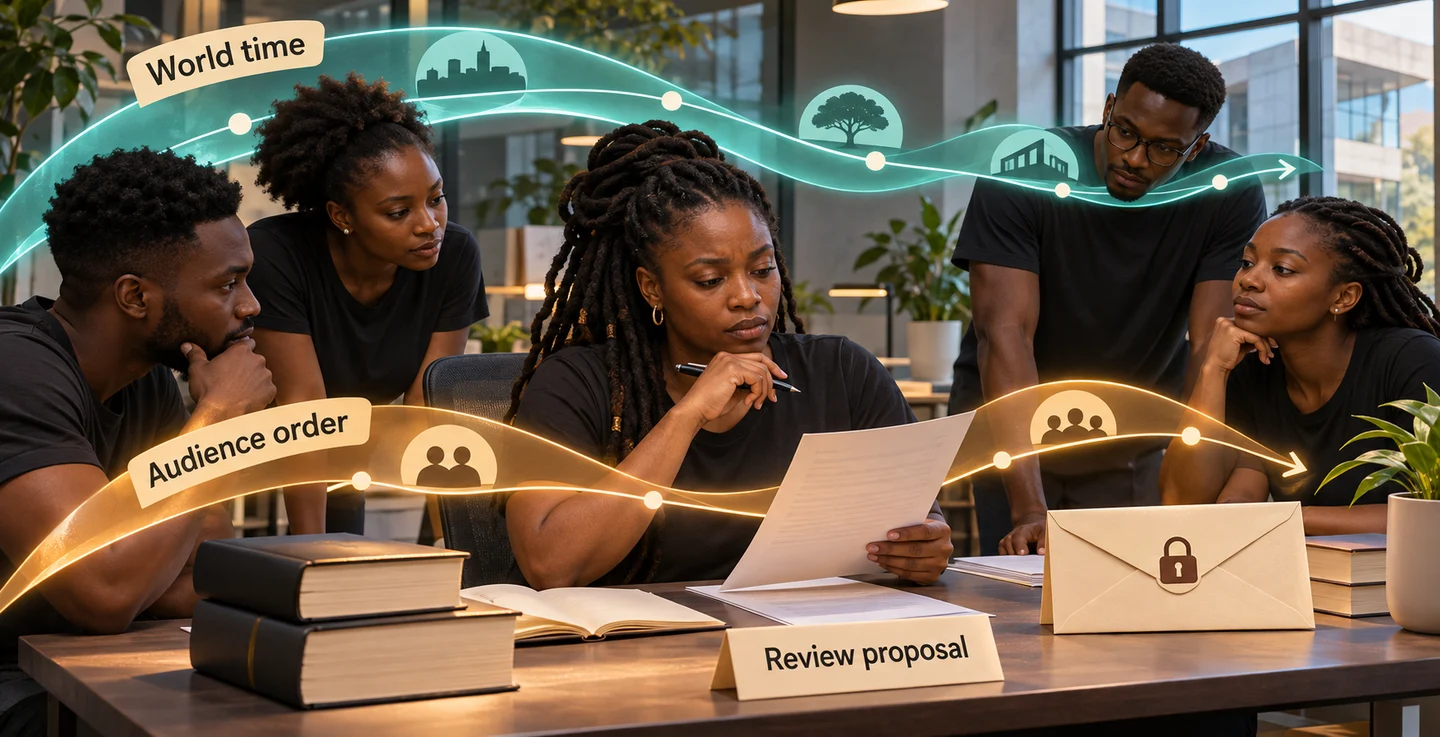
Story decisions: distinguish author context, character knowledge and audience disclosure.
Make co-writing a candidate workflow
The Novelist brief assembles the chosen scene with scoped canon, story-bible material, chapter plans and earlier approved prose. Coverage metadata says what portion of the material is included. A partial packet should not support a claim that the entire novel has been read.
A connected assistant supplies candidate prose; Ordinator does not bundle an automatic prose model or provider credentials. Submission requires the current base revision, a fresh candidate identity and the appropriate parent candidate when continuing an earlier version.
The system fingerprints both the source scene and the candidate text. Proposed facts remain separate. If the constraints or prose change, later review needs to refer to the new exact material rather than inherit an assessment of an earlier draft.
The audit combines declared-condition checks with a separately labelled external subjective assessment. Missing planning fields are deterministic findings. Whether the scene is moving, funny or dramatically convincing is a creative judgement with its own provenance.
Quoted assessment excerpts must occur in the actual candidate. That modest requirement prevents an eloquent review of a sentence that the manuscript has never met.
Owner review still prepares a proposal; canon approval remains another decision. Approving prose also does not silently approve every new fact embedded in it. The candidate can be beautifully written and still need a separate decision about what it establishes.
Let screenplay and staging retain their sources
Screenplay and storyboard work use equivalent working-to-review-to-proposal boundaries. Interchange and editing support writing workflows without turning every imported line into approved canon.
Storyboard planning produces a typed editable 3D stage. Working and approved payloads remain separate, so a later edit can be recognised as different or stale rather than overwrite the previously reviewed board.
That creates a useful path from narrative constraints to blocking. I can plan a scene, stage its actors and camera, review the arrangement and then bind a production request to the approved stage.
Geometry remains its own evidence. Those are connected creative questions with different checks.
The production handoff compares the exact typed stage fingerprint with its approved source and checks the frozen project revision. A stage with the right name and the wrong content is still the wrong stage.
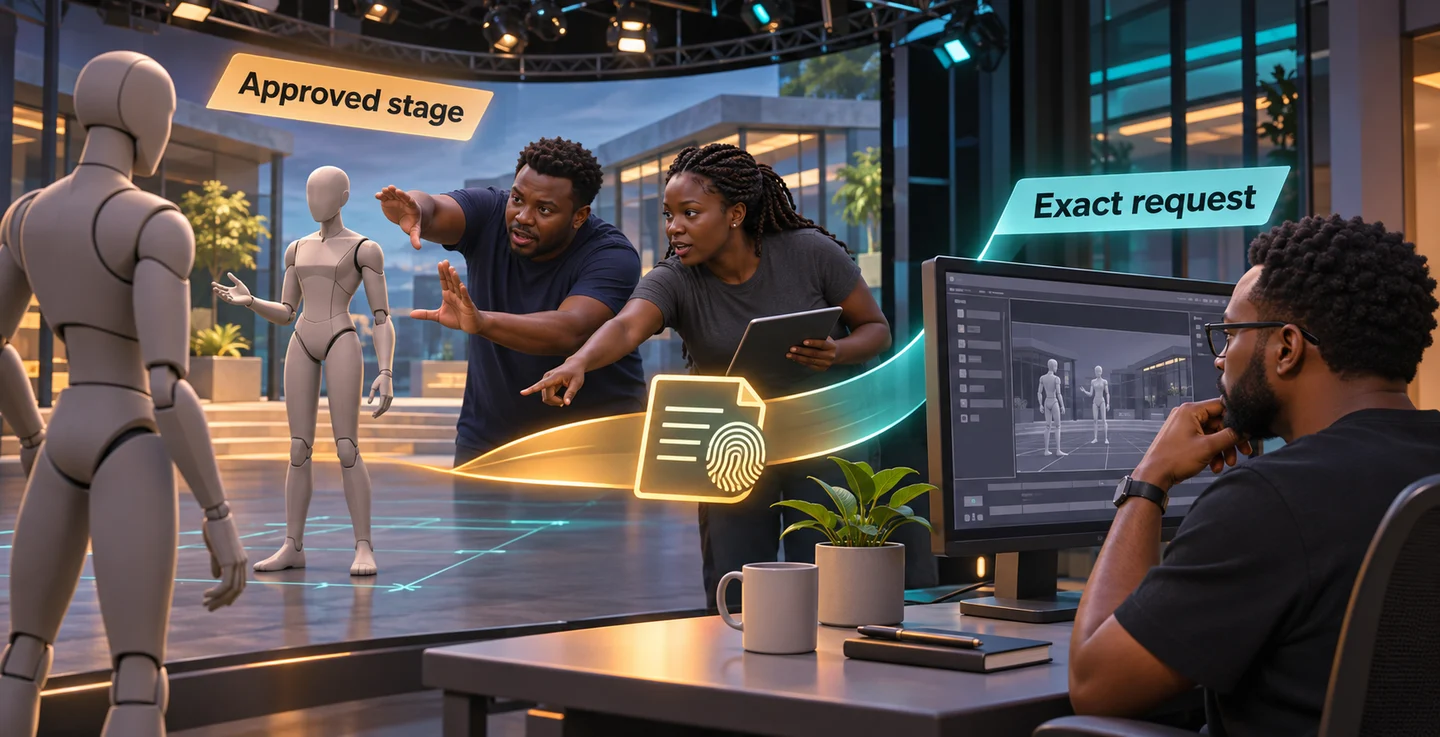
Stage to request: preserve approved source identity before engine execution.
Give the engine a bounded assignment
Production requests begin awaiting approval. The owner approves the exact current job revision with a note before it becomes queued. An assistant can prepare the request but cannot approve its own execution.
MCP Hall presents process, session and job state, with separate indicators for configured profiles, connected adapters and discovered tools.
The Blender adapter uses a fixed background payload with factory startup and automatic script execution disabled. Remotion and MMMotion Graph have their own argument and composition contracts. These are integrations around installed specialist runtimes, rather than full native editors embedded inside Ordinator.
Owned process handling keeps adapter lifetime explicit. A running native editor remains distinct from the client process that contacted it. If cancellation leaves a Premiere mutation’s outcome unknown, later mutations need reconciliation rather than a hopeful assumption that the host stopped at exactly the right moment.
The engines run with the user’s Windows permissions. A project directory is a working boundary, not an operating-system sandbox. That distinction belongs in the engineering contract even when the interface makes a local task feel pleasantly contained.
Make artifacts belong to the request
When a production tool returns material, I need to find the file that belongs to this request. Ordinator checks project-contained files, exact sizes and SHA-256 identities through scoped media access. A tool can report success without supplying a useful artifact inventory; that should lead to a question about the missing output rather than a celebration of the word success.
The source relationship also survives change. A later story revision can mark earlier output stale while preserving its evidence. The old render still exists, but it no longer represents the current approved scene by default.
That is valuable in creative iteration. I want to compare previous work without allowing its continued presence to conceal that the source changed. Deleting history and declaring every old output current are equally poor ways to remember a production.
Artifact checks, decoded media, broad visual quality, owner acceptance and publication remain separate milestones. The project can retain each without compressing them into an all-purpose Done badge that nobody is willing to interrogate.
Keep picture and sound in exact positions
Edit & Sound adds a typed picture/audio model with exact frame and sample positions, source capture and explicit reconform decisions. Dialogue, music and effects have their own tracks and buses, with gain, pan, fades, automation and supported processing.
The Rust mixer verifies source identity and length, then produces deterministic PCM output with peak, RMS and clipped-sample information. Category and master outputs make the result more useful to a later finishing stage.
For a changed picture cut, reconform becomes a decision about how sound relates to the new timing. A media file with the same friendly name is not necessarily the same source, and an old mix does not become aligned because the new edit is only a little shorter.
It is also distinct from standalone Soundr; overlapping concepts do not make the applications the same product.
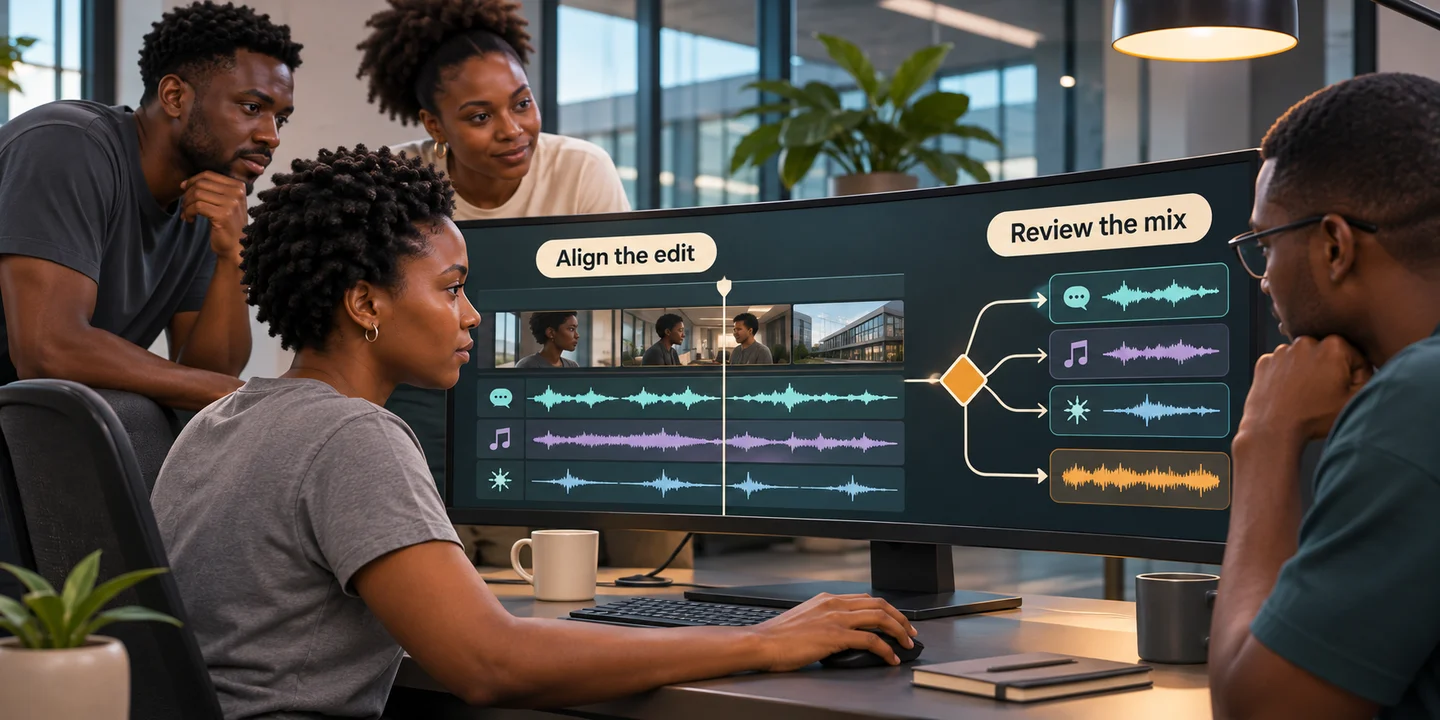
Edit and sound: retain source identity, align exact positions and review the mix.
Export the work without exporting old authority
Document export selects approved scenes in one adaptation with known presentation order, then produces the supported Fountain, PDF, EPUB or JSON representation. Native PDF handling checks font coverage and can fail on missing glyphs rather than silently substitute unreadable text.
A successfully written document still needs layout and distribution review. EPUB conformance, a reader preview and human page inspection answer questions beyond the local export call.
Offline backup preserves database history and project media with a hash manifest while excluding credentials and caches. Restore creates a new destination, rechecks files and project integrity, and quarantines recovered execution state.
Assistant grants are revoked and adapters require reconnection. That is a principle I particularly value: recover the creative content without restoring every old permission to act on it. A backup should not become a time capsule of authority that wakes up looking for something to render.
Build one set of rules beneath the studio
Ordinator separates its Rust story engine, workflows, typed models, process ownership and adapters into crates, with shared service rules behind the visual interface and project-scoped MCP. The Windows host uses WebView2 around the studio experience.
The ink/slate, teal, amber and cream identity includes an existing converging-aperture mark and workspace-specific artwork. A collapsible navigation rail is separate from the genuinely resizable context pocket, which adapts its docking on narrow layouts. Guidance controls and the action console help reach contextual operations without becoming a hidden autonomous model.
My strength here is connecting those layers: narrative intent, explicit approval, source-linked production and evidence that remains useful after revision. The application helps keep the decisions answerable so the creator can keep making them.
Let the story keep its secrets
Ordinator gives a growing creative project places for approved facts, working candidates, stages and outputs, with relationships that survive revision. A writer can keep revelation separate from chronology; a director can connect a reviewed stage to its production request; an editor can see when earlier output no longer represents the current scene.
Building that connected studio brought narrative design and exact engineering into the same problem. I want the machinery to protect the decisions so I can spend more attention making better ones.
The character can learn the twist at the right time. The continuity department may even reach lunch with a clear head.
Back to the story’s beginning ↑
About the work
Connecting canon, co-writing and continuity decisions to inspectable production artefacts.
A local creative-production studio with revisioned story canon, co-writing candidates, continuity modelling and explicitly approved renderer jobs.
Design and technical decisions
The local Rust studio connects revisioned canon, co-writing candidates and continuity modelling. Renderer jobs are tied to exact approved decisions and inspectable production artefacts.
Connected work

Software
Orbit
The builder’s companion. Keep prompts, IDE conversations, projects and development sessions together, with AI entirely optional.

Software
Orchestra
A production control room for the long journey between an idea and a prepared release.

Software
Screenwritr
A writing workstation where scenes, story-world entities and drafts stay connected.
Software
Storytellr
Turning a screenplay into a space where shots, cameras and timing can be explored.